



Written by Ambre Montespan on Nov 18, 2024 · Updated on Oct 15, 2026

Table of contents:
Do you own a handpan and dream of playing beautiful melodies on it? Want to learn how to read and understand the sheet music and tablature written for this instrument? What do the numbers, letters, and symbols on these musical documents actually mean?
I’ve been playing handpan, including the Hang, for over 10 years, and I still use sheet music from time to time. So I can walk you through it, step by step, so you can do the same.
Handpan sheet music uses numbers to represent the notes you need to play, plus letters that often indicate a specific percussive effect. Tablature is even simpler: it shows you visually which note or notes to strike on the instrument.
Once you’ve read this article, you’ll know how to interpret:
- Handpan sheet music
- Tablature for this percussion instrument
This will enable you to play any song that comes your way in the form of one of these musical documents. What’s more, you’ll also be able to write your own compositions down on paper so you can share them with the world.
Now, let’s dive right into how to read sheet music for the Hang drum.
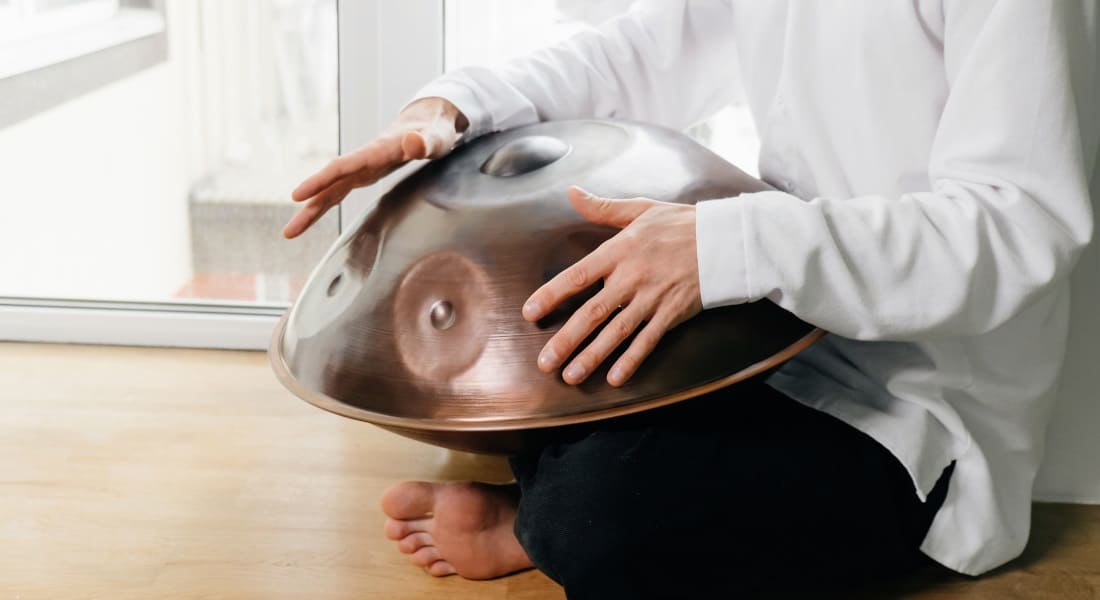
How to read handpan sheet music?
In theory, you could play the handpan using traditional sheet music—the familiar five-line stave, treble or bass clef, and notes like quavers, crotchets, or minims. However, the handpan is designed to be played even if you’ve never studied music theory. Most handpan players haven’t spent years studying music theory. That’s why handpan sheet music is simplified into a sequence of numbers, with a few symbols borrowed from standard notation to add precision. Below is an example of handpan sheet music:
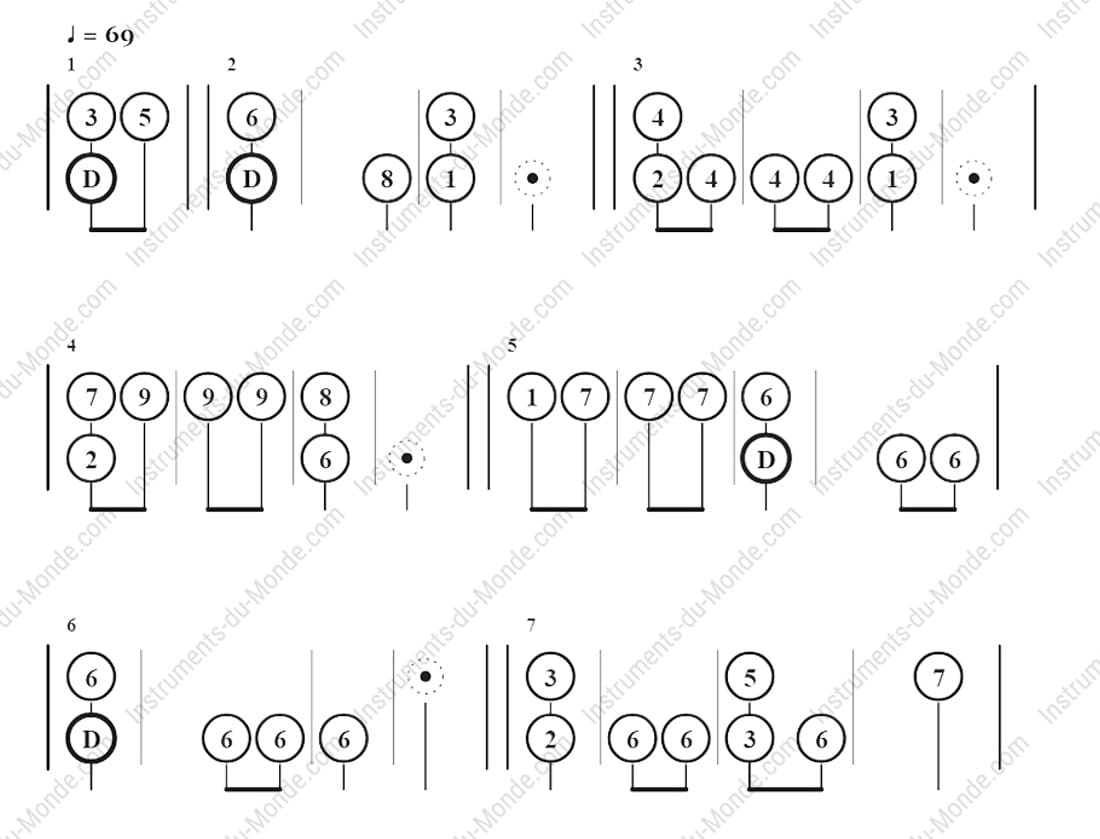
The score is read the usual way: from left to right and from top to bottom. To make it easier to follow, the bars are numbered. These are the numbers placed above certain vertical lines. In this example, there are 7 bars. In music, a bar is a unit of time that divides a score into equal segments. Bars help structure the rhythm and organise the music to make it easier to read and perform.
Within each bar, you’ll notice other vertical lines that are the same height as the bar lines—these mark the beats. A beat is the basic unit used to measure musical duration. In the example above, the second bar has four beats, just like the third, while the first has only one. So it's worth noting that in some songs, not every bar contains exactly the same number of beats — though this remains fairly rare.
What determines how long each beat lasts is the tempo. Here, it’s represented by the number next to the crotchet note at the top left. In this example, the tempo is 80 beats per minute, sometimes abbreviated as BPM. The higher the tempo, the faster the percussionist will play the melody. A tempo of 60 corresponds to one beat per second. So, if the bar has 4 beats, it should last 4 seconds. The tempo can change during a song. Sometimes the change is sudden, with a new tempo shown using the same crotchet symbol. Other times it’s gradual, and the marking “rall.” indicates the tempo will progressively slow down.

Finally, and most importantly, the numbers correspond to the notes on your instrument, not including the ding. The “1” will always be the lowest note on your instrument. The ding is simply written as “D” when it needs to be played. If you have a 10-note handpan tuned to D Kurd, here is a table showing the correspondence between the numbers and the musical notes:
| Notation on the score | Notes on the handpan |
| D | D3 (2nd octave) |
| 1 | A3 (2nd octave) |
| 2 | Bb3 (2nd octave) |
| 3 | C4 (3rd octave) |
| 4 | D4 (3rd octave) |
| 5 | E4 (3rd octave) |
| 6 | F4 (3rd octave) |
| 7 | G4 (3rd octave) |
| 8 | A4 (3rd octave) |
| 9 | C5 (4th octave) |
Within a single bar, the notes at the top are played with the right hand, while the notes at the bottom are played with the left hand. Notes placed at the same level are played at the same time. So, to begin this piece, you strike note 3 with the right hand and the Ding simultaneously with the left hand, then move on to note 5 with the right hand, and so on. As for duration, a note is held until a new number appears in the notation. You then strike the instrument harder or softer to match what the piece calls for.
Below the circles around the notes or the Ding, you'll see lines that correspond to the stems used in standard music notation. They indicate how long each note lasts. A single vertical line means the note is played for one beat — the equivalent of a crotchet in music theory. Two stems joined together, as at the start of the fifth bar in the example, correspond to two quavers: both are played within a single beat, so each one lasts half a beat. More rarely, stems can carry two horizontal bars instead of one. That's a semiquaver, so the note or notes involved are played in a quarter of a beat.
In some pieces, you may come across letters other than “D,” which means to play the ding. These will always be percussive effects. Here is a description of each of them:
- d (ding tonefield): a strike on the shoulder, the flat area surrounding the ding.
- F (fist): a strike made with the base of a closed fist on the inter-note (unpitched) area of the handpan. Use moderate force with this effect to avoid deforming your instrument.
- K (knock): a knuckle strike on the inter-note area of the handpan.
- P (palm mute): a strike with the palm on the ding, producing a very low, muffled sound.
- S (slap): a strike with the flat of the fingers on the inter-note area of the handpan.
- T (tak): a sharp strike on the ridge between the shoulder and the inter-note area of the handpan.
- • (ghost note): touch the handpan very lightly on the inter-note area without producing sound. The goal isn’t to play a note or create an effect, but to help you stay in time. It’s not essential for playing the melody.
- M (muted): this symbol always appears next to a note and means it should be muted. In other words, you’ll briefly leave a finger on the handpan’s surface to dampen the vibrations.
- __ (finger roll): the underline may appear beneath a note or beneath a percussive effect such as a slap. In the latter case, it will be noted “S”. A finger roll means repeating the same note or percussive effect very quickly using 2 or 3 fingers, like a drum roll.
How to read Hang drum tablature?
Handpan tablature is an even more stripped-down form of musical notation than sheet music. It’s a visual system that shows the notes to be played using a simplified diagram of the instrument. Here is an example:
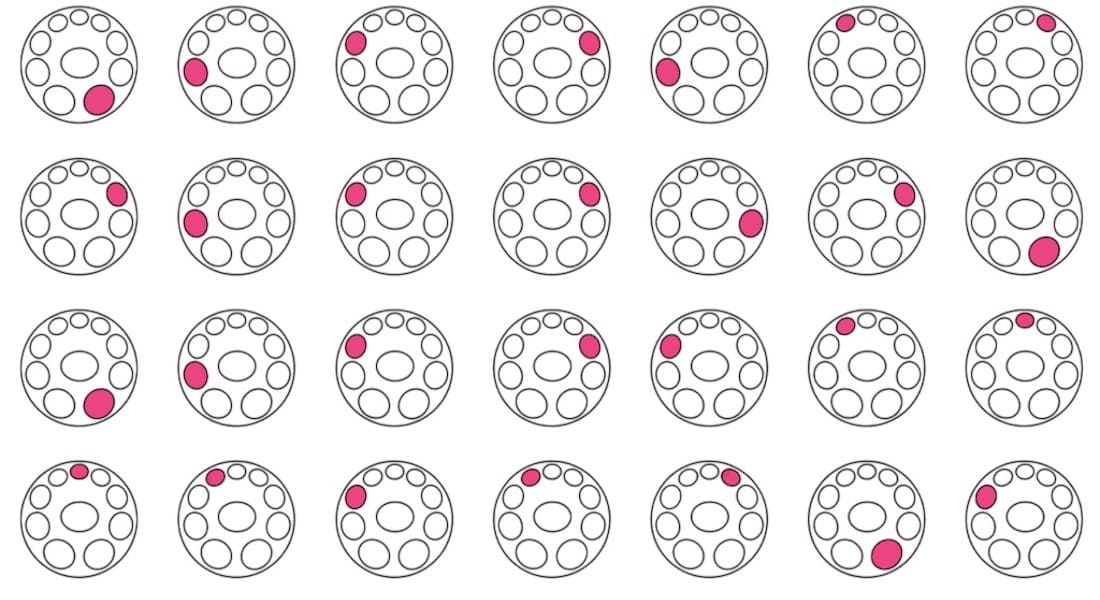
While this approach may appeal to beginners, handpan tablature is very rare. In addition, you need to find tablature that corresponds to the number of notes on your handpan. Also, tablature takes much longer to create than sheet music. A song that would only take one or two pages as sheet music generally takes up much more space in tablature, which isn’t very practical. That’s why most musicians choose to learn to read sheet music instead. It’s far more flexible and precise for playing a melody because, as you may have noticed, tablature doesn’t indicate note duration or tempo.
Play more than 25 songs with your instrument
Reading sheet music for the handpan was truly designed to be simple, intuitive, and accessible even if you’ve never studied music theory. With the tutorial you’ve just discovered, you now have everything you need to decode handpan notation and play a wide range of melodies.
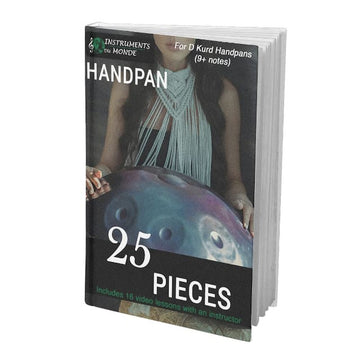
However, while it’s fairly easy to read sheet music and tablature for the handpan, it’s much harder to find. Even though the instrument has been growing in popularity for several years, sheet music remains rare. That’s why I recommend the book from the Instruments du Monde store. It includes 25 sheet music arrangements for 9- and 10-note D Kurd handpans, plus a 16-video course with a teacher to help you learn how to play.
Play dozens of melodies and treat yourself to this book of sheet music by clicking on the image below:
Now that you have the skills to play many melodies, why not share them at a handpan festival? These gatherings are a unique opportunity to meet other enthusiasts who’ll be happy to listen to your compositions.


