



Written by Ambre Montespan on Mar 14, 2023 · Updated on Oct 15, 2026

Table of contents:
Have you noticed that one or more of the tines on your kalimba make a strange sound? Do they sound out of tune—or not at all because they don’t seem to vibrate? Is this a technical problem that you can fix? And if so, how?
As a kalimba player with over 10 years of experience, I’ve encountered this issue many times. Most of the time, there’s a straightforward fix. Let me guide you through troubleshooting your thumb piano so you can enjoy its sweet notes once again.
Kalimba tines can struggle to vibrate and ring out if the instrument is dirty around the bridges. Shorter tines can also naturally have trouble resonating—it’s simply part of the kalimba’s design.
After reading this article, you will learn how to:
- Fix the problem of tines that do not vibrate
- Fix tines that sound out of tune
You’ll keep your instrument playing in tune with a clear, harmonious tone, delighting both your ears and your audience.
Let’s take a look at how to solve the problem with your metal tines.
Why are the tines on my kalimba not vibrating?
In most cases, when the tines of a kalimba have difficulty vibrating or do not vibrate at all, it’s worth checking the cleanliness of the instrument, the alignment of the tines, and even the tine lengths.

Maintaining the mbira tines
A tine may vibrate less well, or not at all, if dirt has become embedded between the tine and the lower bridge, which is the horizontal piece, often made of wood, closest to your thumbs. Because the tines vibrate to produce sound, they can shake loose tiny dust particles that then interfere with proper contact between the tine and the bridge.
In the most severe cases, grime can completely prevent the tine from vibrating, so the instrument will produce little or no sound. To solve this problem, you should clean your kalimba regularly to remove this build-up. On this subject, we offer a free guide on how to maintain your thumb piano; in particular, you will learn how to take it apart to clean it effectively.
Aligning the instrument’s keys
The tines of the kalimba are not fixed in place. They are held under pressure between the two wooden bridges and a metal pressure bar. As a result, you can shift a tine without necessarily noticing, even with just a light touch, or if the instrument is dropped or jostled in transit. The problem is that a tine that is not oriented at 90° to the bridges and the pressure bar will not resonate optimally. You can see an example in the photograph below:

It is therefore important to ensure that all your tines are correctly positioned so that there are no problems when you play them. No tools are needed—just pinch the end of the tine with your fingers and push it to the right or left as needed until every tine sounds right again.
Why don’t the short tines on the kalimba sound?
Most musicians who discover the kalimba are surprised that the shortest tines, often the last two on the left and right ends, resonate very weakly compared to the others. In reality, this is a physical phenomenon specific to the thumb piano that cannot really be resolved.
To understand this, you need to understand how the kalimba works. When you press and release a tine, it oscillates in the air, causing sound vibrations. The longer the tine, the more room it has to vibrate strongly. On the other hand, the small tines have difficulty moving up and down because the flexibility of the metal is quite limited. You can observe this phenomenon in the video below:
Short tines are not able to move as freely as long ones, which is why they inevitably resonate less.
This effect is even more pronounced when the kalimba has a sound box. The sound hole is often a circle placed in the centre of the soundboard. This means that the central tines, which are the longest, benefit more from the resonating chamber than the tines at the ends. This can make it feel like the short tines barely sound at all compared to the longer ones.
There is no real remedy for this problem. You can slightly boost the volume of these tines by pressing them a bit harder than the others. Some high-end kalimba models feature tines made of a more flexible metal and a thinner bridge, which can improve how the short tines resonate. But you should be aware that you will never get a sound as loud as that of the central tines.
Why do the tines of the instrument sound out of tune?
If you feel that the notes played on your kalimba are out of tune, it is most likely a tuning problem or the presence of a buzz.
How can you check the tuning of your kalimba?
You may feel that when you play a melody, one or more tines produce an unpleasant sound. It is likely that your instrument is out of tune. As we mentioned earlier, the tines of the thumb piano are not fixed to the bridges, but simply held in place under pressure. They are therefore likely to move up or down, which will change their sound. This can happen naturally as you play over time or when the instrument is subjected to a violent shock.
The good news is that it is very easy to tune a kalimba so that it plays the right notes again. It is a task that anyone can do and can be completed in just a few minutes. Check out this article on tuning the mbira, which will explain how to do it. This way, you will no longer play wrong notes on your instrument.
How can you fix a buzz or crackle on your sanza?
Buzzing, sometimes described as a rattle or metallic hum, is a characteristic sound that occurs when the player plucks a tine. It is a particularly unpleasant metallic noise that you can hear in the video below:
If this happens, it means there is dirt or grime between the tine and the lower bridge, so the tine no longer sits flush against the metal. To fix it, simply remove the affected tine, clean it thoroughly, and clean the part of the bridge where the tine rests. Then put it back in place by following my method for installing kalimba tines.
Why are the tines of my thumb piano hard to touch?
You may have noticed that the keys on your kalimba are particularly hard to press. There is a certain amount of resistance, and over time, this can cause your fingers to hurt. This is true of almost all kalimbas, and there’s not much you can do to remedy it. That said, higher-quality models offer softer, more flexible tines that can relieve your thumbs—though they will still be made of steel.
In addition, the smallest tines will always be the hardest to play. This is because the longer the tine, the more effective the lever arm will be when you press it. On the other hand, a short tine will be much harder to get ringing. This is a physical phenomenon that is inseparable from the way the kalimba works.

Treat yourself to a high-quality kalimba to produce wonderful sounds
Although the kalimba is a simple percussion instrument, it can sometimes have resonance or vibration issues, just like any other instrument. But thanks to this article, you now know how to solve most of the problems you may encounter.
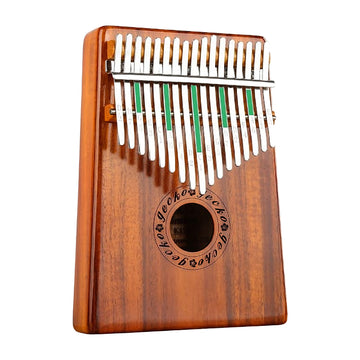
Nevertheless, there are many problems that stem from the very design of the kalimba and which, unfortunately, you cannot do anything about. That’s why the Instruments du Monde store recommends the Gecko brand, internationally recognised for the care and precision it brings to kalimba design—especially the K17K model, made from sumptuous reddish koa acacia wood.
Discover this musical instrument now by clicking on the photo below:
Many beginners wonder if they absolutely must have long fingernails to play this percussion instrument well. Find out our answer by clicking here. You will learn that no matter the length of your nails, there is always a solution to comfortably play beautiful music on the kalimba.


