



Written by Ambre Montespan on Mar 14, 2023 · Updated on Oct 15, 2026

Table of contents:
Have you noticed that two musical instruments—the tongue drum and the handpan—look incredibly similar and you’d like to understand what sets them apart? Are you thinking about buying one of them but can’t decide which to choose? How do you make an informed choice: tongue drum or handpan?
Having played both instruments regularly for over 10 years, I can give you a clear, detailed comparison so you can quickly tell them apart and choose the one that suits you best if you decide to buy one.
Although visually similar, the tongue drum and the handpan have many differences. While the surface of the handpan is hammered into shape, the tongue drum is cut out. This affects the sound, the price, and the difficulty of learning to play.
By reading this article, you will finally learn:
- All the differences between a tongue drum and a handpan
- The advantages and disadvantages of each instrument
- How to choose between them based on your own criteria
You’ll soon be a true expert, able to spot either instrument at a glance and decide which one is best suited to you or your loved ones.
Let’s dive right in and explore this fascinating topic!
The differences between a tongue drum and a handpan
While a novice could easily confuse a steel tongue drum with a handpan (also known as a Hang or Hang drum), there are actually many differences between them. Let’s take a look at them now.

Differences in appearance between the two instruments
From a distance, both instruments vaguely resemble a flying saucer. However, upon closer inspection, there is a noticeable difference in their appearance. This difference comes from two very different manufacturing processes.
In the case of the tongue drum (also known as a tank drum or hank drum), the top of the instrument is cut using an angle grinder or, on higher-end models, a laser. These cutouts are usually tongue-shaped (which is where the name comes from) and come in different sizes. Each tongue is a different size because its dimensions determine the note you hear when the player strikes it. Visually, a tongue drum will always have a number of cutouts (usually between 6 and 14), all in different sizes.
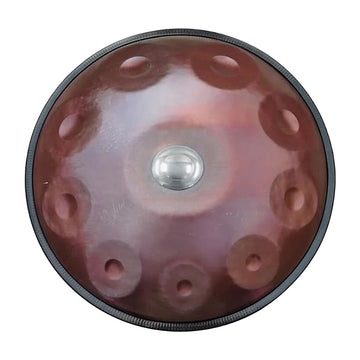
In the case of the handpan, the upper shell isn’t cut—it’s hammered. The artisan uses specialised tools to shape the metal without cutting all the way through, as with a tongue drum. Depending on their position, these shaped areas are often referred to as “tone fields,” “dimples,” or “dings.” The finished handpan often looks a bit like a turtle shell.

So if the instrument in front of you has a cut shell, you can be sure it’s a tongue drum. If, on the other hand, the metal appears to have been hammered, it’s a handpan!
Tongue drum or handpan: a difference in sound
These distinct manufacturing methods naturally influence the sounds produced by these two exotic musical instruments. Describing their tones is tricky: some call them magical, while others say they’re ethereal, relaxing, soft, or simply unique. The best way to decide is to watch the two videos below and hear for yourself.
First, a handpan:
And a tongue drum:
Then it’s up to you to decide which instrument you like best in terms of sound.
A price gap between the steel tongue drum and the Hang
Because they’re made so differently, there’s a big price difference between the steel tongue drum and the Hang. With a tongue drum, the build mainly involves cutouts, which can even be done by a capable DIYer with the right tools.
Making a Hang is very different. As mentioned above, this musical instrument requires the metal to be hammered into the desired shape. This hammering has to be extremely precise, and it takes a long time for the artisan making it. It also requires specialised tools as well as templates that help achieve the desired notes.
In short, a tongue drum takes far less time, requires fewer tools, and involves fewer advanced techniques than a handpan. That’s why the price gap is significant. Generally, a tongue drum costs between A$85 and A$1,000 (depending on its size, number of notes, and overall finish), while a handpan costs at least A$1,700. More luxurious models with more notes can cost over A$5,000.

Variable dimensions and weight between the tank drum and the Hang drum
Another major difference between the tank drum and its cousin, the Hang drum, is their size. While the vast majority of handpans are now fairly standardised at about 55 cm (22 in) in diameter and weigh around 7 kg (15 lb 7 oz), tongue drums vary much more.
Although it’s not uncommon to find tongue drums with a diameter of 55 cm (22 in), there are much smaller ones and even a few larger ones. For example, you can find models that are only 20 cm (8 in) in diameter, and they generally have just 6 or 8 notes.
So if you’re looking for something smaller, more mobile, and easier to transport than a 55 cm (22 in), 7 kg (15 lb 7 oz) Hang drum, a compact tongue drum is a perfectly valid option.

Handpan and tongue drum: distinct origins
Of course, the handpan and tongue drum have very different origins:
On the one hand, the handpan was invented in Switzerland by Felix Rohner and Sabina Schärer. The initial idea behind the design of this instrument was mainly to combine two other existing instruments, namely the steel drum and the ghatam. After several years of experimentation, the first handpan was created in 2000. Since then, its success and community have continued to grow.
On the other hand, the tongue drum or hank drum comes from the United States. In 2007, Dennis Havlena, also inspired by two other musical instruments (the handpan and the Tambiro), had the idea of cutting a propane tank with an angle grinder and using the body of the tank as a resonance chamber. He presented his prototype tongue drum in a video that you can find below:
Since then, the tongue drum has become more professional. It’s no longer made from a used gas cylinder (although some people still do this to build their own tank drum). Instead, makers select specific materials to produce tongue drums that are more durable and more harmonically balanced.
Different learning curves for the two musical instruments
Whether you choose a handpan or a tongue drum, both instruments are relatively easy to learn. It’s impossible to play a wrong note, as with a violin or guitar, because everything has already been tuned during the design process. This means that the musician playing the instrument doesn’t necessarily need to know music theory to enjoy it fully.

That said, the tongue drum has the edge here because it’s even easier to start playing than the handpan. A quick comparison between players makes the difference clear. With a tongue drum, the core technique is simply striking the tongue you want with your hands or a mallet. With a handpan, however, you can learn a wider range of playing techniques that can be more challenging to master, such as multi-finger strikes, thumb hits, and circular or pivoting motions.
In addition, many handpan teachers in France are beginning to offer their services to beginners who want to progress quickly. However, there are very few (if any) tongue drum teachers, simply because this instrument doesn’t truly demand the same level of expertise as the handpan.
This doesn’t mean the handpan is better than the tongue drum—it all depends on how much time and, potentially, how much money you want to invest in lessons to develop your playing.
The steel tongue drum: much more durable than the Hang
The last difference to consider is the durability of these two musical instruments. In general, a tongue drum is much more robust, requires less maintenance, and therefore tends to last much longer than a handpan.
In terms of strength, the convex shells of tongue drums are generally thicker than those of handpans. This means that if the instrument is subjected to a hard impact, it will be less likely to deform. More importantly, even if deformation does occur, a tongue drum tongue can often be straightened by a handy person with the right tools. All you need to do is carefully bend the tongue back and retune the instrument with an electronic tuner. If you’re interested in this topic, I discuss how to tune a tongue drum in this article.
With a handpan, it’s very different. The hammering the instrument undergoes is extremely precise, which means that if it gets dented or warped, it will be very difficult for a non-expert to bring the shell back to its original shape. Because the handpan is so thin and sensitive, it’s recommended to take it to an artisan every 4 or 5 years (or even sooner) to be hammered again and retuned. Over time, playing and transport can cause tiny deformations that gradually detune the instrument.

Another factor to consider is sensitivity to heat. Again, because the handpan’s shell is so thin, you’ll want to protect it from direct sunlight so it doesn’t overheat. If you leave a Hang in intense sun for several hours, the metal can deform more easily and go out of tune. With a tongue drum, you won’t have this issue, since the thicker metal makes it more resistant to temperature changes.
As a result, the tongue drum is a much more robust instrument that shouldn’t shift much over time and will normally give you no trouble even decades after purchase, as long as it’s properly maintained. That’s in contrast to the handpan, which—despite being made of metal—remains a delicate instrument.
How to choose your instrument: steel tongue drum vs. Hang
Now that we’ve covered all the differences between the steel tongue drum and the Hang, how do you choose between the two? It mainly comes down to your sound preferences and how much time and money you’re willing to invest.

If you have around A$2,500 to spend, love the sound of the handpan, and aren’t afraid to take on slightly more advanced techniques, go for the handpan. On the other hand, if your budget is more limited or you find the notes of the tongue drum especially relaxing, choose this musical instrument.
To help you decide, below is a summary table of the advantages and disadvantages of these two instruments:
| handpan |
tongue drum |
|
| Sounds | “magical” and spellbinding | Relaxing and gentle |
| Price | A$1,700–A$5,000 | A$85–A$1,000 |
| Dimensions | About 55 cm (22 in) in diameter, around 7 kg (15 lb 7 oz) | Highly variable—some tongue drums are handpan-sized, while others are pocket-sized |
| Origin | Switzerland | United States |
| Difficulty | Easy | Very easy |
| Durability | Average | Very high |

Choose a beautifully designed instrument!
As you’ve probably noticed, although tongue drums and handpans share a “flying saucer” look, there are many real differences between these two musical instruments. Price, manufacturing methods, and learning curve are all very different. Now that you know what to look for, you’ll be able to tell at a glance whether an instrument is a handpan or a tongue drum, and choose the one that fits you—or your loved ones—based on your own criteria.
Unfortunately, handpans are quite expensive compared to tongue drums, and that can be a real barrier for many aspiring musicians who’d love to get started with this wonderful instrument. That’s why some tongue drums feature double-cut tongues. This gives the player a wider range of notes and techniques than a standard tongue drum while also making it possible to develop a playing style that’s closer to the handpan.
To help musicians in this situation, Instruments du Monde offers a beautifully designed tongue drum with double-cut tongues. It’s the perfect compromise between a basic tongue drum and a very expensive handpan.
Discover this tongue drum now by clicking on the image below:

One last point in favour of the tongue drum: you can find plenty of tongue drum sheet music online, so you can play popular melodies. You just need to know how to read the symbols. To help with that, we created a guide to learning how to read tongue drum sheet music. After reading it, you’ll be able to play all the songs you want! If you’d like to learn everything there is to know about the tongue drum, check out this comprehensive guide.


