



Written by Ambre Montespan on Aug 12, 2024 · Updated on Oct 15, 2026

Table of contents:
Want to know how to practise grounding with a Tibetan bowl? What benefits are generally associated with this practice? And what do you need if you decide to try this energy technique?
Having been immersed in the world of singing bowls for over 10 years, I’ve attended many grounding sessions with this Asian percussion instrument. I’ve also led several myself, so I can walk you through the practice step by step.
Grounding is an energy practice that’s said to help you reconnect with the earth. It’s done with a Tibetan bowl large enough for someone to stand with their feet inside it. The practitioner then strikes the instrument to create vibrations.
By taking the time to read this short article in its entirety, you will learn:
- Why it can be beneficial to practise grounding with a Tibetan singing bowl
- What equipment you need to gather to carry out this auditory and sensory experience
- How to practise grounding properly with this zen instrument
This will give you the opportunity to find out whether grounding is really a practice that suits your needs, while learning the right method to practise it effectively. You can also share this unique experience with your loved ones or your clients if you are an energy professional.
Now, let’s take a closer look at the benefits of grounding.
What equipment is essential for grounding with a Tibetan bowl?
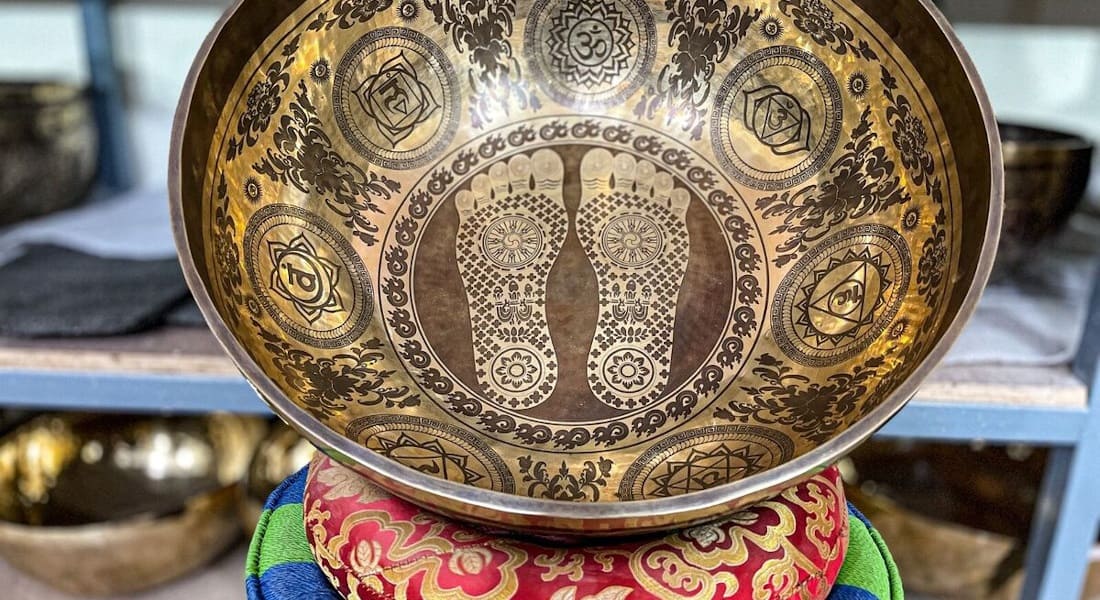
As you may have guessed, to perform grounding with a Tibetan bowl, you will inevitably need a Tibetan bowl. But not just any bowl. First, you’ll need an instrument large enough for an average adult to stand inside the singing bowl. For feet of normal size, you’ll need a bowl with a minimum diameter of 35–40 cm. You can go up to 50 cm, or even about 60 cm, if your budget allows. Some Tibetan bowls even feature engravings of a pair of feet inside. These singing bowls are specifically designed for grounding, so they’re worth prioritising if you want to try this technique. In addition to the footprints, mantras, special symbols, or prayers in Tibetan are often engraved to support the best possible results.
Next, you’ll need a mallet large enough to resonate a Tibetan bowl of this size. I recommend choosing the largest mallet possible for best results or using one designed for gongs. Finally, you’ll need a mat, blanket, or cloth to keep the Tibetan bowl from touching hard surfaces, which could scratch or damage it.
How can you enhance your grounding with this Asian instrument?
This practice is ideally done with two people: one who wants to improve their grounding, also called the receiver, and the other who will strike the Tibetan bowl, whom I will refer to here as the practitioner. First, choose the ideal spot for this energy treatment. You can do grounding on any relatively flat surface. Ideally, place the bowl outside, in direct contact with the earth or grass, making sure there are no pebbles, stones, or gravel that could damage your instrument. This direct connection can strengthen your connection with the earth. Alternatively, you can set it up indoors, taking care to place a rug or blanket between the singing bowl and the floor if the surface is hard, such as tiles, hardwood, or concrete.
Once the location is set, ask the recipient to stand barefoot, or at least in socks, and step inside the Tibetan bowl. If the bowl features engraved footprints, place the feet directly on top of them. It’s important that the soles of the feet make as much contact with the metal as possible. The recipient should then stand with their head, back, and legs straight, taking a few deep, relaxing breaths. They may close their eyes if they wish during these breaths.

When the practitioner senses the recipient is ready, they stand directly in front and strike the rim of the Tibetan bowl to set it vibrating. They then wait for the sound and vibrations to fade, move a quarter turn clockwise, and strike again. Continue in this manner, striking the musical instrument at regular intervals while moving a quarter turn around it with each strike. Grounding typically lasts 5 to 10 minutes but may extend as needed. In all cases, the grounding ends at the same starting point—with a strike and the practitioner facing the recipient.
Meanwhile, the recipient focuses on the vibrations penetrating the soles of their feet. They can visualise the vibrations or energy flow rising through their body, passing through the seven major chakras, from Muladhara (the root chakra) to Sahasrara (the crown chakra). Think of it as the sap of a tree fed by the earth, starting at the trunk and travelling up to each leaf. The whole experience should feel relaxing and calming, in addition to helping you reconnect with the earth.
It’s also possible to practise grounding alone. Simply strike the Tibetan bowl at regular intervals while standing inside it. Concentrating during the vibrations takes practice, but it can be effective with time. You can watch solo grounding in the video below:
Why is it beneficial to practise grounding with a singing bowl?
The main benefit of practising grounding is reconnecting with the earth. According to belief, the Tibetan bowl acts as a sensor and energetic catalyst, connecting the receiver to the energy of planet Earth. This may bring benefits in terms of emotional stability and self-confidence. In energy work, it’s often observed that, due to modern lifestyles, people can feel “cut off” from the nourishing earth—especially when shoes create a barrier between the body and the ground. Today, it’s relatively rare to walk barefoot in direct contact with the earth. Grounding aims to restore a connection that was much more common in ancient times.
From a more pragmatic point of view, grounding is also an excellent way to massage the feet and arches through the vibrations produced when striking the instrument. It is exactly like a classic sound massage with Tibetan bowls, except that this one is much more powerful because the instrument is much larger. As a result, grounding offers effects similar to foot reflexology, though in a less precise and localised way. It can also help relax the muscles and joints of the feet, giving you a deeply soothing moment.
Experience grounding with a genuine Tibetan singing bowl
Among the many practices performed with Tibetan bowls, grounding remains a technique that is still quite mysterious and not widely used by practitioners. It’s therefore natural to take an interest in this sound and sensory experience, which can feel a bit obscure at first. But with the information you’ve just read, you now know what grounding is and how to do it.
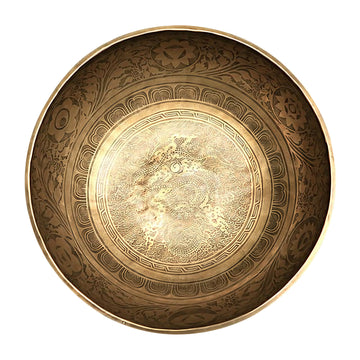
Nevertheless, singing bowls specifically designed for grounding are rare. Normally, these bowls feature engravings in the shape of footprints and other symbols to enhance the effectiveness of this practice. I recommend purchasing one from Instruments du Monde, which works closely with Tibetan and Nepalese artisans who take pride in their craft. There you will find an excellent model with a diameter of 50 cm that is entirely dedicated to the practice of grounding.
Learn more about this singing bowl by clicking the image below:
Now that you know how grounding works with a Tibetan bowl, are you aware of the benefits associated with each note produced by this musical instrument? Find out more by consulting our guide on selecting the musical note when purchasing a Tibetan bowl. You’ll be able to choose your next bowl with confidence. Alternatively, you can learn much more by reading our article to find out everything there is to know about singing bowls. This Asian instrument will hold no more secrets for you.


