



Written by Ambre Montespan on Mar 14, 2023 · Updated on Oct 15, 2026

Table of contents:
Do you own this magnificent musical instrument, the tongue drum, and want to know how to change its tuning? Or maybe you’ve noticed your instrument isn’t as well tuned as it was when you bought it and you’d like to fix that.
It’s been over 10 years since I discovered the steel tongue drum, also known as a hank drum or tank drum, and it was love at first sight. Since then, I’ve played it regularly and become truly passionate about this unusual instrument. So I can answer your questions accurately about tuning this extraordinary American instrument.
The tongue drum was not designed to be tuned. Ideally, it should only be tuned during manufacture. However, it is possible to change its basic tuning by placing magnets on the tongues or by changing their size.
Once you’ve read this article from start to finish, you’ll know:
- Why it may be necessary to tune your musical instrument
- How to tune your tongue drum
- What makes tunable steel tongue drums unique
Tuning your tongue drum will then be a mere formality for you! As a result, you’ll be able to change the instrument’s tuning whenever you like or restore its original tuning if your tank drum happens to be out of tune.
Let’s explore this fascinating topic together.
A musical instrument that is not normally tunable
First, it’s important to understand the basics of how a tongue drum is made in order to see why this musical instrument is not normally designed to be tuned. Some instruments, such as the guitar, piano, and violin, have various mechanisms that allow them to be tuned. In practical terms, for a guitar, for example, you turn the tuning pegs, or machine heads at the top of the neck (on the headstock) to increase or decrease string tension and change the pitch.

With a tongue drum, it’s quite different. In the vast majority of cases, there is no built-in system on the instrument to change the sound the tongues produce. When the craftsman makes a steel tongue drum, they cut the tongues according to the tuning they want to achieve. That tuning isn’t meant to be changed afterwards. That’s why a tongue drum isn’t generally considered an instrument you can tune. And that makes sense: compared to a guitar, a tongue drum doesn’t go out of tune nearly as easily.
However, there are various techniques that can be used to modify the sounds produced by the tank drum. In reality, these techniques weren’t intended by tongue drum makers; they’re more like workarounds discovered by players who wanted a bit more flexibility from their instrument.
But if tuning your tongue drum isn’t intended, why would you want to do it? That’s what we’re going to look at right now.
Why tune your tongue drum?
There are many reasons why you might want to tune your tongue drum.

First of all, the tongue drum is made almost entirely of metal, and unlike the strings of a guitar, the tongues aren’t under tension. Still, over time, repeated striking—or a hard impact during transport, or a drop—can cause one or more tongues to deform. In that case, the sound can change, and it may be useful to retune the instrument.
It can also happen that a tongue drum isn’t perfectly tuned due to a small mistake or a manufacturing defect. Human error is real, and when you buy an instrument, there’s always a chance one or more notes may be slightly off. In that case, tuning is simply about correcting the issue that happened during the creation of the hank drum.
Finally, quite simply, a player may want a new tuning just for fun—to explore new textures and discover new musical landscapes with this relaxing instrument. For example, some musicians choose to retune a tongue drum from 440 Hz to 432 Hz or 528 Hz to explore the effects some people attribute to those frequencies.

What equipment is essential for tuning your steel tongue drum?
If you don’t have perfect pitch (which is true for most people), you’ll need the right tools to give you a reliable reference for the notes you want on your tongue drum.
To get those references, you’ll need either an electronic tuner, one or more tuning forks, or a smartphone with an instrument-tuning app.
Tuning the hank drum with an electronic tuner
Electronic tuners are small devices that listen to the sound you produce after striking a tongue and tell you whether the pitch is sharp, flat, or right on target compared to the desired note. These devices are very light and battery-operated. They’re ideal for tuning your tongue drum, and they’ll also work with pretty much any other instrument since the principle is the same. More advanced tuners let you work with multiple reference frequencies and cost only a few dozen euros.

A tuning fork for tuning your tongue drum
Tuning forks are usually shaped like a large metal fork. Simply strike them to make the metal vibrate and produce the note they’re designed for. Then you match the note you hear on your instrument to the tuning fork’s pitch. They require no electricity and are highly reliable. On the other hand, you’ll need a different fork for each frequency and a good ear to dial in the tuning you want.
A smartphone app for tuning your instrument
Finally, smartphone apps use your device’s built-in microphone to do exactly the same job as the electronic tuner mentioned above. Some apps are free with adverts, while others are paid, and you may need a constant data connection.
You’re free to choose among these three options, but we recommend an electronic tuner. It’s far more reliable than a smartphone app, which can depend heavily on microphone quality and, above all, isn’t designed specifically for this use.

Finally, you may also need specific equipment depending on the technique used to tune the tongue drum. We’ll cover that equipment below when we get into each method.
How do you tune a musical instrument?
Tuning musical instruments is done empirically. That means you work on the tongue whose note you want to change, play it, and compare the pitch you get to the target note to see whether the adjustment is correct. If it isn’t, you repeat the process until you reach the note you want.
To compare the note you play with the desired note, you’ll need one of the tools listed above. Then, through trial and error, adjust each note on your tongue drum.
Different ways to achieve perfect tuning with a tongue drum
Great! Now that you know how to tune a musical instrument, let’s look at how to change the sound of the tongues on your tongue drum.

Bend the tongues of the tank drum to find the right tuning
If your tongue drum is only slightly out of tune, this method may suit you perfectly. Take a thin, sturdy tool, such as a knife, and use it as a lever to gently twist the tongue from its current position. We recommend placing a cloth between the body of the hank drum and the tongue to minimise damage to your instrument. Be careful not to bend it too much, as there’s a risk of breaking the tongue, which would be disastrous.
Keep in mind that this method is best for small adjustments. It’s mainly for fine-tuning a setting or correcting a minor defect on a tongue.
Tuning your tongue drum with magnets
To use this technique, you’ll need a tongue drum made of magnetic metal (copper, for example, is not magnetic) and several neodymium magnets. You’ll also need access to the inside of the instrument (often from underneath), which is not the case for all steel tongue drums. If you meet all these conditions, you can move on to the next step! Otherwise, go directly to the next technique.

The goal is to place one or more magnets on the tongues inside the tongue drum to alter their weight and change the note produced. Position the magnets in the centre of each tongue. However, you can move them up or down to fine-tune the note while making sure to stay centred on the tongue. It’s perfectly fine to stack magnets, since the goal here is simply to add weight to the tongue. Also, having many small magnets is more useful for precise adjustments than having only a few large ones.
This lets you significantly change the note produced by each tongue. However, adding weight only lowers the pitch, which means you can’t make your tongue drum higher. Also, if the instrument takes a hard impact during transport, the magnets may shift and your tuning work will have to be redone. This method is therefore limited, but it can be truly useful if you don’t travel much with your tongue drum.

Tuning the instrument with a hacksaw
For this technique, you’ll need a hacksaw. The goal is to continue cutting the tongues, making them longer than they were originally. Simply insert a hacksaw blade into the gap forming the tongue and continue cutting in line with what was originally done by the craftsman. This is meticulous work that should be done little by little, checking regularly to determine whether the desired note has been achieved.
Just like placing magnets inside the tongue drum, cutting the tongues with a hacksaw will only make the notes lower. To make them higher, you’d have to remove material, which is more complicated to pull off. Still, some players manage it with a file and plenty of elbow grease! And as you’ve probably realised, the downside is that—unlike magnets—this method is irreversible.
Tuning the steel tongue drum during manufacture
You may also be in the unique situation of making your own tongue drum and want to know how to cut the tongues to achieve the desired tuning.

In reality, the shape of the tongues isn’t very important. They can be rounded, square, hexagonal, or even triangular. Just remember: the smaller the tongues, the higher the notes, and vice versa. Also, the smaller the tongue drum, the higher the notes it will produce overall.
The special case of tunable tank drums
You may have heard that there are tunable tongue drums. These instruments work on the same principle as the neodymium magnet technique mentioned above. A positioning diagram is provided, and you simply need to follow it to get the desired tuning.
Tunable tongue drums have the advantage of being quick and easy to use for changing the tuning or scale. However, they also have many drawbacks. The number of possible tunings is fairly limited. Also, don’t expect to switch tunings quickly mid-session: you’ll have to stop playing, flip your tongue drum over, set the correct magnet combination, and then start again.
But above all, the biggest drawback of tunable tongue drums is the price. For a 30 cm (12 in) model with only 8 notes, you’ll have to pay between €400 and €500. At that price, you might as well consider buying several steel tongue drums that cover many more notes for less money, or a larger instrument with 12 to 15 tongues.

Pick up a 14-note hank drum!
As you’ve seen, tuning a tongue drum isn’t easy, since the instrument really isn’t designed for that job. Still, you now know all the techniques available to try tuning your steel tongue drum yourself. That means you can correct a flaw or explore new musical worlds by changing the tuning of your relaxing instrument.
It’s true that the different methods presented in this article can feel unusual and hard to pull off. One is irreversible, while another relies on magnets that take time to set up and can shift if the instrument gets knocked. However, these are the only methods currently available if you want to tune your tongue drum.
Instead of risking permanent damage to your instrument, consider choosing a new tongue drum with more notes. That way, you’ll multiply your musical possibilities during your playing sessions. At Instruments du Monde, we’ve selected a high-quality 14-note tongue drum made of nitrided steel—ideal for anyone who wants to expand the range of melodies they can play on this instrument.
Discover this magnificent tongue drum now by clicking on the image below:
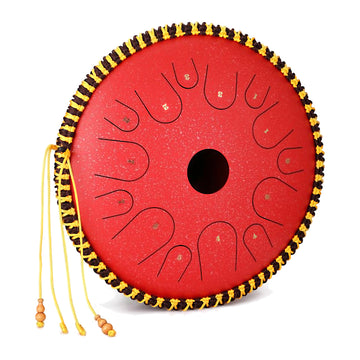
Did you know there’s another instrument that’s very similar to the tongue drum, called the handpan? It’s actually a distant cousin. Learn the differences between a tongue drum and a handpan in this article. You’ll see that they share certain roots, yet they’re very distinct instruments. To learn more about the tongue drum, check out this other article.


Richard Blessley
Jul 7, 2026I’ve just recently gotten neodymium magnets for my tongue drum and am doing research because I have to fit my hand through the sound hole each time I put in and take out the magnets. Is there a better alternative? I know what I am already considering is a longer keychain magnet (because I didn’t know how small, nor did I realize, of a keychain magnet it was) that is about 3 inches long (whatever that may be in mm since that’s usually the measurement unit for these magnets).
Ambre Montespan
Jul 7, 2026Hello Richard,
Personally, I don't know of any other alternatives. It's true that this solution can be complicated if the musician has large hands. If you find an interesting method, please share it with us in the comments on this article.
Best regards