



Written by Ambre Montespan on Jul 3, 2023 · Updated on Oct 15, 2026

Table of contents:
Have you recently discovered the ocarina and want to learn more about it? Are you wondering how this musical instrument differs from the classic flute you may have already played? Are you considering buying one of these wind instruments and would like a comparison to help you choose?
Having played both the flute and the ocarina for over 10 years, I’ve spent countless hours with each one and learnt to clearly identify what sets them apart. As a result, I can easily explain the many distinctions between these two instruments.
Ocarinas differ from flutes mainly in how they’re made, the sound they produce, their origins, how challenging they are to learn, and, of course, their price.
Once you have read this article, you will be able to understand all the differences between ocarinas and flutes, including the following points:
- Their manufacturing methods
- The sounds produced by these two musical instruments
- Their historical origins
- Their respective learning curves
- Typical price ranges
- Their fragility
This will greatly increase your knowledge of these musical instruments and make it easier for you to choose between them if you are unsure which model to buy.
Now let's take a closer look at these instruments.

A distinct design between the flute and the ocarina
At first glance, it’s clear that the flute and the ocarina are not designed in the same way. In fact, their shapes are very different. While flutes are often composed of one or more straight tubes, the ocarina actually belongs to the subgenre of globular flutes because of its distinctive shape, which vaguely resembles a goose’s head.
Thus, the flute, whether it’s a concert flute or a recorder, is a conventional instrument, factory-made and comprising many moving parts that can be easily replaced. Flutes are often made of metal, wood, or synthetic materials such as plastic or resin. On some models, you can adjust the tuning by moving the tubes closer together or further apart. It’s worth noting that, in the case of the recorder, the player blows in the direction of the tube, while for the concert flute, the player blows air at a 90° angle to the tube.
On the other hand, the ocarina is made of a single piece, except for the rare models that can be tuned. Therefore, in most cases, it will not be possible to change the pitch of the instrument. Almost all ocarinas are made of either ceramic or plastic, although it is possible to find them in wood or metal. Finally, this instrument is much less common (and often feels more “exotic”) than a flute. It’s very often made by hand to achieve that unique shape, which is difficult to reproduce with industrial machines. In that sense, the ocarina is generally more artisanal than most flutes.
Different sounds depending on the musical instrument
These design differences naturally lead to different sound character. An ocarina typically produces a very soft, resonant tone, generated by a whistle that vibrates air in a hollow chamber following the Helmholtz resonator principle. Recorders and concert flutes, on the other hand, tend to sound airier and more breathy. In terms of acoustics, neither instrument is truly “better” than the other. They simply have different voices, and each musician can prefer a flute or an ocarina depending on taste. The best approach is to form your own opinion by watching the videos below, which present both instruments.
Presentation of an ocarina:
Presentation of a concert flute:
The origins of these two musical instruments differ
Although rudimentary models dating back to prehistoric times have been discovered, the recorder has existed in Europe since at least the 14th century, particularly in England, where it gradually developed and became more complex to reach its current form. Similarly, the first traces of the transverse flute can be found in Asia, but it was in Europe that it finally developed from the 9th century onwards.
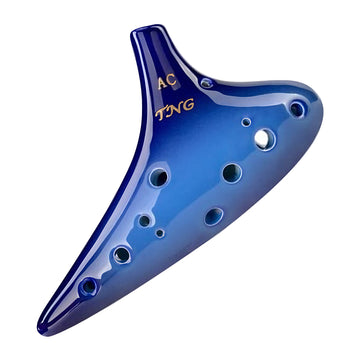
The ocarina, on the other hand, is a much more recent innovation compared with other flutes. Early globular flutes first appeared in Mesoamerica (present-day Mexico) and were later introduced to Europe by the conquistador Hernán Cortés in the 16th century. It was not until the 19th century that Giuseppe Donati, an Italian, gave it its distinctive goose-head shape and increased the number of holes on the instrument to 10. Thus, the origins of the ocarina differ radically from those of a classical flute.
The flute is more difficult to learn than the ocarina
It also happens that the complexity of a flute is not the same as that of an ocarina, which becomes obvious when learning to play either instrument. A standard flute offers a much wider range of notes and the ability to play in multiple keys, unlike the ocarina, which is more limited. Therefore, the flute is generally harder to learn. In terms of fingering, both are about equally challenging. However, ocarinas require more practice to play in tune, since you need to blow more or less strongly depending on the note you want to produce. Higher notes require a stronger breath than lower notes to stay in tune. With a flute, the breath pressure stays much more consistent from note to note.
At this point, it’s fair to say that both instruments have their share of advantages and disadvantages. However, you’ll find more online help and tutorials to improve on the flute, since it’s far more popular than the ocarina. In addition, sheet music and teachers are fairly easy to find. For the ocarina, you’ll likely need to dig a bit more.
In conclusion, if you’re aiming to reach a very high level, perhaps with the goal of joining an orchestra, the flute is the clear choice. If you simply want an instrument to unwind and play for your own enjoyment, the ocarina will serve you well.
Price differences depending on the instrument
The most significant difference between ocarinas and flutes is undoubtedly their price. It’s important to be aware that a good concert flute will cost several hundred, or even several thousand New Zealand dollars, even if it is a student model. In contrast, a mid-range ocarina will cost you less than NZ$190, which can be a decisive advantage for this wind instrument. The most expensive models are double and triple ocarinas, which cost between NZ$300 and NZ$800.
The ocarina is more fragile than the flute
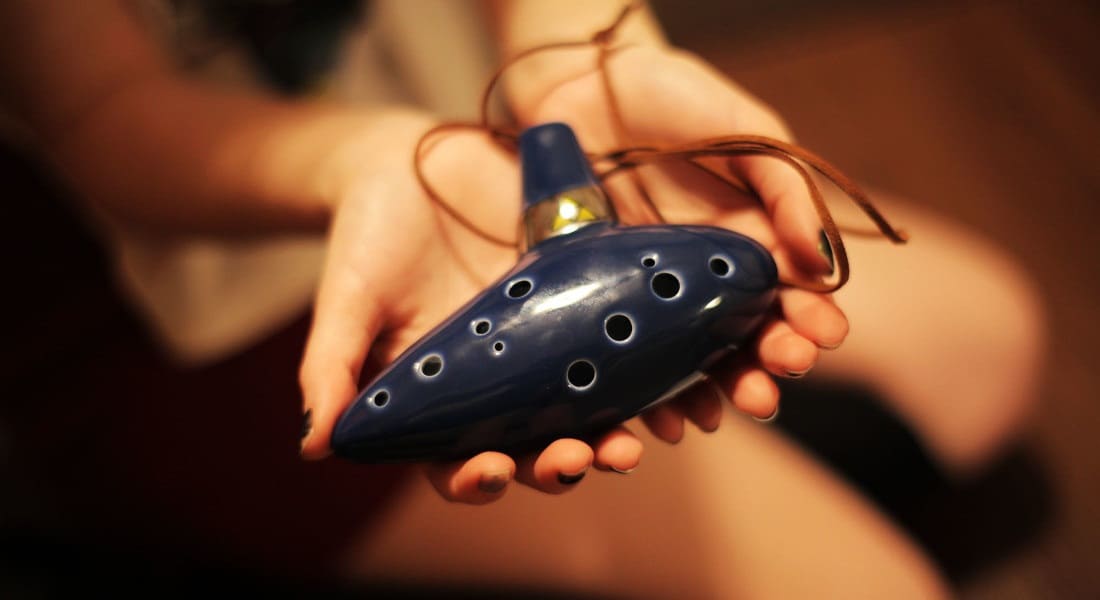
While the price is clearly in favour of the ocarina, the same cannot be said for its fragility. Dropping an ocarina on the ground will very often destroy the instrument, unless it is made of plastic. Furthermore, if you take it with you on a trip, you will need to take care to protect it so that no relatively heavy objects crush it. Although a flute is far from indestructible, it is still more resistant than an ocarina. In addition, some parts are modular, so it is often possible to repair it by replacing certain pieces. This is not possible with an ocarina, where even the slightest crack will render it unusable. It’s simply an instrument you need to handle with a bit more care.
Treat yourself to the wind instrument you love
Ocarinas and recorders or transverse flutes differ in their origins, prices, and sounds. Each instrument is different and has its own charm that may lead you to choose one over the other. Now that you've read this article, you're in a position to know which of these two magnificent musical instruments you prefer.
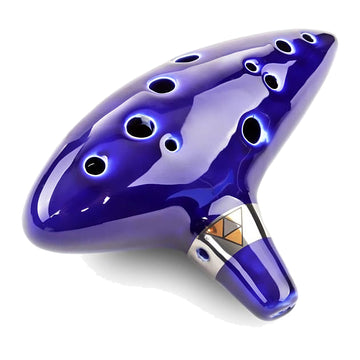
However, if you do prefer the ocarina, finding a high-quality one can be challenging, as this instrument is still rare in bricks-and-mortar stores. To overcome this problem, the Instruments du Monde store offers a collection of more than 50 ocarina models, so you’re sure to find your future instrument among them. For example, this 12-hole ocarina inspired by the Zelda video game is perfect for beginners.
Click on the image below to purchase this ocarina now:
The way you blow into an ocarina is completely different from a flute. It takes a bit more technique and control on this wind instrument. Learn how to blow properly into an ocarina with our article, packed with tips to help you play like a pro.


