



Written by Ambre Montespan - Updated on Aug 11, 2026
Table of contents:
Have you just bought a tongue drum and want to play melodies you’ve found online or in a book? Not sure how to read sheet music for this instrument and want to learn? What do the numbers and letters on the sheet music actually mean?
Having played the steel tongue drum for over 5 years and arranged more than 50 songs on this American musical instrument, I can easily teach you how to read sheet music for it.
To read tongue drum sheet music, you need to understand that each number or letter corresponds to a musical note. You simply play the tongues that match the notes indicated, following the traditional reading direction—from left to right and from top to bottom.
After reading this comprehensive guide, you will finally understand:
- Why you absolutely must learn to read tongue drum sheet music
- How to read sheet music with numbers or letters
- Where to find sheet music for steel tongue drums
Interpreting tongue drum sheet music will become second nature, and you’ll finally be able to play any melody you want—or even create your own arrangements to share with friends, family, or online.
So, let’s dive in and explore this fascinating topic.
Here's why you need to learn to read tongue drum sheet music!
Knowing how to read tongue drum sheet music is an important step for any instrumentalist who wants to play songs, avoid mistakes, and improve their visual memory and mastery of their musical instrument.

Play all your favourite songs with your steel tongue drum
This is the number one reason to learn how to read sheet music for your steel tongue drum: to play all your favourite songs. Once you understand how to read sheet music, you’ll be able to play any melody you find online or that friends share with you. Whether you’ve heard the song before or not, you’ll still be able to play it.
Avoid mistakes by playing your instrument with sheet music
No one can truly memorise every song you might want to play on a tongue drum, also called a steel tongue drum, hank drum, or tank drum. But if you don’t know how to read sheet music, you’ll have to learn every melody by heart. As a result, you’ll either be limited by how many tunes you can keep in your memory, or you’ll inevitably make mistakes—like hitting the wrong note or, even worse, blanking out in front of an audience and forgetting part of the song.
Learning to read sheet music gives you access to an unlimited number of melodies and helps you avoid those embarrassing moments in front of an audience. Think of sheet music as your personal safety net.

Improve and develop your visual memory with a tank drum
Learning music in general is often associated with stronger cognitive performance. This is widely accepted by professionals in the field, as Emmanuel Bigand, director of a CNRS research lab, points out in his book "Les bienfaits de la musique sur le cerveau" (The Benefits of Music on the Brain).
It appears that music theory, and therefore learning to read sheet music, reinforces these benefits. Tongue drum sheet music is no exception, and it can help build your visual memory. Your brain will thank you!
Improve your tongue drum skills
With experience, you’ll be able to read the score for your hank drum without looking at your instrument, almost as if you were playing blind. You’ll know the location of each tongue and the corresponding note like the back of your hand, making your playing more fluid and strengthening your control of the tongue drum.
What do the numbers on a tank drum score correspond to?
There are two main types of tongue drum scores, which consist mainly of numbers. The simple ones are mainly for beginners, while the more advanced ones include some music theory concepts.
Simple numbered tongue drum scores
To help you visualise what a simple tongue drum score looks like, here is an example using the song "Happy Birthday":
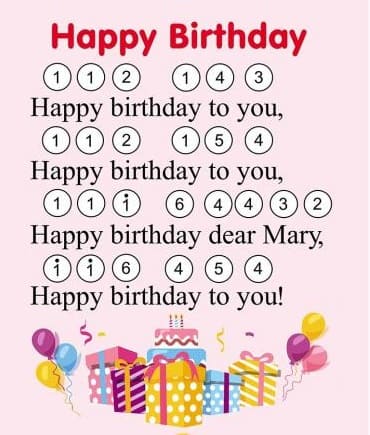
You can see that there are several numbers inside the white circles. Here, each number corresponds to a single musical note using the Arabic numeral notation system (abbreviated NMCA). Lyrics may or may not be included; when they are, they simply help you keep your place in the song. Below is a table showing the correspondence between solfège notes and NMCA:
| solfège | do | re | mi | fa | sol | la | si |
| NMCA | 1 | 2 | 3 | 4 | 5 | 6 | 7 |
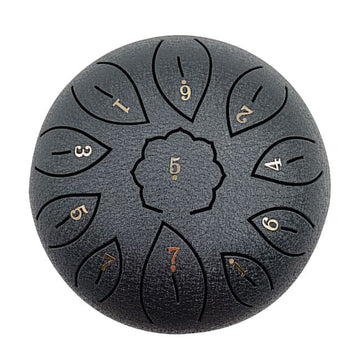
Read the score in the traditional direction—from left to right and top to bottom. Play each note in succession, following the reading order, to recreate the melody. To do this, simply strike the tongue on your tongue drum that corresponds to the note in question. When you purchased your instrument, you should have received stickers; refer to the tongue drum manual to place them correctly.
You may also have noticed that some numbers have a dot just above them. In NMCA, this dot means it’s the same note, but one octave higher. If the dot sits below the number, it indicates an octave lower. Depending on the author of the score, the dot may be replaced by "°" or "*". That’s how you’d write a do (C) one octave higher: 1° or 1*.
Finally, some scores may include parentheses or dashes—for example, (16) or 1–6. This simply means you should play all the notes at the same time; in our example, that would be do and la together.
However, this simple score—while ideal for beginners—doesn’t indicate note duration, rests, or tempo. That’s why advanced scores exist, adding more precision.

Advanced steel tongue drum scores with numbers
Below is an example of an advanced score for the steel tongue drum:
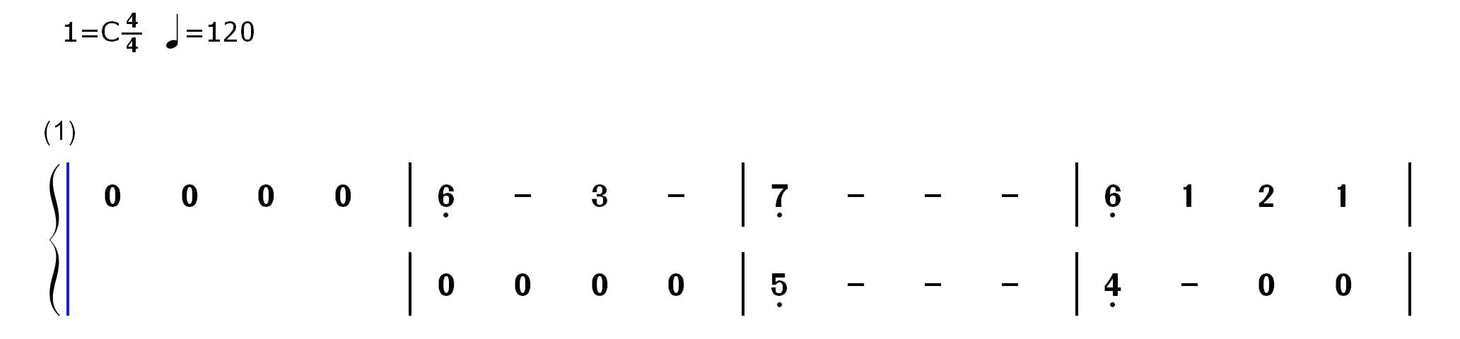
The numbers correspond to the same notes as those in the simple score. However, you’ll now see zeros and empty spaces—these indicate moments of silence (rests). Let’s add some coloured visual cues to this score so you can see how it works:
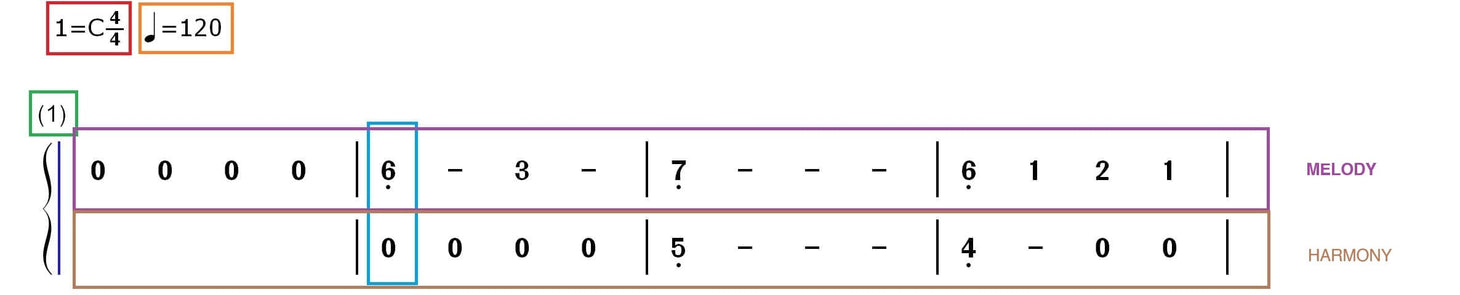
A – Time signature
The symbols and numbers in the red box indicate the time signature. This sets the rhythmic framework for the bars in the score. Bars are separated by the vertical bar lines between the numbers. In this score, each bar contains 4 crotchets.
The orange box shows the tempo of the song. The tempo specifies the speed at which the music should be played. In this score, it is 120. This number corresponds to beats per minute (BPM). If you have no knowledge of music theory, watch the video below, which will teach you the basics of time signatures:
Finally, the green box indicates the number of the bar you are on. Here, it is the beginning of the song with the first bar.
B – Melody and harmony notes
The purple and brown boxes correspond to the musical notes to be played. The top line is the melody, and the bottom line is the harmony. You read them together—so when you reach the blue box, for example, you’ll play °6 in the melody while the bottom line indicates a rest (0).
C – The duration of musical notes
You may have already noticed that there may be dashes instead of numbers. There may also be one or more bars below a number. These dashes and bars indicate the duration of the musical note, with the following correspondence:
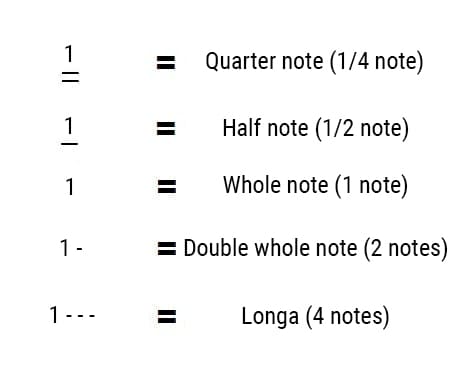
So if a dash appears in front of a number, hold the note for twice as long as the same number without a dash. If two bars sit below a number, play the note for one-quarter of the duration of the same number without bars. To control note length, strike your tongue drum more or less firmly so the resonance can ring out for a longer or shorter time.
Some numbers can also be linked together in this way:
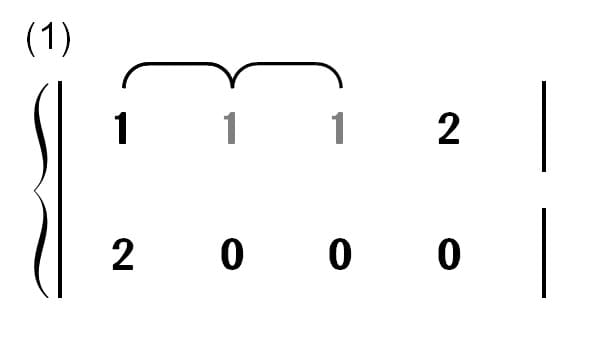
In this case, it’s a tie. You only play note 1 once, but you hold it for three beats.
Finally, one or two dots can also be placed after the number of the musical note. This is an augmentation dot. With one dot, you extend the note by half its original value. With two dots, you extend it by half plus half of that half (in other words, an extra quarter). Here is an example:
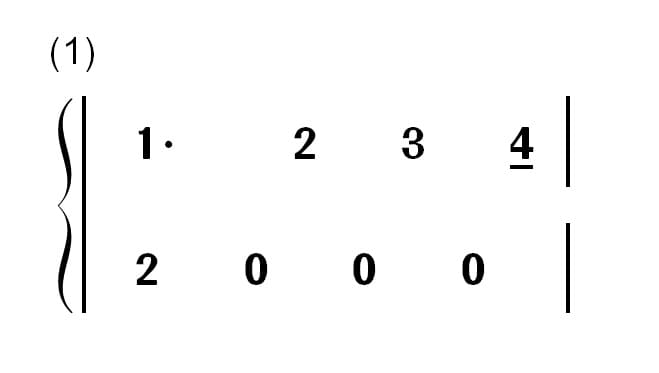
Here, note 1 lasts for one beat, and you add half of its value, for a total of 1.5 beats. That’s why the numbers after it are offset from the harmony line (the bottom line). If there had been two dots after the 1, the note would have lasted for 1.75 beats.
How to read sheet music for your musical instrument using letters?
Tank drum sheet music may also be written with letters. This is simply another system that replaces numbers: the Anglo-Saxon notation system. Here is a table showing the correspondence with solfège:
| solfège | do | re | mi | fa | sol | la | si |
| Anglo-Saxon notation | C | D | E | F | G | A | B |
The same rules that apply to numbers also apply to letters. There is no difference, except that sometimes, in rare cases, you may see a number after a letter, such as D4. The letter represents the note, and the number indicates the octave. So, D4 is one octave lower than D5—similar to the dots we saw earlier, which can appear above or below the numbers.
Where can I find sheet music for the hank drum?
Sheet music for hank drums is still quite rare, as the instrument is fairly exotic and not widely known. The good news is that its popularity is growing, and new sheet music is likely to appear over time.
To help popularise this instrument, at Instruments du Monde, we offer a selection of sheet music for tongue drums. Everything is completely free, and you can even download it as a PDF if you’d like. Feel free to share these good vibes with everyone around you!
You can also visit Pinterest to find tongue drum sheet music, though we can’t guarantee the quality of the melodies you’ll find there. Or, you can also arrange your own sheet music if you feel like it!

Protect your fingers when playing steel tongue drum sheet music!
Reading sheet music for your instrument can definitely feel like a hurdle for beginners, yet the rewards far outweigh the effort. Now you have all the keys you need to decipher these famous scores and play them smoothly on your instrument. A whole new world will open up to you, and you’ll be done with forgotten notes and mistakes during your practice sessions.
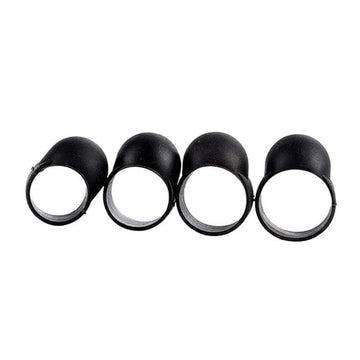
You can play the tongue drum either with mallets or directly with your fingers. Mallets are ideal for beginners who are new to the instrument, while playing with your fingers allows for greater speed and precision. This is because some scores sometimes require playing sequences of notes that can be tricky with two mallets. In addition, playing directly with your fingers can cause friction injuries over time. That’s why Instruments du Monde offers finger protectors specially designed for tongue drums.
Improve your playing and protect your fingers by clicking on the image below:
Reading sheet music is an excellent way to master your instrument, but you may have realised that it doesn't suit the way you want to use it. To remedy this problem, take a look at our guide to help you choose your tongue drum. You'll be sure to make the right choice and select the instrument that's perfect for you. Finally, read our comprehensive guide to tongue drums, which will tell you everything you need to know about this instrument.


