



Written by Ambre Montespan - Updated on Aug 11, 2026
Table of contents:
While browsing the internet, hanging out with friends, or attending a music festival, have you ever spotted a curious musical instrument shaped like a flying saucer or a turtle shell? Did you notice that this unusual object produces sounds you might describe as celestial? But you have absolutely no idea what it is?
As someone who’s been passionate about world musical instruments for over 20 years, I can answer all your questions about these UFO-looking instruments.
Today, two metal percussion instruments are famous for their flying-saucer shape: the handpan (also known as the Hang or Spacedrum) and the tongue drum (also called the hank drum, tank drum, or steel tongue drum).
After reading this article, you’ll finally know:
- Which musical instruments look like spaceships?
- What are the differences between these particular instruments?
- Where can you buy these instruments with their exotic sounds?
Instruments that resemble flying saucers won’t be a mystery anymore! You’ll be ready to pick one up and explore a wonderful new world of music.
Without further ado, let’s dive in.
The handpan, an instrument resembling a flying saucer or a turtle shell
If you’re looking for the instrument that most closely resembles a UFO or a turtle shell, you’re in the right place. After these next few lines, you’ll know everything you need to know about the handpan.

What is a handpan?
The handpan is an idiophone percussion instrument made primarily of metal, about 22 in (55 cm) in diameter and roughly 10 in (25 cm) tall. It’s built from two convex shells (think “wok-shaped”) that are hammered and welded together around the rim to create that iconic flying-saucer look.
On the upper shell of the handpan, you’ll notice circles or ellipses. These are called “tone fields,” and they’re the spots you strike to produce sound. Each tone field corresponds to a musical note. The note in the center of the handpan is called the “ding,” while the lower shell features an opening called the “gu.” Thanks to this opening, the entire body of the instrument acts as a resonating chamber. On some handpans with a large number of notes, tone fields can also be placed on the lower shell.
One of the biggest advantages of this instrument is that it’s very hard to hit a “wrong” note. During the build, each tone field is carefully tuned through a long hammering process and corresponds to a specific pitch. That’s why it’s a great option for anyone who’s never studied music theory.

How do you play this unusual instrument?
Since the handpan is a percussion instrument, you play it by striking the tone fields with your hands or with mallets. Handpan music is very intuitive, and since written scores aren’t widely available, most players enjoy composing their own melodies and letting the instrument’s mesmerizing tones lead the way.
The handpan is played resting between your legs or on a support also known as a “stand.”
This simple playing approach, combined with the fact that no special musical background is required, makes the handpan very beginner-friendly.
Below is a video by Sam Maher, an excellent handpan player, showing you how to play this UFO-shaped instrument:
The origins of the Hang
The handpan, handpan drum, or Hang was created in Switzerland by Sabina Schärer and Felix Rohner in 2000. To craft this instrument that resembles an unidentified flying object, they drew inspiration from the steeldrum and the ghatam, two other musical instruments originating in Trinidad and Tobago and India, respectively.
The handpan was so successful that its creators’ production capacity couldn’t meet demand. Since no patent was filed right away, other makers started producing handpans too, which helped spread its popularity throughout the music world. Today, the handpan continues to win people over with its magical sound.


Is it a UFO? No, it’s a tongue drum!
Alongside the handpan, another musical instrument also has the look of a spaceship: the tongue drum, which we’ll explore next.
What is a tongue drum?
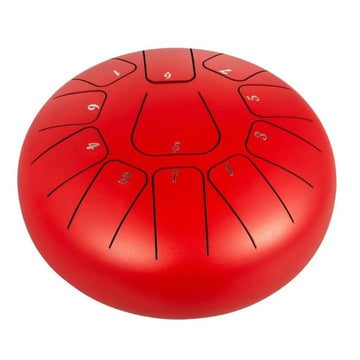
Like the Hang, the tongue drum is a percussion idiophone. It’s made from two steel shells welded together to create that signature UFO-like appearance. Sizes can vary a lot, from very small models around 6 in (15 cm) in diameter to much larger ones measuring about 18 in (45 cm) across.
The upper shell features tongue-like cutouts made using a grinder or laser. This distinctive design is what gave the instrument its name: “tongue drum.” Some tongue drums also feature a cavity in the lower shell, allowing the entire body of the instrument to work as a resonating chamber.

Just like the handpan, it’s very hard to play a “wrong” note on a tongue drum. Each tongue is cut and tuned with precision, which is exactly why it’s so popular with beginners.
How do you play this exotic musical instrument?
To play the tongue drum, you strike the tongues to create vibrations that resonate through the steel body. You can play with your hands, finger protectors, or with sticks or mallets, which are commonly used with this instrument.
The tongue drum can be placed directly on the floor or on a table when it has non-slip rubber pads on its lower shell. Otherwise, it can be played between your legs or on a stand.
You can find lots of tongue-drum sheet music online, so you can learn melodies like “Pirates of the Caribbean,” “Bella Ciao,” or “The Sound of Silence.”
Below is an example of Ed Sheeran’s song “Perfect,” which can be played on this instrument:
The origins of the steel tongue drum
The tongue drum, also known as the steel tongue drum, is actually a cousin of the handpan we just covered. American inventor Dennis Havlena developed it in 2007. Using the same principle as the handpan, but working with the domed end of a used 29 lb (13 kg) gas cylinder, he cut tongue shapes into the metal to produce sound. To fine-tune the instrument, neodymium magnets of different sizes and weights are placed on the tongues inside the drum, subtly changing the vibrations until the desired note is reached.
Here is Dennis Havlena’s video presenting the prototype of the tongue drum:
Since then, the instrument has evolved and become more refined. The cutouts are more precise, and the tongue drum’s design shifted from a gas cylinder look to a flying-saucer shape that’s easier to carry and more visually appealing.
The tongue drum is also known as the “steel tongue drum,” the tank drum, or the hank drum.
What are the differences between a handpan and a tongue drum?
Although these two musical instruments look similar and are even “cousins,” there are several important differences worth looking at right away.

A fundamental difference in design between these two instruments
Once you look past their very similar silhouettes, you can spot a key difference in how the handpan and tongue drum are made.
The upper shell of the handpan has no cutouts: the metal is hammered into shape. The tongue drum, on the other hand, is directly cut and machined. So with a quick glance, an experienced musician can tell them apart.
This design difference directly affects the sound each instrument produces. The handpan generally resonates more and feels more sensitive and expressive than a tongue drum.

A price difference between the handpan and the tongue drum
The manufacturing techniques described above obviously affect the price of these two instruments—and in this case, the impact is huge.
It’s important to understand that while a tongue drum “simply” requires cutting (with a grinder, or laser cutting on higher-end models), a handpan takes many long hours of work by experienced craftspeople, who hammer the shell with specialized tools to achieve the right shape and tuning.
For example, while you can find entry-level 8- to 10-note tongue drums for around $70, a 9-note handpan will cost about $1,000. That major gap reflects the level of craftsmanship required to produce a high-quality handpan.
Where can you buy an instrument such as a handpan or tongue drum?
Since handpans and tongue drums are still fairly rare and exotic instruments, it can be tough to find a wide range that truly fits everyone. Here are a few options.

Online
Online is still the best option for variety. You’ll find handpans and tongue drums in many different sizes, with more or fewer notes, and tuned in the scale of your choice.
At the Instruments du Monde store, you will find a collection of over 50 tongue drums and a collection of over 100 handpans.
In a physical store
You can also visit a brick-and-mortar store, which lets you try the instrument to see if it’s right for you. However, the selection will usually be very limited (if there is any at all), and prices are often higher.
Second-hand market
At certain events, you might come across used instruments for sale. Again, the selection will likely be limited, and the quality may be hit-or-miss, but the pricing can be attractive.
However, for a first purchase, or if you’re not confident in what to look for, we recommend skipping this option to avoid getting scammed or ending up with a damaged instrument.

Embark on a sonic journey with an exotic instrument today!
As you can see, there are two musical instruments with the look of an alien spacecraft: the handpan and the tongue drum. It’s important to tell them apart, because both their design and their price can vary dramatically. After reading this article, you’re now truly in the know—you’ll be able to distinguish between these two instruments at a glance and explain to friends or family where they come from and how they’re made.
Maybe one of these two instruments has charmed you so much that you want to start learning?
Perfect: neither the handpan nor the tongue drum requires any prior music training. And since it’s the more budget-friendly option, Instruments du Monde offers dozens of tongue drums so everyone can find the instrument that fits them best.
Enjoy the relaxing benefits of this musical instrument—simply click on the image below:
Are you familiar with this percussion instrument, which looks like a kalimba has been embedded inside a frame drum? It’s called a sansula, and you can learn all about it by reading our article. Read our article on the sansula and deepen your knowledge of exotic musical instruments.


