



Written by Ambre Montespan - Updated on Sep 25, 2026

Table of contents:
Have you recently discovered a musical instrument called a handpan or Hang, with mesmerizing tones and a flying-saucer shape? Are you wondering how this sound sculpture was invented? What are the origins and roots of this percussion instrument?
More than 10 years ago, I completely fell in love with the handpan the first time I heard it. I quickly became obsessed and dove deep into its history. So today, I can walk you through the origins of this instrument and its uniquely captivating resonance.
The Hang was invented by Felix Rohner and Sabina Schärer, founders of the Swiss company PANArt Hangbau SA, in 2000. This instrument was inspired by the steel drum and the ghatam. It was only a few years later that copies of the Hang came to be called handpans.
By the end of this article, you’ll know everything you need to know about:
- How the Hang was invented
- How the Hang became the handpan
- The popularity of this musical instrument today
As a result, you’ll know the full backstory behind this one-of-a-kind instrument and be able to explain to anyone exactly how the handpan came to life.
Now, let’s dive into the details of the invention of the Hang drum.
Who invented the handpan or Hang drum?
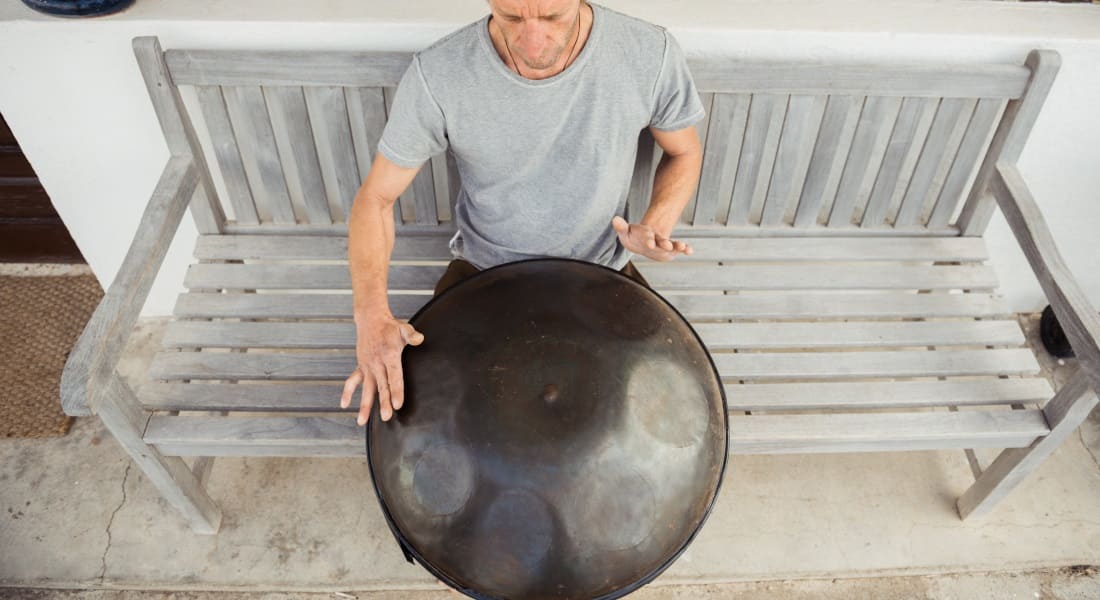
Officially, the Hang—the direct predecessor of today’s handpan—was invented by Felix Rohner and Sabina Schärer in 2000 in Bern, Switzerland, specifically in the workshops of PANArt Steelpan Manufaktur SA. However, this instrument didn’t come together in just a few months. It took shape in the creators’ minds over several years and went through many prototypes before being finalized in the form we know today.
It all began in 1976 when Felix Rohner, then a teacher, discovered the steel drum, also known as the steelpan or simply the pan, a percussion instrument made entirely of metal that originated in the Caribbean, specifically Trinidad and Tobago. This instrument has a round, convex shape with facets that are hammered to produce different musical notes. The steel drum already bears a strong resemblance to the handpan, which would appear much later. Watch a video presentation of the steel drum below:
After this discovery, Felix Rohner and several partners founded PANArt Steelpan Manufaktur SA on May 12, 1993. The company is entirely dedicated to crafting and tuning steel drums. In 1994, PANArt Steelpan Manufaktur SA began producing steel drums with a new material, nitrogen-enriched steel, which would later be called nitrided steel. This material would later be used in the manufacture of the Hang and the handpan and would be called Pang by PANArt Steelpan Manufaktur SA from 1996 onwards. In November 1999, percussionist Reto Weber visited Felix Rohner and Sabina Schärer, his partner who had joined the company in 1995, to have his steel drum tuned, as it was playing out of tune. During this visit, Reto Weber introduced them to an Indian instrument called the ghatam. It is a terracotta pot about 20–24 in (50–60 cm) in diameter that is struck with the hands to produce sound. You can see a ghatam in action in the video below:
Reto Weber then suggested that it would be interesting to create a kind of metal ghatam that would be much stronger and lighter than a clay instrument. The couple liked the idea and began designing prototypes of instruments made from Pang. So it was Reto Weber who sparked the creation of the Hang and the handpan. They quickly discovered that the shape yielding the best acoustics was two convex shells bonded together to form a lens-like object. Inspired by instruments such as the tabla, gamelan, various drums, musical saws, tuning forks, and bells, they crafted many prototypes to enhance the sound.
Finally, they named it the Hang—a word that means “hand” but also “hill,” echoing its gentle curve. The Hang was completed in 2000 and introduced to the public at the Frankfurt Music Fair in Germany in 2001. A distribution network was then set up to sell the instrument to those who wanted one. At that time, a Hang sold for around €300, which sounds almost unreal today. The first generations of Hang, manufactured between 2000 and 2005, were offered in no fewer than 45 different scales. By 2002, more than 1,000 had been sold worldwide, mainly by shipping instruments directly from Switzerland through the postal service or via retailers.
This is how the Hang was born. But now let’s see how this percussion instrument’s name evolved from Hang to handpan.
How did the Hang become the handpan?
In 2003, seeing the popularity of their new instrument increase, PANArt Steelpan Manufaktur SA was renamed PANArt Hangbau SA, revealing a change in direction for the company as the Hang became its main market. Through the internet, and in particular the YouTube platform, which was launched in 2005, a real craze developed around the Hang. So much so that between the end of 2005 and the beginning of 2006, demand was so high that PANArt Hangbau SA could no longer supply enough instruments to meet it. The company then made the surprising decision to cut ties with all of its retailers. Felix Rohner and Sabina Schärer justified this decision by stating that they were under too much pressure to manufacture the Hang in large numbers. They preferred to build far fewer instruments, but to focus on the quality and precision of each one. In addition, there were several breaks in the production of the Hang starting in 2006 so that PANArt Hangbau SA could devote itself to improving the Hang through research and development.
Since then, only PANArt Hangbau SA has been able to sell Hang instruments, and buyers have had to travel to Switzerland. In addition, buyers must provide a letter explaining their motivation and sign a legally binding clause stating that they will not resell their instrument for profit under any circumstances. This step was taken because some buyers were reselling their Hangs for ten times the original price. These restrictions, combined with the limited production of the Hang, have led to a long waiting list, with buyers typically waiting several months for an instrument.
Other manufacturers then began designing replicas of the Hang to meet this unfulfilled demand. These replicas had different names, such as Bill Brown’s “Caisa” in Germany, “Bells” in Spain, and “Halo” in the United States by Pantheon Steel. These instruments had a slightly different shape from the Hang, but were clearly inspired by it in their manufacturing process. Watch the video presentation of the Caisa by Bill Brown in 2007:
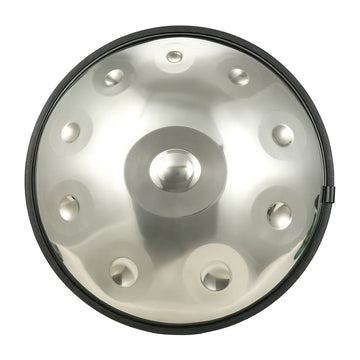
To encompass all these replicas, Kyle Cox, another manufacturer, introduced the term “handpan” in 2007. Most musicians now use this term. As a result, the name handpan is now more widely used than Hang. Meanwhile, PANArt Hangbau SA sought to protect its creation by patenting both the Hang and the Pang, its nitrided steel alloy. However, it withdrew from the market, and in 2013 PANArt Hangbau SA announced the end of the manufacture and sale of its Hang, leaving the field open to all handpan makers.
This decision may seem surprising, yet the company wished to focus on crafting new instruments inspired by the Hang. Today it offers models such as the Hang Balu, the Hang Gubal, and the Hang Urgu.
How popular is the handpan today?
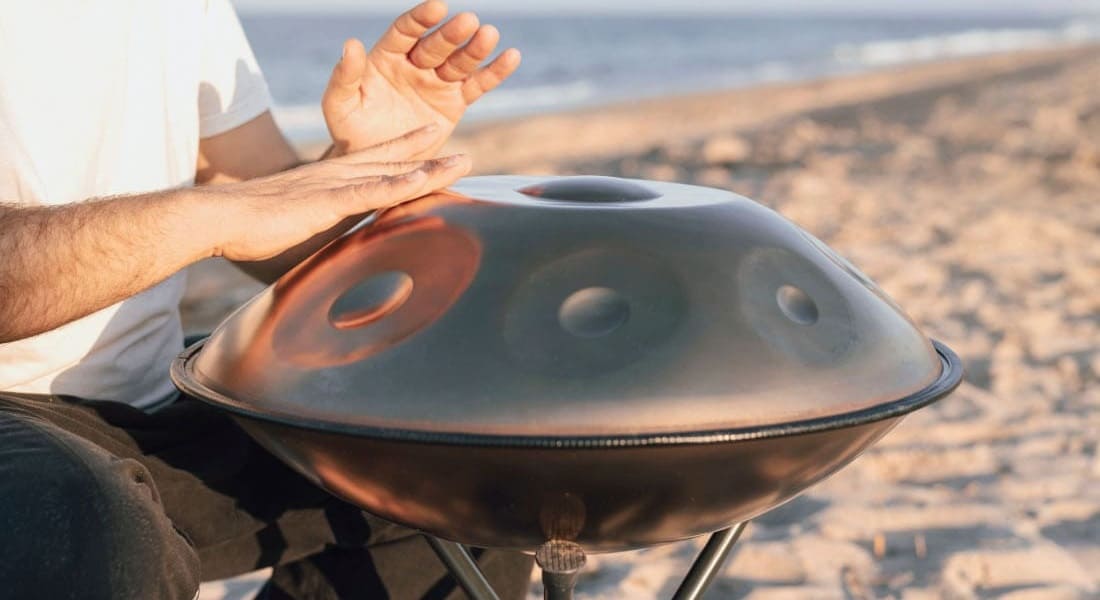
Since PANArt stopped selling the Hang and social media took off, the handpan has become more and more popular around the world. This is mainly because of its unique sound and the fact that you don’t need to know music theory to enjoy playing it. Today, there are more than 400 manufacturers around the world who regularly produce handpans. However, there is a risk that this popularity could be jeopardized.
Although PANArt Hangbau SA has not designed any new Hang instruments since 2013, the fact that hundreds of manufacturers are imitating its iconic instrument is not really to their liking. As a result, in 2020, the Swiss company took legal action to ban the manufacture of handpans worldwide, asserting its intellectual property rights. As I write these lines in 2024, these proceedings are still ongoing, and they clearly put all handpan manufacturers and sellers in a complicated situation. This is especially true since PANArt Hangbau SA frequently sends letters informing manufacturers that legal proceedings will be brought against them as soon as the courts have validated their position, giving them formal notice to cease their activities. I go into more detail about these legal issues in my article explaining the difference between the Hang and the handpan.
In parallel with this, on July 1, 2024, Felix Rohner and Sabina Schärer’s company posted a video presentation of the Hang on its YouTube channel. This video includes a link to the official PANArt Hangbau SA website, which announces that the Hang is once again in production and priced at CHF 2,500, or around €2,700. Purchase is not open to the general public—interested buyers must contact the company directly to learn how to acquire one. Here is the video in question:
Does the release of this video, after more than 10 years of silence about the Hang, have anything to do with the legal battle over copyright? Personally, I think so, even though Felix Rohner and Sabina Schärer have not yet commented on the matter. In conclusion, the future of the handpan remains uncertain, even though its popularity continues to grow.
Discover the handpan with a high-quality instrument
Cleverly combining several musical instruments from different parts of the world, the origins of the handpan are rich and complex. But thanks to all the information contained in this article, you now have a perfect overview and understanding of all the historical elements that led to the creation of the Hang, and then the handpan.
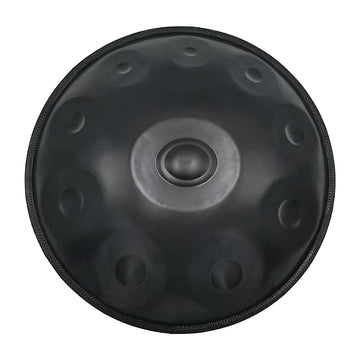
Nevertheless, finding a good-quality handpan online is no easy task. Many manufacturers try to pass off low-end models as instruments intended for virtuosos. That’s why I recommend the Instruments du Monde store, which sells dozens of high-quality handpans. By shopping at this address, you can be sure of getting a good deal. Like this 10-note handpan, which is very similar to the original Hang from PANArt Hangbau SA.
Discover this magical instrument now by clicking on the link below:
If you already own a handpan, it is important to take care of your instrument to prevent rust from forming on its metal surface. To this end, read my article on handpan maintenance. You will learn all the techniques for keeping your handpan in mint condition, as well as how to remove rust spots.


