



Written by Ambre Montespan - Updated on May 8, 2026
Table of contents:
Are you eager to learn how to play a melody on your kalimba but can’t find any sheet music or tablature that matches your instrument? Would you like to create the sheet music yourself, but don’t have any particular background in music? How can you convert or transpose sheet music for your kalimba?
Having personally converted and transposed dozens of songs specifically for the thumb piano, I’m in a great position to help you through the process and walk you through it step by step.
The simplest and most accessible method for converting or transposing sheet music for the kalimba is to find the piano sheet music for the song you want, then rewrite each note while adapting it to what your thumb piano can actually play.
By reading this guide in its entirety, you will learn:
- The difference between converting and transposing sheet music
- How to arrange sheet music or tablature for the kalimba
- How to transpose sheet music for a thumb piano
You’ll have everything you need to play any melody you want on your kalimba. No need to wait, maybe indefinitely, for someone else to adapt your favorite music—you can do it yourself and share your creations with kalimba communities all over the internet.
Let’s start learning how to convert or transpose sheet music for the kalimba.

What is the difference between converting and transposing sheet music for the kalimba?
Converting or arranging sheet music is not the same thing as transposing it. It’s important to clarify this difference so you don’t mix the two up in the rest of this article.
Converting or arranging a score means adapting it to a specific instrument, in this case the kalimba. The thumb piano is a relatively simple instrument, generally consisting of 17 steel tines, and therefore 17 musical notes, so it can never match the rich sound of a classical piano, which has 88 keys. The same is true of the guitar and violin, which have a much higher range—the span of sounds the instrument can produce—than a kalimba. So, when converting or arranging a piece, the challenge is to adapt it to the simplicity of the thumb piano while losing as little musical richness as possible.
Transposing a score is a slightly different process that involves changing the key of a melody. Usually, if you have a kalimba tuned to C major, the sheet music is already written for the instrument you want to play it on. However, if you have, for example, a kalimba tuned to B major and you want to play a thumb piano piece written for C major, it won’t work as-is. You’ll need to shift the notes to match your instrument’s key. That’s the purpose of transposition.
Now that you understand the difference between these two processes, let’s take a closer look at how to convert a score for the kalimba.

How do you arrange a score for the thumb piano?
To arrange or convert a score for the kalimba, start by locating the original score you’ll use as a basis, then familiarize yourself with a few essential music-theory concepts, and finally, move ahead with the conversion itself.
Can the kalimba play all songs?
In theory, yes—a kalimba has enough notes to play most well-known songs. The only condition is that the notes you need stay within its range. Also, keep in mind that you won’t get the same level of detail as a full-size piano, and you’ll inevitably lose some richness when you turn a piano score into a kalimba arrangement.
How can you find the sheet music you want?
First, if you’re converting or arranging a score for your kalimba, it’s highly recommended to start with a “base”—in this case, the score of the song you want to play, but already written for another instrument. This step isn’t mandatory, since you can absolutely convert a piece by ear. However, that requires solid music knowledge, strong listening skills, and, ideally, perfect pitch. Realistically, that’s not most people. The easiest option is to start from existing sheet music.
The most effective way to find this basic sheet music is to look for piano sheet music. The piano is the instrument that translates most naturally to kalimba, which makes the conversion easier later on. To find it, you can visit MuseScore, which offers free piano sheet music, or simply do a Google search. If you can’t find anything, your last option is to convert it by ear.
Once you have the desired sheet music, the actual arrangement work can begin. But first, you’ll need to know a few essential musical symbols from music theory.

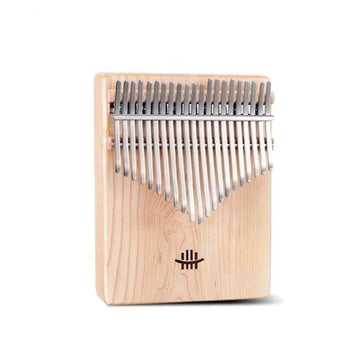
Some essential music theory concepts for converting sheet music
To help you understand how to convert sheet music for any instrument into sheet music for the kalimba, it’s useful to cover a few simple music-theory basics. Don’t worry: we’ll go over everything you need in under 5 minutes, and you don’t need any prior musical knowledge. Let’s use a piano score as an example, which you can see below:
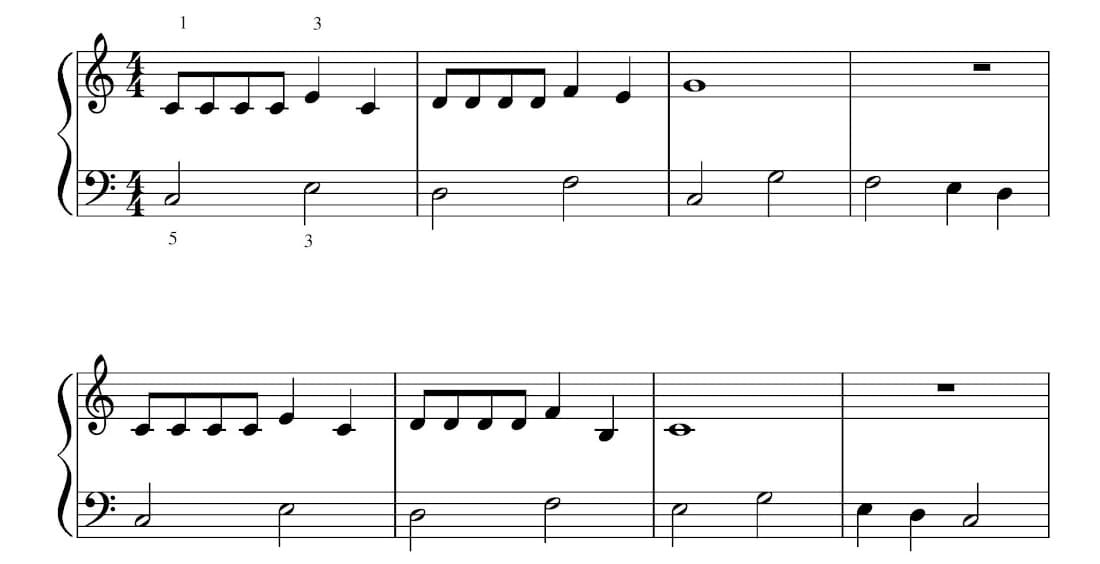
Sheet music is read from top to bottom and from left to right. You’ll notice several parallel horizontal lines separated into blocks by a large bracket on the left. In this example, within each bracket you can see two groups of five horizontal lines. This group of five lines is called a staff. When two staves are linked by the same bracket, it means they should be played at the same time.
At the beginning of each staff, you’ll notice a specific musical symbol called a clef. The clef tells you the pitch of the notes on the staff. To help you, here is a diagram showing the notes in music according to the clef and their location on the staff.
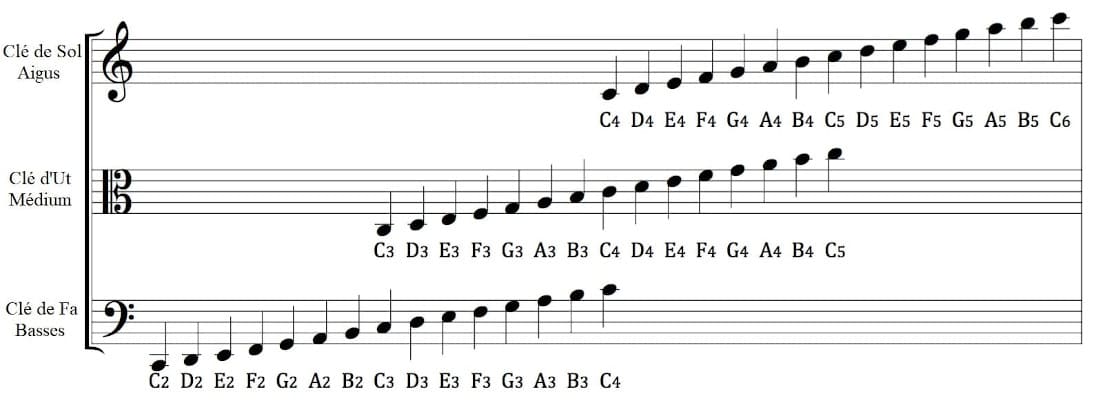
Below each note, you’ll find a letter and a number. The letter corresponds to the musical note in English musical notation, and the number indicates the octave. The lower the octave, the lower the note. To convert the letters into solfège musical notation, use the following table:
| solfège | do | ré | mi | fa | sol | la | si |
| English notation | C | D | E | F | G | A | B |
So, C4 corresponds to do, but in the 3rd octave in French solfège numbering (so it’s written do3). Likewise, E5 corresponds to mi, written mi4.
You may also spot other numbers at the start of the first staff line—in our example, the 4. This is part of the time signature. This detail isn’t essential for converting your score, so feel free to set it aside for now. You’ll also notice vertical lines spaced regularly across the staff. These mark measures, which divide the music into equal beats. Again, this isn’t crucial for conversion, so don’t worry about it yet.
Let’s now look at how to adapt all this to a kalimba.

How do you convert a score for another instrument into a score for kalimba?
From this point on, the conversion process is fairly simple. Grab a sheet of paper and write down the notes from the score, converting them into letters using the English notation system. Let’s go back to the example we discussed earlier:
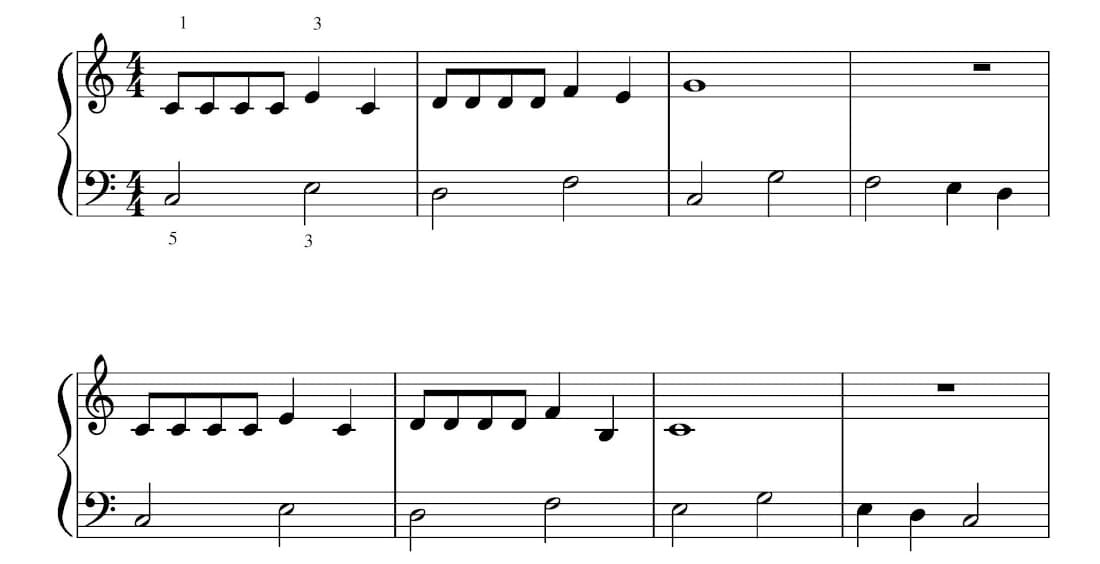
The result will be as follows:
(C4 C3) C4 C4 C4 (E4 E3) C4
(D4 D3) D4 D4 D4 (F4 F3) E4
(G4 C3) G3
F3 E3 D3
(C4 C3) C4 C4 C4 (E4 E3) C4
(D4 D3) D4 D4 D4 (F4 F3) B3
(C4 E3) G3
E3 D3 C3
The notes between the parentheses mean that they should be played at the same time.
Most kalimbas generally have 17 tines and are tuned to C major, giving you 17 musical notes ranging from C4 to E6. If you opt for a 21-tine thumb piano, you’ll enjoy four additional lower tines that extend the range from F3 to E6.
So, as you may have already noticed, some notes are simply not playable on your kalimba because they’re too low or too high. This is normal, because a piano can play many more notes than a kalimba. In this case, you can either transpose the melody (more on that later), remove the unplayable notes, or even omit the entire bass clef staff. Your melody may lose some richness, but it’s important to remember that a kalimba can’t match the full subtlety of a classical piano. Sometimes you’ll need to sacrifice certain notes to keep the piece playable.
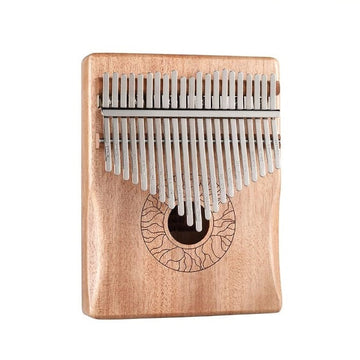
Once you’ve refined your score through transposition or by removing notes, you’ll just need to remove the octave information. On kalimba, C4 is the “base” C, so it’s simply written as "C". If it’s the same note one octave higher, C5, it will be written as "C*". For C6, it becomes "C**", and for F3, "F.".
Using our previous example, this would give us:
(C C.) C C C (E E.) C
(D D.) D D D (F F.) E
(G C.) G.
F. E. D.
(C C.) C C C (E E.) C
(D D.) D D D (F F.) B.
(C E.) G.
E. D. C.
All you have to do is play this score on your kalimba, and you’ll get the melody you converted. If you really don’t know how to read all this, I created a guide to learning how to read kalimba sheet music. You’ll be able to play any song you want accurately. Note that this is a simplified score: it doesn’t include note or rest durations, which means you’ll need to already know the general rhythm of the piece. If you want something more precise, you’ll want to use tablature, which we’ll look at next.
However, as we mentioned earlier, not all of these notes can be played on a standard 17-tine kalimba. Read on to learn how to transpose a score.

How do I play my sheet music if there are sharp or flat notes?
It’s possible that on your piano score, some notes are altered by a sharp or flat, such as C#4 or Db4. This means the pitch is raised by a half step for a sharp and lowered by a half step for a flat. So C#4 won’t sound the same as C4. So how can you adapt that sheet music to kalimba? There are several options, and we’ll go through them now.
The chromatic kalimba
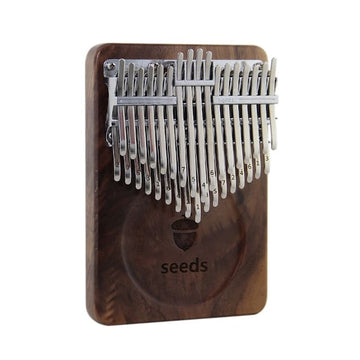
The first, and simplest, option is to get a chromatic kalimba, which has many more tines and therefore lets you play sharp and flat notes in addition to the standard notes.
This type of instrument is called chromatic because it includes notes from the chromatic scale (including notes altered with sharps or flats), unlike the vast majority of thumb pianos, which are diatonic instruments and only have the notes C, D, E, F, G, A, and B for a kalimba in C major.
Adapting the instrument to the score
The second option is to adapt your instrument by tuning it differently so that an existing note becomes the one you need. For example, in the sheet music for the theme song of the series "Game of Thrones" for thumb piano, there are no F notes to play, only F sharps. As a result, you can tune the F notes on the kalimba to F sharp.
 However, you will no longer be able to play F notes as long as you leave this tuning in place. So be sure the piece doesn’t call for any Fs. When you’re ready to switch back to playing scores with F notes, you’ll need to retune your kalimba to its original tuning. Not sure how? We’ve got you covered with a free tuning manual that shows you how to tune your kalimba exactly the way you want.
Adapting the score to the musical instrument
Finally, the third method is to replace the sharp or flat note with another note that’s more or less similar. To do this, choose one of the two closest notes according to the diagram below:
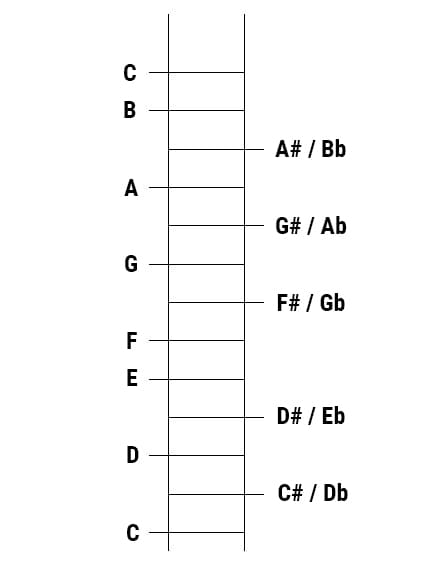
So, for a C#4, which corresponds to C#3, you can consider either C4 or D4, which correspond to C3 and D3, respectively. To know which one to choose, the easiest approach is to play the melody both ways and listen to what sounds best.
Of course, with this technique, you’ll lose some subtlety because you’ll be changing notes the composer originally intended. But if you can’t use the two previous methods, this is the only way to adapt the original piece for kalimba, unless you can transpose the sheet music, which we’ll look at now.
How do you transpose a score for finger piano?
Transposition involves changing the pitch of a melody while maintaining the intervals between the notes. This can be useful if you have a kalimba tuned to an unusual key or if you want to play a melody whose notes are generally too low or too high.
If we take the example we discussed earlier when converting sheet music, we obtained the following result:
(C C.) C C C (E E.) C
(D D.) D D D (F F.) E
(G C.) G.
F. E. D.
(C C.) C C C (E E.) C
(D D.) D D D (F F.) B.
(C E.) G.
E. D. C.
However, certain notes are not accessible on a classic 17- or 21-tine kalimba, such as "C.", which corresponds to C3. In that case, it’s wise to transpose the score by raising all the notes by one octave. The result will be as follows:
(C* C) C* C* C* (E* E) C*
(D* D) D* D* D* (F* F) E*
(G* C) G
F E D
(C* C) C* C* C* (E* E) C*
(D* D) D* D* D* (F* F) B
(C* E) G
E D C
The melody is then preserved in a higher version than the original, but it will now be possible to play it on a kalimba because all the notes are present on the steel tines of the instrument.
You can also transpose by raising the music by just one whole step. In that case, every note in the score moves up by one whole step. Just keep in mind that this can introduce sharps or flats, which can be tricky if you don’t have a chromatic kalimba.

How do you create tablature for the mbira?
Tablatures are scores developed specifically for the kalimba, and they’re more precise than simplified versions that only use numbers or letters.
To create tablature, simply transfer the note durations and time signatures to a blank kalimba tablature sheet or use free software such as Kalimba Tabs.
Develop a richer playing style with a chromatic kalimba
Knowing how to convert and transpose a score specifically for the thumb piano will open up endless possibilities as you learn this instrument. It’s also a great way to share your arrangements or help new players who don’t yet have the experience to convert or transpose music themselves. Now that you’re familiar with the different techniques, you can write kalimba sheet music for any song you want, with no limits on your creativity.
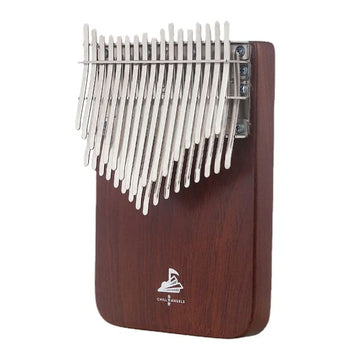
However, you may occasionally encounter melodies that require a thumb piano with more tines in order to play notes altered by sharps and flats. To address this issue, the Instruments du Monde store offers a chromatic kalimba with 34 tines. With this instrument, you can play richer songs by including sharps and flats.
Treat yourself to this chromatic kalimba today!
Converting and transposing sheet music will no longer be a mystery to you, but did you know that this instrument can be made with either a diatonic or chromatic scale? To find out which musical scale suits you best, check out this comparison, which will tell you everything you need to know about your kalimba’s scale. For a more general article, take a look at our comprehensive guide to this musical instrument.


