



Written by Ambre Montespan on Jun 19, 2023 · Updated on Oct 15, 2026

Table of contents:
Thinking about buying an ocarina soon? If you’ve been researching, you’ve probably noticed there are models with different numbers of holes. So how many do you actually need for your future wind instrument? Which hole count should you choose?
I’ve been playing ocarina myself for over 10 years, and I had the exact same question when I was starting out. So I’m going to share my experience with this type of flute to help you pick the right instrument.
Twelve-hole ocarinas are best suited for beginners because, surprisingly, they’re easier to learn than 6- or 8-hole models. Multi-chamber ocarinas, on the other hand, are best saved for advanced players.
By the end of this article, you’ll have a clear overview of:
- 4-hole ocarinas
- 6- and 8-hole ocarinas
- 10- and 12-hole ocarinas
- Double, triple, and quadruple ocarinas
With this information, you’ll know exactly how many holes to look for, depending on what you want from the instrument and your musical background.
Let’s start by exploring the different ocarinas in order of increasing hole count.

Ocarinas with 4 holes
Ocarinas with 4 holes are the smallest on the market and relatively rare. They can play 8 different notes, often within a single octave, which limits you to very simple melodies. While there are many variations of this type of ocarina, the 4 holes are usually placed on the top of the instrument. The player typically uses the index and middle fingers of both hands. Of course, when counting “holes,” you don’t include the blowhole (where you breathe into the instrument) or the sound opening/voicing where the ocarina’s whistle is formed.
Four-hole ocarinas are rare mostly because adding two extra holes on the underside, bringing the total to six, expands the musical possibilities without meaningfully increasing either the price or the size of the ocarina. That’s why most musicians opt for a 6-hole ocarina—and I agree: if you’re seeking a compact, portable instrument, the 6-hole model is a smarter choice. Unless you really love the look of a 4-hole ocarina, this type is generally best avoided, except perhaps for very young children in an early music education context.
Instruments with 6 or 8 holes
As mentioned above, 6-hole ocarinas generally have 4 holes on the top and 2 on the bottom, which are covered with the thumbs. In the case of an 8-hole model, the two additional holes are also on top, alongside the other 4, and are played with the ring fingers. Much more versatile than 4-hole models, 6-hole ocarinas can play 10 natural notes and 7 altered notes (sharps or flats), bringing the total to 17 notes. 8-hole models can play up to 11 natural notes plus the same 7 altered notes, for a total of 18 notes.
Much more popular, 6-hole ocarinas were mainly developed by English musician and instrument maker John Taylor in the 1960s. He invented a fingering system that allowed 17 different notes to be played with only 6 holes. However, there’s a major drawback to John Taylor’s ocarina design: unlike a classic 12-hole transverse ocarina, the player must memorize the fingerings for every single note. It’s also worth noting that some low-end models sold in South America, for example, may have 6 or 8 holes but aren’t tuned according to John Taylor’s method, so they can’t play nearly as many notes.
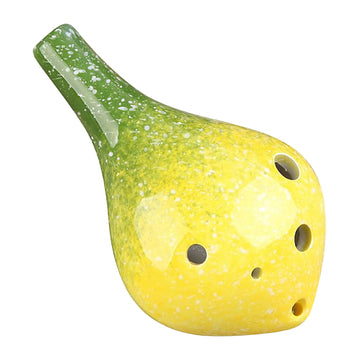
As a result, and somewhat paradoxically, 6- and 8-hole ocarinas are harder to master than 10- and 12-hole transverse models. Their main advantage is size: they’re smaller, so they can easily be worn as a pendant and slipped into almost any bag. They also tend to have a more egg-shaped design, which some musicians prefer. However, if ease of learning is your priority, you’ll be better off choosing a 10- or 12-hole model, which we’ll cover next.
Are 10- or 12-hole ocarinas worth considering?
12-hole transverse ocarinas are by far the most common and popular on the market. Originally invented by Giuseppe Donati in Italy in 1853, the 10-hole transverse ocarina later evolved in Japan in the late 1920s when an instrument maker had the idea of adding two extra holes to bring the total to 12. An ocarina with this many holes can play 13 natural notes and 9 altered notes, for a total of 22 notes, which corresponds to a range of roughly an octave and a half. The 10-hole transverse ocarina, on the other hand, has the same musical capabilities as the 8-hole ocarina mentioned in the previous section.
Compared to John Taylor’s model, the transverse ocarina is larger, has more holes, and often costs a bit more. But it comes with one decisive advantage: a far more intuitive fingering system. Where the John Taylor ocarina forces you to learn finger combinations that don’t always feel logical at first, the transverse model is straightforward: with all holes covered, you lift fingers one by one to go up in pitch.
The transverse ocarina puts comfort and ease of learning first. Even if it isn’t the most “efficient” design in terms of holes versus total notes, it’s an excellent choice for beginners. That’s why the 12-hole ocarina is the main model that I personally recommend for all new players who want to get started with this wind instrument.

Multi-chamber models with numerous cavities
Beyond 12 holes, ocarinas are no longer named by their hole count, but by the number of chambers they have. That’s why there are double, triple, and quadruple ocarinas, with 2, 3, and 4 chambers, respectively. Think of each extra chamber as an additional mini ocarina attached to the main body, which is often a 12-hole model. As a result, multi-chamber ocarinas have as many mouthpieces and sound openings as they have chambers.
Mastering this type of instrument takes time and experience. The player has to switch between chambers, both in terms of breath control and fingering. As a result, a multi-chamber ocarina is best suited for musicians who already feel comfortable on a 12-hole transverse model and want to expand what they can play—for example, reaching notes across two octaves.
Choose the right ocarina for your situation
The number of holes is a crucial factor for anyone looking to buy an ocarina. Still, be careful: as we’ve seen, hole count and difficulty don’t necessarily go hand in hand. That said, with what you’ve learned in this article, you now know how many holes you should be aiming for.
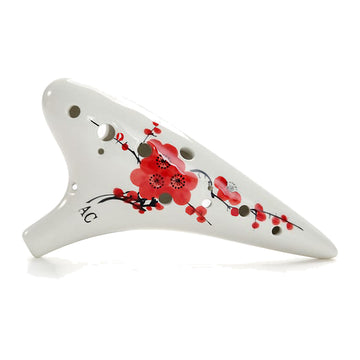
One last thing: ocarinas aren’t the kind of instrument you’ll find everywhere in standard music stores, so it can be tricky to track down a model that truly matches every player’s needs, from beginners to advanced musicians. That’s exactly why the Instruments du Monde online store is so helpful—it offers more than 50 different ocarinas to suit every level. For example, this handcrafted 12-hole model is a perfect pick for beginners.
Start your ocarina journey with this excellent model by clicking the image below:
Curious about what ocarinas really cost? How much does an ocarina cost? We break it all down in an article dedicated entirely to that question.


