



Written by Ambre Montespan on Apr 17, 2023 · Updated on Oct 15, 2026

Table of contents:
Have you just discovered a small wind instrument called the ocarina? Do you already own one and wonder about its origins? Where does this little object that looks a lot like a flute but has a very distinctive shape actually come from?
I’ve been playing the ocarina for over 10 years, and I asked myself the very same questions long ago. After digging deep into its history, I can sum up the most important facts to satisfy your curiosity and help you see this instrument in a whole new light.
The ocarina was officially invented in 1853 in Italy by Giuseppe Donati. However, he was largely inspired by other, much older instruments from Asia, Africa, and Mesoamerica, some of which date back 12,000 years.
After reading this article, you will know:
- Which instruments led to the creation of the ocarina
- The stages that led to the advent of the modern version of this wind instrument
As a result, you’ll learn everything there is to know about the origins of the ocarina. Soon you’ll be able to explain the real story behind this small musical instrument to anyone who’s curious.
Now, let’s dive into the fascinating story of the birth of the ocarina.
What musical instruments inspired the ocarina?
Interestingly, several cultures, completely independently, came up with the idea of creating a musical instrument that resembles a primitive ocarina. Archaeological evidence of globular flutes has been found in Mesoamerica, Asia, Africa, and Europe.

Prehistoric African remains of this wind instrument
A 30,000-year-old clay whistle that works on the same principle as an ocarina was discovered in Central Africa. However, it can’t really be considered a musical instrument. On the other hand, globular flutes capable of playing a few notes have been found on this continent, particularly in Egypt, the oldest of which were made 12,000 years ago. This strongly suggests that the ocarina was influenced by instruments created at the dawn of humanity. Archaeological excavations in Africa have revealed little information, except that the instrument could also be made of stone, bone, or bark.
Traces of ancient ocarinas in Mesoamerica
You may have heard that the Inca or Maya invented an instrument similar to the ocarina—round in shape, with only four holes, and capable of playing five notes. The reality is more complex. Archaeological excavations and research conducted by Curt Sachs, a German ethnomusicologist who helped found organology (the study of musical instruments), suggest that the Chibchas were more likely to be the inventors. The Chibchas were a people who lived in what is now Colombia between 500 BCE and 1536. Remains found at their ancient sites have revealed the presence of globular flutes made of clay and even gold in some graves. It should be noted that wooden examples may also have existed, but they likely wouldn’t have survived the damage caused by time.
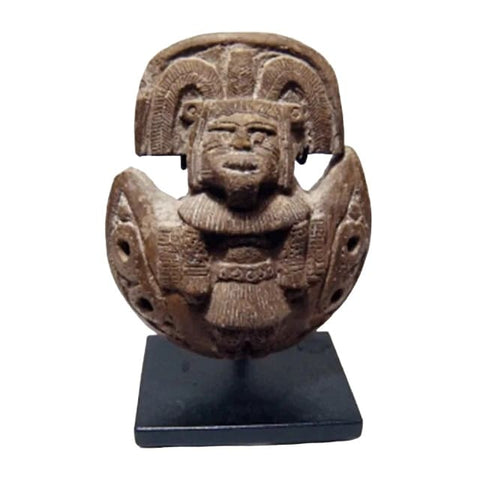
In contrast, neighboring peoples used mostly simple whistles that could play just one or two notes. So it looks like the Chibchas developed a basic ocarina first, and the idea later spread to the Maya, Inca, and Aztec. Over time, the Chibcha model evolved, and more complex instruments with eight holes were discovered in Peru before also becoming popular throughout almost all of South America. The instrument then took on an egg-shaped, or ovoid, form. Some examples intended for the wealthiest classes could be highly detailed and crafted into specific shapes, as in the photograph below, where a feather-crowned deity has been sculpted from clay.
Ancient globular flutes found in Europe
Starting in 1966, archaeological excavations in the city of Runik in the former Kosovo led to an astonishing discovery: a small 3.15-inch-long (8 cm) terracotta wind instrument with a mouthpiece and four other holes dating from the Neolithic period. This small object, which has been named the Runik Ocarina, is over 8,000 years old and shows that the peoples of Europe also had some knowledge of musical instruments. Subsequently, another ocarina-type instrument was discovered in Romania at the Liubcova Orniţa site. This one dates back over 5,000 years.
However, the ocarina quickly disappeared from Europe, and it was not until the 15th century, in what is now Germany, that the gemshorn was invented. This is a type of flute made from a hollowed-out and pierced chamois horn. The gemshorn has a mouthpiece like the ocarina and is played in a similar way. Watch the video below to discover a contemporary version of this magnificent instrument.
The ocarina in ancient Asian cultures
Traces of small ocarina-like instruments have been found in China, Japan, Korea, and a few other Asian countries. For example, bird-shaped examples have been discovered in India. It’s also worth mentioning the xun, one of the oldest Chinese musical instruments, which has been used for over 7,000 years. The xun is very similar to the ocarina, except that an ocarina uses a mouthpiece, while a xun is played by blowing across an opening. Given the closeness between the xun and the remains of ancient ocarinas found in Asia, it’s highly likely that these two instruments influenced each other. You can watch a video of the xun below:
How was the modern ocarina created? Where does it come from?
It wasn’t until the conquest of present-day Mexico by the Spaniard Hernán Cortés (1519-1521) that a new stage in the development of the modern ocarina was reached. At the end of this conquest, the Spanish brought back everything they considered strange and unusual from their expeditions, including Aztec and Maya musicians who possessed 8-hole ocarinas. These musicians performed before King Charles V, who found them particularly interesting.
At the monarch’s urging, the musicians performed throughout Europe, and legend has it that an anonymous baker in Rome, impressed by the acoustics of this new type of flute, decided to make his own. Bakers at the time were accustomed to crafting small terracotta objects that they placed in their ovens along with the bread. Soon other bakers were crafting these small flutes as well, and they spread throughout Italy, remaining popular for over 300 years. During this time, this simple version of the ocarina was seen more as a souvenir or a toy for children than a musical instrument, and it still retained its egg-shaped form originating in South America.
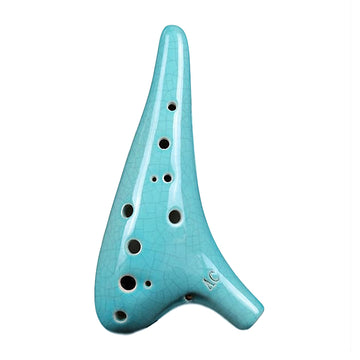
It wasn’t until 1853 that a 17-year-old Italian brickmaker named Giuseppe Donati made the first real ocarina. The first notable change was in the shape of the instrument, which was no longer round but vaguely resembled a goose’s head. It was thanks to this particular shape that the name ocarina was coined. It is derived from the word “ucarèina” or “ucarènna,” which means “little goose” in a Bolognese dialect. In addition, the instrument now has 10 holes, ingeniously arranged so that the musician uses all of their fingers when playing it. The ocarina is now considered a true musical instrument capable of playing a sufficient number of notes. In 1864, Giuseppe Donati formed the “Gruppo Ocarinistico Budriese” or “Budrio Ocarina Group” in his hometown with the aim of promoting this instrument around the world. This group has been performing for over 150 years and you can watch one of their recent performances in the video below:
How has this wind instrument evolved since its creation by Giuseppe Donati?
The ocarina quickly crossed Italian borders and spread throughout Europe, but it was in the United States, beginning in the 20th century, that it really became part of the country’s musical culture. This instrument quickly won people over thanks to its portability and gentle tone. During World War I and World War II, American soldiers played it on many occasions. Then, starting in the 1950s, children were taught to play the ocarina in public schools. It was nicknamed “sweet potato” because of its resemblance to the tuber and the softness of the sound it produces.
In Asia, the ocarina also carved out a place for itself among other instruments. In 1928, Japanese sculptor Takashi Aketagawa improved on Giuseppe Donati’s model by adding two smaller holes to the top of the ocarina. The instrument now had 12 holes and a wider range, extending lower, and this is the model that is still used today. However, this model only became widely known in 1986, when one of the world’s best ocarina players, the Japanese Nomura Sojiro, composed a melody for the documentary “The Great Yellow River,” which was very successful. You can hear this piece in the video below:
Even so, the ocarina gradually slipped into obscurity. Although double- and triple-chamber models were developed, letting players reach a significant number of notes across several octaves, the classic recorder was often favored because it was more durable, less expensive, and offered an even wider range.
However, a video game released in 1998 on Nintendo 64 breathed new life into the instrument. The game, Zelda: Ocarina of Time, allows players to take on the role of Link, a hero who learns to play several ocarina tunes in order to save his princess. The international success of this video game has greatly contributed, and continues to contribute, to the popularity of this instrument. Today, you can hear the ocarina at concerts or in certain films.
Get your hands on this musical object with Italian origins
Although the ocarina has a name with undeniable Italian origins, this ceramic musical instrument actually originated in Mesoamerica. It later evolved in Japan to reach its most popular form, the 12-hole model. Now you know the whole story behind this little instrument, which is sure to charm you with its soothing sounds.
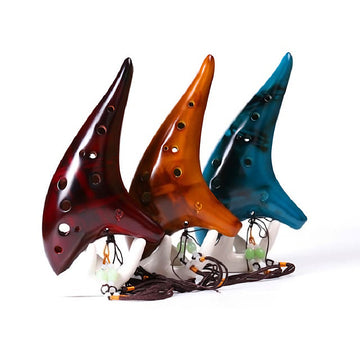
However, ocarinas are still not easy to find in most music stores. Getting your hands on one—especially if you have specific requirements for design or acoustic capabilities—can be quite difficult. That’s why it’s best to shop at the Instruments du Monde store, which offers more than 50 different models of ocarinas to satisfy every musician. For example, you can discover this magnificent 12-hole model available in three colors.
Get your ocarina now by clicking on the image below:
Did you know that it is possible to play different notes with your instrument? Find out how by reading our article on tuning the ocarina. This is also an essential step if you want to make your own ocarina in order to play the right notes.


