



Written by Ambre Montespan on Apr 10, 2023 · Updated on Oct 15, 2026

Table of contents:
Have you recently heard about a fascinating musical instrument called a Tibetan singing bowl? Do you already own one and want to learn more about it? How does a singing bowl work? How does it produce sound?
With a deep passion for Tibetan singing bowls for more than 10 years, I’ve dug into numerous international scientific studies to understand exactly how this percussion instrument works. In this article, I’ll break it down clearly so you can fully understand what’s happening when your bowl “sings.”
A Tibetan singing bowl works through vibrations created when the player strikes or rubs the metal. Those vibrations travel through the bowl’s bell-like shape, which acts as a resonator and produces the instrument’s signature tone.
Reading this short article will tell you:
- How a singing bowl works
- What studies have analyzed the behavior of Tibetan bowls
This Asian musical instrument will no longer hold any secrets for you, and you will understand exactly how it is used to generate beautiful, harmonious, and soothing sounds.
Let’s take a look at how a Tibetan bowl works.
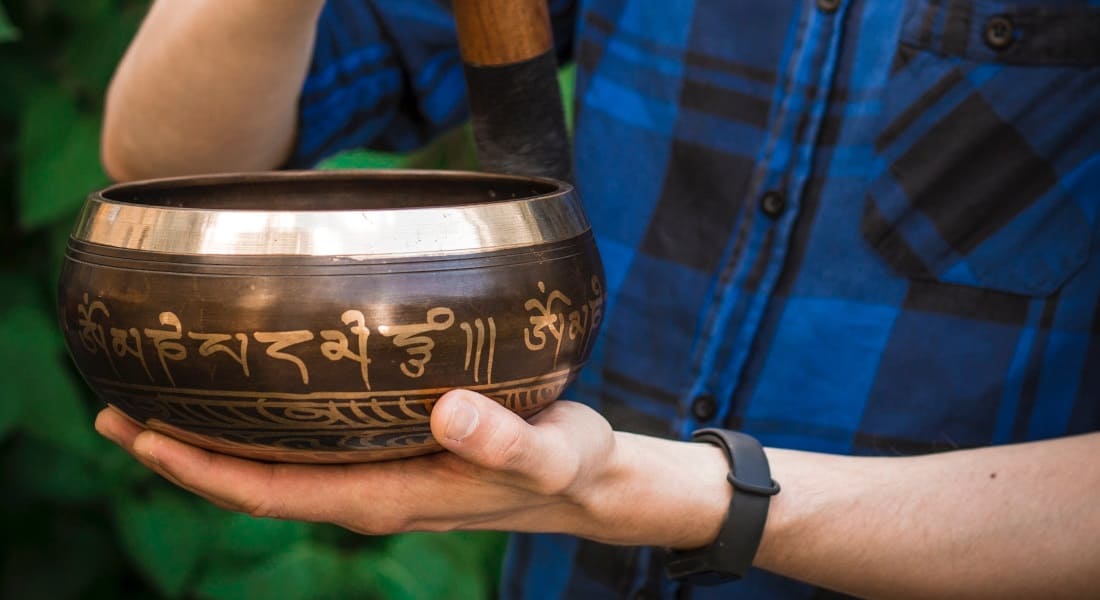
How does a Tibetan singing bowl produce sound?
Like all other musical instruments, Tibetan bowls create sound through vibrations that travel through the air. Specifically, these vibrations are caused either when the musician strikes the singing bowl or when they rub it with a stick or mallet. The entire instrument vibrates as a result, and you can feel it clearly when the bowl rests in your hand.
The note produced in this way by the Tibetan bowl depends on its size, weight, wall thickness, composition, and shape. This is why it is very difficult for artisans to forge a singing bowl with a specific musical note in mind, as there are so many parameters to take into account when hammering by hand. By contrast, with molded quartz crystal bowls, manufacturers can achieve very precise notes at the desired frequencies.
While striking a Tibetan bowl has not been widely studied scientifically—the physics involved is simple and well understood—the same is not true when a musician rubs the bowl to make it sing. In fact, when the stick is rotated around the rim of the singing bowl, the instrument does not produce a single tone, as one might expect. If you have ever tried this experiment, you will have noticed that two notes are played alternately. This phenomenon stops as soon as the player stops rubbing the Tibetan bowl. You can hear this phenomenon in the video below:
A 2006 Portuguese study entitled “The Dynamics of Tibetan Singing Bowls” examined this question. Professors Inácio and Antunes refer to this phenomenon of alternating sound as the beating effect. As the stick rotates around the outer wall of the singing bowl, friction keeps the instrument vibrating, producing continuous sound. But where does this beating effect come from? In fact, the study showed that it occurs because Tibetan bowls are never perfectly round or symmetrical. It is therefore the slight manufacturing imperfections that give this instrument its unique character in terms of acoustics.
Finally, to explore the functioning of Tibetan singing bowls in greater depth, the Institute of Physics in London published a 2011 study on how this Asian instrument behaves when water is placed inside it. Because water is harder to move than air, the vibration frequency slows down, and so does the note the bowl produces. Thus, by placing a liquid such as water in a singing bowl, the sound it produces becomes lower. But it also appears that the water tends to crackle, and even that droplets are ejected from the bowl. This phenomenon, which has also been studied, is caused by vibrations that very slightly deform the instrument, making it oval for a brief moment. Because of this deformation, increasingly larger waves are produced, which eventually collide with each other to create these famous droplets. You can observe this phenomenon in the video below:
Choose a Tibetan bowl that works perfectly
Although the Tibetan bowl appears to be a rather simple, even simplistic, musical instrument, its actual mode of operation, which is quite complex, has been the subject of scientific research to determine all its physical aspects. Now, thanks to the information you have just read, you too know how the singing bowl works.
However, not all Tibetan singing bowls are able to sing properly. This is mainly because their shape or the composition of their metal alloy is of poor quality. To avoid these issues, the Instruments du Monde store offers a wide range of Tibetan bowls, selected from among the finest examples, so you can confidently choose a truly high-quality model—like this beautifully crafted seven-metal singing bowl.
Discover this fabulous singing bowl now by clicking on the image below:

Are you a practitioner of Islam, Judaism, or Christianity? Are you wondering whether you’re allowed to use a singing bowl? If so, read my article on the compatibility of Tibetan bowls and religion. You’ll find out whether using one aligns with your faith or tradition. To learn even more about this percussion instrument, browse this other article that will teach you everything you need to know about Tibetan singing bowls. It’s a wealth of information available to you completely free of charge.


