



Written by Ambre Montespan - Updated on May 8, 2026
Table of contents:
Do you already own a Tibetan singing bowl or are you thinking about getting one soon? Have you noticed the many symbols engraved on these spiritual instruments? What does each one mean? And do these symbols influence how you use your singing bowl?
With over ten years of hands-on experience with Tibetan bowls, I’ve had the privilege of discovering and appreciating a wide variety of symbols and engravings and maker’s marks found on these unique instruments. Thanks to my in-depth research on the subject, I can help you understand their deeper meanings.
Several dozen symbols can be found on Tibetan singing bowls. Whether they’re mantras, the Eight Auspicious Symbols, the double dorje, the lotus, or the endless knot, each motif carries its own spiritual meaning.
As you read through this article, you will discover:
- The different symbols engraved on Tibetan bowls
- Their meanings and what they can bring you when choosing such an instrument
This knowledge will help you better understand the symbolism of your singing bowl and give you the information you need about the various markings so you can make an informed choice when purchasing one.
Let’s explore together the richness of the symbols engraved on Tibetan bowls and maybe even find the one that will guide you gently on the path to relaxation and inner peace.
The mantra Om Mani Padme Hum engraved on Tibetan bowls
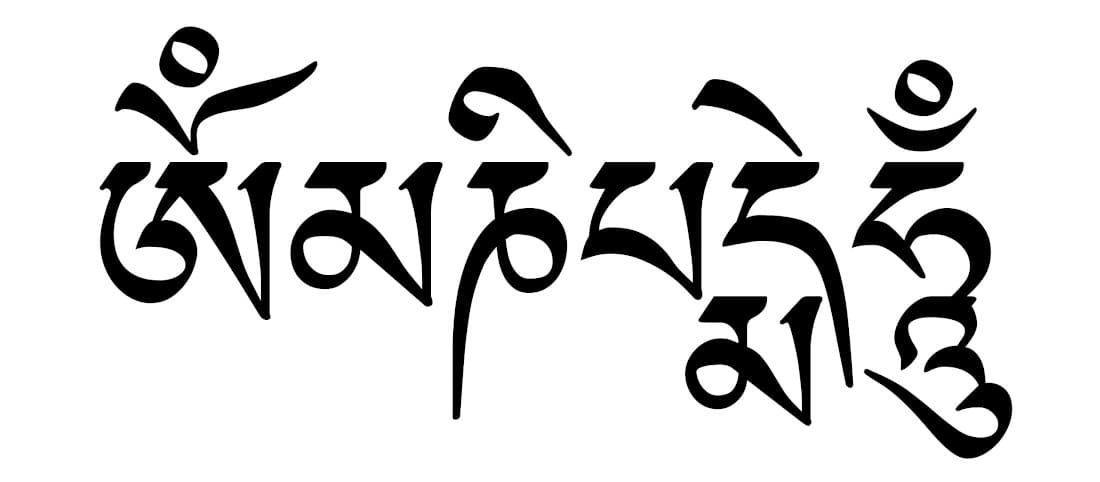
The mantra “Om Mani Padme Hum” is one of the most famous and sacred mantras in Buddhism, primarily associated with the Tibetan tradition. Each syllable of this mantra holds special meaning:
- Om (ॐ): often considered the primordial sound, the sound of the cosmos. It represents the beginning, creation, and unity of all beings.
- Mani (मणि): means “jewel” in Sanskrit. It symbolizes the altruistic path to enlightenment, which is compassion.
- Padme (पद्मे): means “lotus” in Sanskrit. It represents wisdom.
- Hum (हूँ): an interjection meaning “so be it” or “thus it is.” It points to the inseparability of method and wisdom, both essential for attaining enlightenment.
The mantra “Om Mani Padme Hum” is usually recited or chanted to invoke the blessing and protection of Chenrezig (Avalokiteshvara), the bodhisattva of compassion. It is also considered a powerful way to increase compassion within yourself and in the world, while cultivating wisdom. It’s also believed to purify negative karma and strengthen positive karma for those who recite it with devotion. You’ll also come across another version of this mantra, where each syllable is separated and arranged in a more or less circular form.
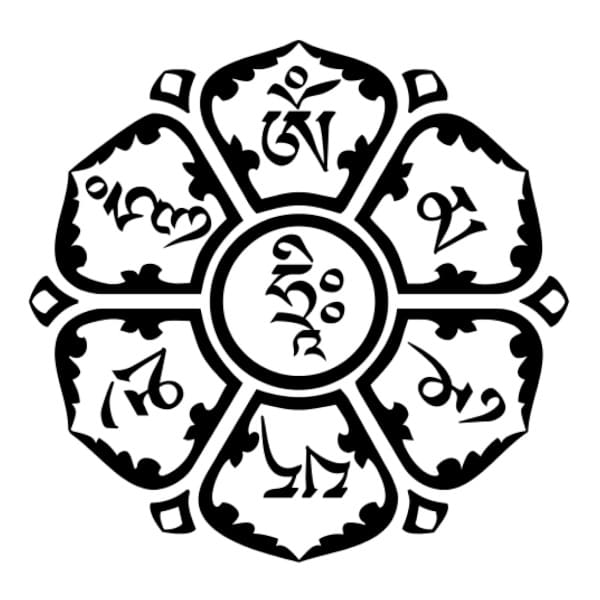
The first version of this mantra is very often found on Tibetan Full Moon bowls, instruments that were forged during a full moon night by performing a specific ritual. Read my article on full moon singing bowls to learn more about this.
The shou lotus engraved on singing bowls
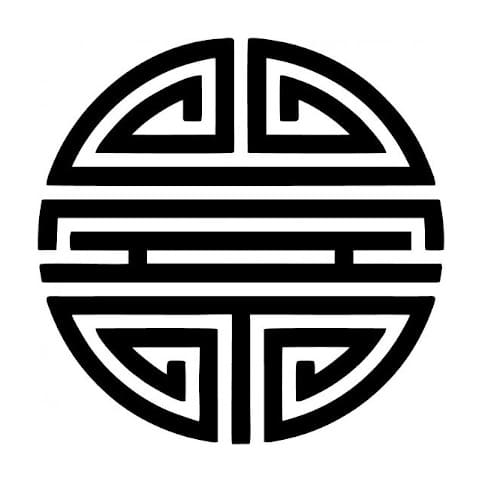
The “Shou Lotus” symbol combines two powerful motifs from Chinese culture:
- Shou (寿): the character “Shou” means longevity or long life. It represents the quest for a long, healthy life, as well as the desire for happiness and prosperity.
- Lotus: the lotus is a sacred flower in many Asian spiritual traditions, including Buddhism and Hinduism. It is often associated with purity, beauty, and spiritual awakening because it rises from muddy water without being stained.
Together, the “Shou” character and the lotus flower express longevity paired with purity and spiritual awakening—a vision of a long, fulfilling life enriched by wisdom, compassion, and spiritual growth. This symbol is commonly used in art, crafts, and decorations to convey wishes for happiness, prosperity, and lasting well-being, and it can also be used in spiritual practices to embody aspirations for personal growth and spiritual fulfillment. In terms of singing bowls, it is very frequently found on Tibetan Full Moon bowls.

The double dorje, or double vajra, is often etched into the base of the instrument
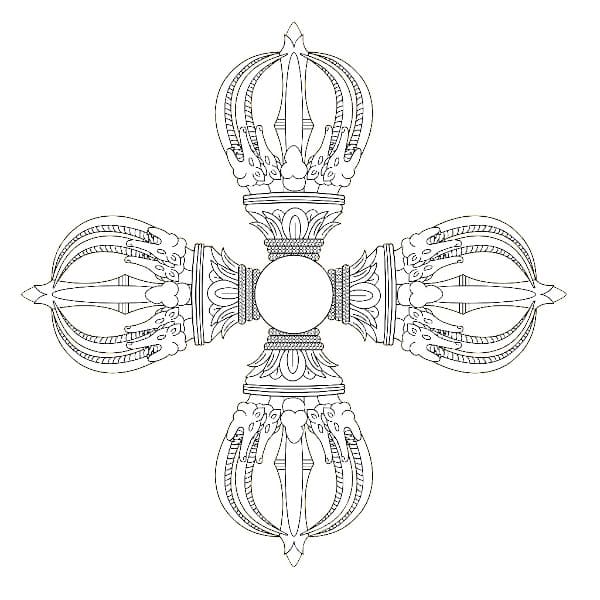
The double vajra, also known as the double dorje, is an important symbol in Tibetan Buddhism and Hinduism. It is usually engraved on the bottom of Tibetan singing bowls. Instead of a simple circle in the center, a yin-yang symbol is sometimes engraved. Here are some meanings associated with this symbol:
- Strength and stability: the vajra represents indestructible strength, stability, and invincibility. The double vajra reinforces this meaning by symbolizing an even more powerful and balanced force.
- Harmony of opposites: the double vajra can also represent the harmony of opposites, such as masculine and feminine, heaven and earth, or creative and destructive energy. This is why a yin-yang may appear in its center depending on the beliefs of the artisan who made the Tibetan bowl.
- Union of wisdom and compassion: in Buddhism, the vajra symbolizes the indestructible nature of the awakened mind, while the double vajra can represent the union of wisdom (one vajra) and compassion (the other vajra), showing the balance between these two essential aspects of spirituality.
- Power of meditation: the double vajra is also associated with the power of meditation and spiritual practice. It represents the ability to overcome inner obstacles and attain a state of enlightenment. Since the Tibetan singing bowl is naturally used in meditation, it makes sense to find this symbol at the center of the instrument.
In summary, the double vajra is a symbol rich in meaning, often associated with strength, harmony, and spirituality in Buddhist and Hindu traditions. Having it engraved on the base of your singing bowl can add an extra dimension of intention and spiritual depth to your practice.
The eyes of Buddha, a powerful symbol
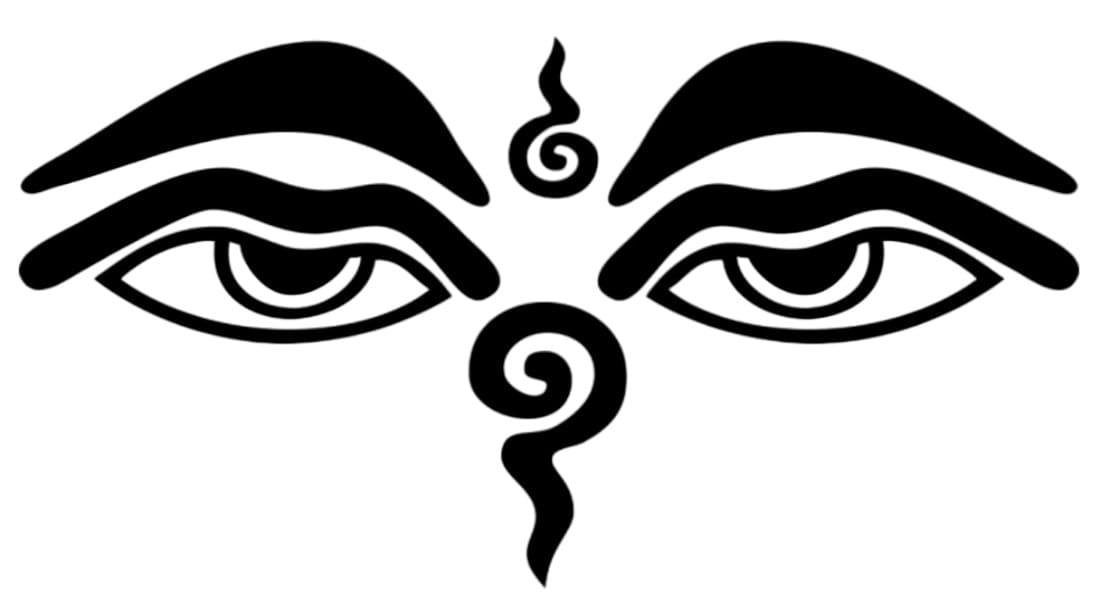
The symbol of the “eyes of Buddha” is a common motif in Buddhist art, especially within Tibetan Buddhism. Here’s what it generally represents:
- Penetrating vision: Buddha’s eyes symbolize the ability to see clearly and deeply, beyond superficial appearances. This represents wisdom and insight.
- Compassion: the eyes are often depicted with a gentle, benevolent gaze, symbolizing compassion and universal love for all beings.
- Continuous presence: in some representations, Buddha’s eyes are drawn on the forehead of an image of Buddha or a stupa, representing the constant and watchful presence of Buddha in the world.
- Awakened consciousness: Buddha’s eyes are sometimes interpreted as representing awakening or enlightenment, where consciousness is fully awake and free from the illusion of duality.
In short, the symbol of Buddha’s eyes is imbued with profound meanings tied to clear vision, compassion, and spiritual awakening.
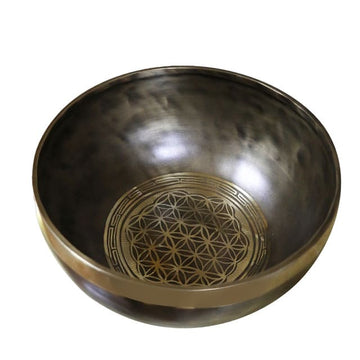
The flower of life, a symbol regularly found on Tibetan singing bowls
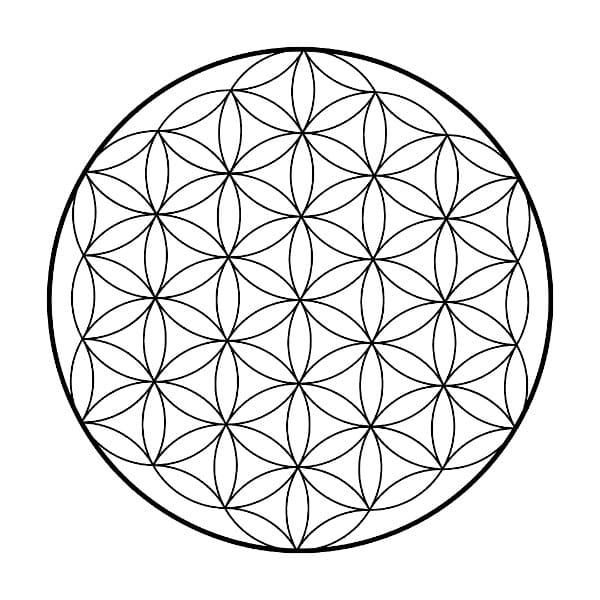
The “flower of life” is a sacred geometric pattern made of interlocking circles that form a symmetrical, flower-like design. This motif appears in many cultures worldwide, which is why it can be found etched onto some Tibetan singing bowls, and it carries several symbolic meanings:
- Creation and interconnection: the flower of life is often interpreted as a symbol of universal creation and the interconnectedness of all life. The interlocking circles represent the interdependence of all things and the way everything is linked.
- Harmony and balance: the geometry of the flower of life is often seen as naturally harmonious. It symbolizes balance and perfection in the universe.
- Vital energy: some believe the flower of life represents vital energy or universal life force. The shapes are seen as patterns that capture and channel this energy.
- Protection and purification: in certain spiritual traditions, the flower of life is used as a symbol of protection and purification. It may be used in rituals to create a sacred space or to ward off negative energies.
- Growth and transformation: the flower of life can also be interpreted as a symbol of spiritual growth and transformation. Like a flower that blooms, it evokes the potential for personal evolution.
Overall, the flower of life is a complex and versatile symbol, carrying deep meanings related to creation, interconnection, harmony, and spiritual growth.
The sacred symbol Om or Aum
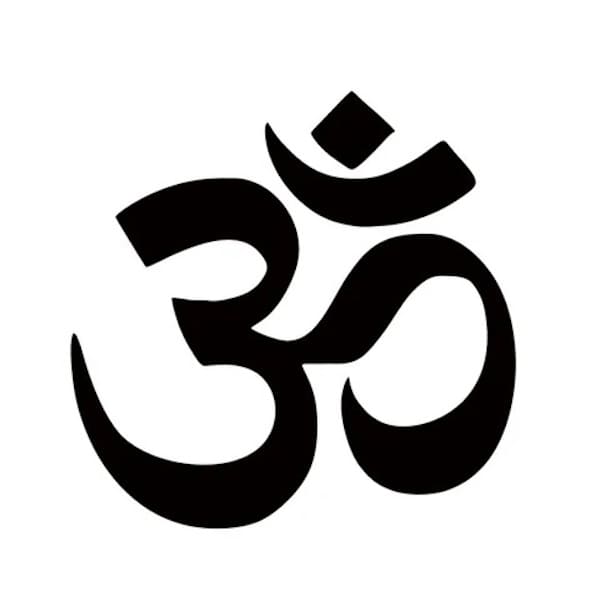
The sacred symbol “Om,” occasionally spelled “Aum,” is one of the most important and ubiquitous symbols in Hindu spirituality and other spiritual traditions of India. It can be seen on some quartz crystal singing bowls. Here are some of the meanings associated with this symbol:
- Unity with the divine: “Om” is considered the primordial sound of the universe, representing the very essence of ultimate reality or the divine in Hinduism. Chanting or meditating on “Om” is seen as a practice for uniting with this divine essence.
- The three states of being: the “Om” symbol is composed of three distinct sounds: A–U–M. These sounds represent the three states of being in Hinduism: waking (jagruti), dreaming (swapna), and deep sleep (sushupti). Together, they also symbolize the transcendent state beyond these, represented by the silence that follows “Om.”
- Cosmic harmony: “Om” is seen as a symbol of cosmic harmony, representing the unity of all aspects of the universe, including the physical, mental, and spiritual. It also symbolizes the harmony between the individual microcosm (the individual being) and the universal macrocosm.
- Protection and blessings: “Om” is often used as a sacred mantra in meditation and prayer. Chanting “Om” is believed to bring protection, inner peace, and blessings.
- Transcending limitations: “Om” is seen as a symbol of transcending the limitations of the ego and the dualities of existence. It’s a reminder of the illusory nature of the material world and the importance of seeking truth and spiritual realization.
Overall, “Om” is a symbol rich in deep spiritual meaning, representing unity, harmony, transcendence, and spiritual realization in the Hindu tradition and beyond.
The endless knot or infinite knot
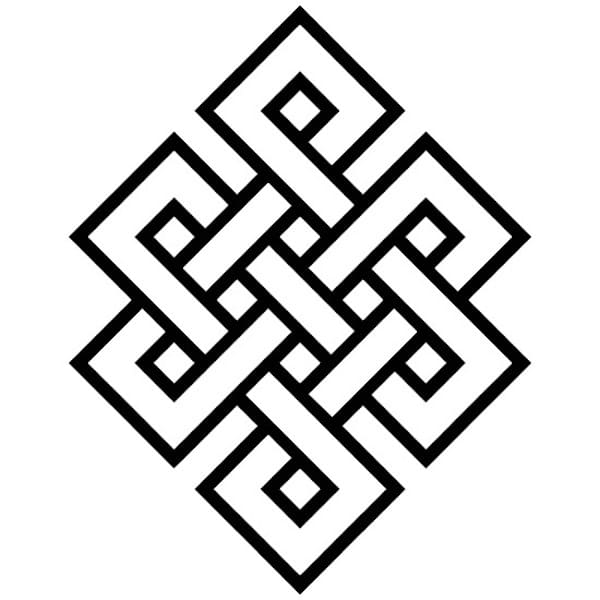
The “endless knot,” sometimes called the “infinite knot” or “Buddhist endless knot,” is an ancient symbol with roots in several cultures, including Buddhism, Taoism, and certain Celtic traditions. Here are some of the meanings associated with this symbol:
-
Interconnection and continuity: the endless knot is formed as a continuous loop with no beginning and no end. It symbolizes the interconnectedness of all things and the eternal continuity of the cycle of life, death, and rebirth.
-
Interdependence and harmony: like the intertwined strands of an endless knot, all aspects of existence are connected in complex, interdependent ways. This symbol reminds us of the importance of living in harmony with others and with nature.
-
Eternity and immortality: because it has no end, the knot is sometimes seen as a symbol of eternity and immortality, reflecting the idea that the spirit or soul is inseparable from the universe and continues beyond physical death.
- Perseverance and resilience: the process of weaving strands together to form an endless knot can be complex and demanding, so the symbol also represents perseverance, resilience, and the inner strength needed to navigate life’s challenges.
- Detachment: since the endless knot has no beginning and no end, it is often interpreted as representing detachment from concepts of time and space. It symbolizes freedom from the limits of conditioned thinking and the dualities of existence.
In summary, the endless knot is a deeply spiritual symbol that evokes notions such as interconnectedness, harmony, perseverance, and transcendence in various cultural and spiritual traditions around the world.
Images of Buddhas or deities
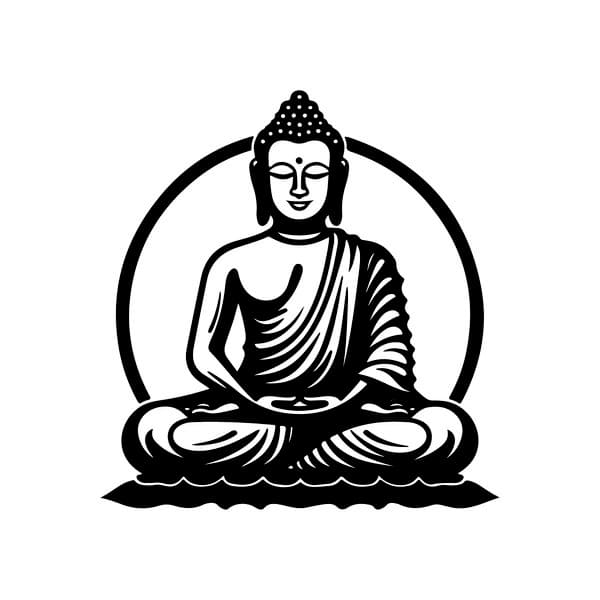
Images of Buddha, such as the one above, and other deities in spiritual traditions carry multiple layers of meaning. For example, it’s not uncommon to find five Buddhas arranged in a star shape on the bottom of a singing bowl. In that case, these are the five Dhyani Buddhas, known for transforming negative emotions into positive energy. You may also find deities such as Tara, Prajnaparamita, or Mahakala engraved directly onto the metal surface of the instrument. The symbolism depends on the deity depicted, but here are some of the most common interpretations associated with these images:
- Awakening and enlightenment: images of Buddha often represent awakening or enlightenment, symbolizing the realization of ultimate truth and liberation from the cycle of suffering (samsara).
- Compassion and benevolence: Buddha is often depicted with a serene face and a compassionate gaze, symbolizing universal compassion and benevolence toward all sentient beings.
- Wisdom and knowledge: images of deities are frequently associated with transcendent wisdom and knowledge, representing a deeper understanding of reality and the means to overcome suffering.
- Protection and blessings: images of deities are sometimes revered as protectors and benefactors, offering protection, guidance, and blessings to those who venerate them.
- Exemplary models: these images serve as models of qualities such as compassion, patience, generosity, and wisdom, inspiring practitioners to cultivate these qualities in their own lives.
- Spiritual connection: images of deities are used as supports for meditation and devotion, helping practitioners connect with the qualities represented and awaken those same qualities within themselves.
Overall, images of Buddha and other deities are rich in symbolism and spiritual meaning, offering practitioners inspiring models and supports for their spiritual path toward enlightenment and liberation.
The symbolism of the 7 chakras on quartz crystal bowls
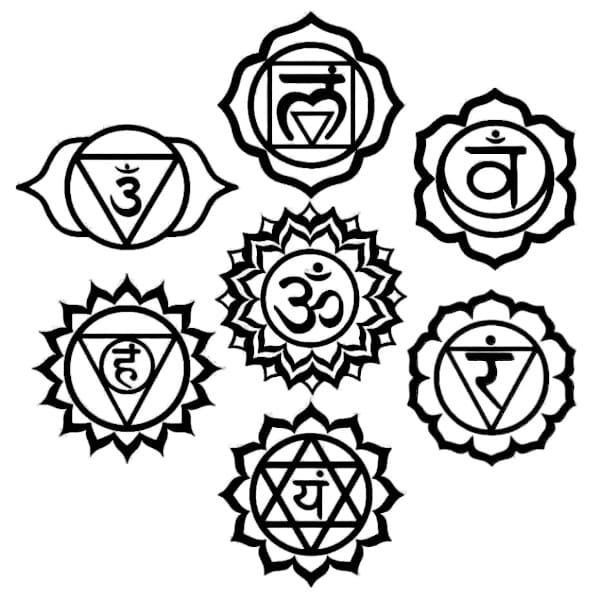
The symbols of the 7 chakras engraved on Tibetan bowls represent each of the main energy centers in the body according to Hindu and Buddhist tradition. These symbols represent different aspects of vital energy in the human body and are often used in meditation and spiritual practices to harmonize and balance these energy centers. Tibetan bowls with this type of engraving can be used to help align and balance your chakras during meditation.
Each chakra is traditionally linked to a color, an area of the body, a planet in the solar system, and a musical note. For example, Muladhara, the root chakra, is linked to the note C. These symbols are generally engraved on quartz crystal singing bowls, which are much easier for manufacturers to tune to a specific note. Click here to learn about the connection between the chakras, musical notes, and the benefits each one brings when present on a Tibetan bowl.
Tibetan script engraved on the instrument
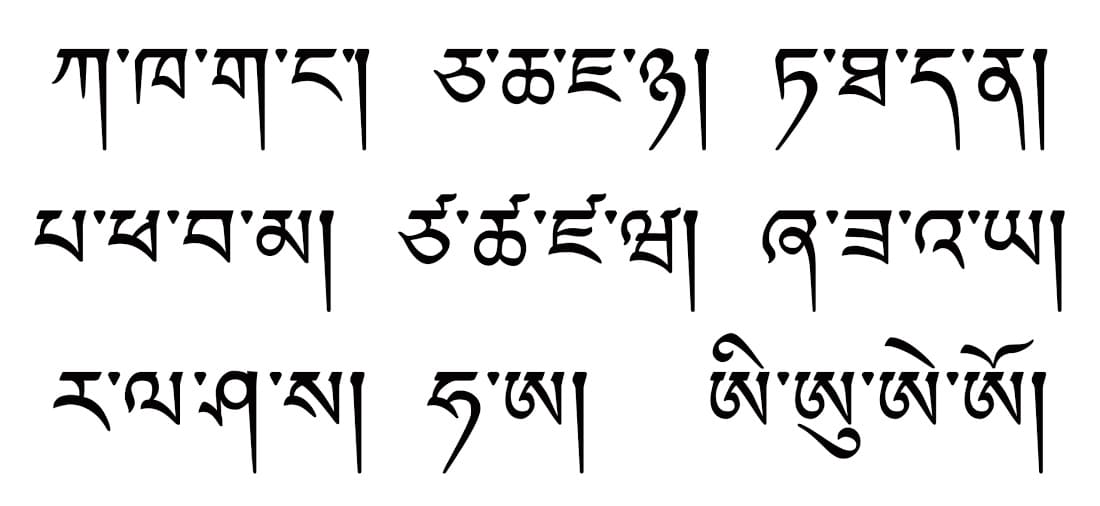
Tibetan bowls are sometimes engraved with inscriptions in the Tibetan alphabet that can carry deep symbolic meaning. Common inscriptions on singing bowls most often include mantras or prayers. There are many of them, and it’s up to you to identify them in order to understand their meanings. You may commonly find the mantra of Tara, recited for protection from danger and for overcoming obstacles; the mantra of Medicine Buddha, used for physical and mental healing; or the mantra of Vajrasattva, used to purify negative karma and support spiritual healing. As for prayers, you’ll need to translate them to grasp their exact meaning.
Choose your next Tibetan singing bowl based on its symbolism
In the fascinating world of Tibetan singing bowls, each engraved symbol tells a story steeped in spirituality and Buddhist tradition. From mantras to double dorjes and images of deities, these motifs are far more than decoration: they carry deep meaning and can help guide your practice toward deeper meditation and a stronger spiritual connection. This article has introduced you to a wide range of these symbols so you can better understand what your percussion instrument may bring you.
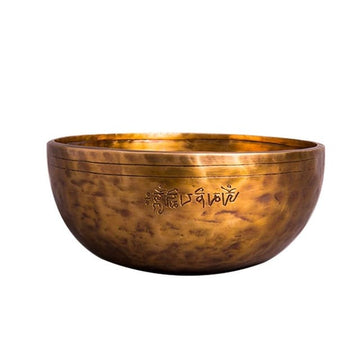
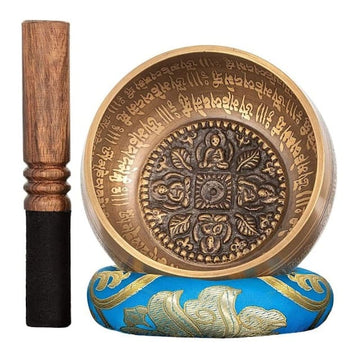
That said, if you’re looking for a specific emblem, it isn’t always easy to find a shop that offers the exact singing bowl you have in mind. That’s why I personally recommend the online store Instruments du Monde, which offers more than 200 Tibetan bowl models for sale. This wide selection makes it easier to choose your instrument based on the symbol that speaks to you. For example, the traditional singing bowl model features a magnificent double dorje at its center to offer the strongest possible sense of spiritual protection.
Discover this Tibetan bowl model by clicking on the image below:
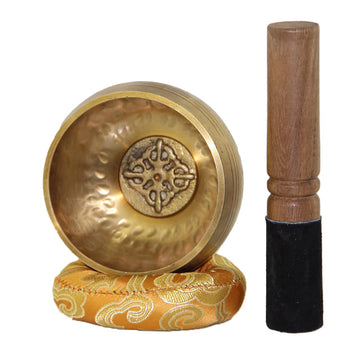
This Asian musical instrument is often sold with helpful accessories. Discover all the accessories related to Tibetan bowls in this other article. You’ll find everything you need to know about cushions, suction cups, and mallets. Alternatively, to deepen your knowledge, read my general article on singing bowls; all the essential information about this instrument is gathered there.


