



Written by Ambre Montespan on Mar 14, 2023 · Updated on Oct 15, 2026

Table of contents:
Have you recently purchased a tongue drum but don’t know how to get started with this unique musical instrument? Are there any techniques to help you improve? How do you play the tongue drum?
Having owned several tongue drums for nearly 10 years now, I’ve had plenty of chances to practise and help beginners master their instrument. In this guide, I’ll walk you through the fundamentals of playing a steel tongue drum and the key steps you can take to improve quickly.
To play the tongue drum well, start by placing the stickers, then learn the basic techniques by understanding how the instrument works. Finally, practise by ear or with sheet music to refine your skills.
Once you have read this guide, you will know:
- How to prepare before you start playing
- The correct way to use a tongue drum
- Different ways to progress easily
With these skills in hand, you’ll be ready to get comfortable with this intriguing instrument and create beautiful melodies to help you relax and unwind.
Let’s get started.
Prepare your instrument before you start playing
Before you start playing the tongue drum, it’s worth setting yourself up properly so you can learn in the best possible conditions. In particular, it helps to place the stickers correctly and to position the instrument in a way that brings out its best sound.

Placing stickers on the tongue drum
In most cases, a sheet of numbered stickers is included with your tongue drum. Each number corresponds to a musical note according to Arabic numeral notation. These stickers help you find your way around the different tongues and identify which note each one plays. Normally, an instruction booklet tells you where each sticker should go. Sometimes they’ve already been installed by the manufacturer. If you’re not sure how or where to place them, check out our detailed article on placing stickers on the tongue drum. As you’ll see, these markers are important, especially for beginners who don’t yet know their instrument inside and out.
Positioning the tongue drum
Next, it is essential to hold your tongue drum properly or place it correctly. Specifically, you have three options.
The first is to simply place the instrument on a hard surface, such as a table or directly on the floor. In this case, you’ll need to make sure your tongue drum has rubber pads on its lower shell so the metal doesn’t rest directly on the hard surface. Otherwise, the instrument will resonate much less and won’t be as pleasant to listen to. If needed, you can rest it on a doughnut-shaped cushion, but it must be the right size for your tongue drum. Therefore, if your tank drum does not have pads, we recommend using one of the following methods.

The second is to position the steel tongue drum directly on your own body, which will serve as a support. To do this, you can sit on a chair or on the floor with your legs crossed. The goal is to find the most comfortable position possible to avoid pain or numbness over time. Then simply set the instrument on your thighs or between your legs. Position it so it’s stable, with its centre of gravity between your legs, and so you can reach every note without moving your arms too much. Don’t place it too close to your stomach, or you may have trouble reaching the notes nearest to you. Finally, raise your knees slightly so the instrument tilts towards you. This will make the tongues easier to reach.
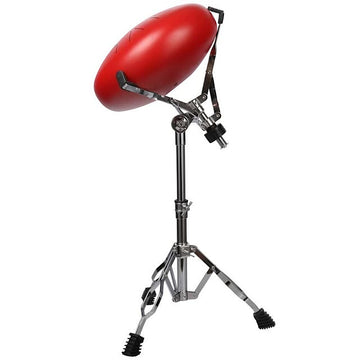
Finally, the last option is to use a “stand.” This is a wooden or metal support that holds the tongue drum while you play. It lets you practise standing up and, if you own several tongue drums, it also makes it easier to use multiple instruments within the same melody.
How to use a tongue drum?
Now that you’re set up to play your tongue drum, let’s get into the essentials: how the instrument works and the different ways you can produce notes.
The basics of using the instrument
The tongue drum is a relatively simple percussion instrument. To produce sound, you strike the cutouts—often tongue-shaped—on the shell. Each tongue corresponds to one unique musical note. However, depending on where you strike the tongue, the sound will be more or less intense. Striking closer to the centre of the tongue drum produces deeper, stronger tones, while striking closer to the outer area produces a lighter sound.
It’s also worth noting that the sound comes from the vibration of the steel tongues. So if you want to stop a note that has just been played, simply press the vibrating tongue with your finger. This technique is sometimes used to add a specific style to your playing.

Is it difficult to learn the tongue drum?
Unlike some stringed instruments where it’s easy to play a wrong note, that’s simply not possible with a tongue drum. Because it has fewer notes than a traditional piano, it’s especially beginner-friendly. As a result, this instrument is easy to learn and easy to play—even children can pick it up quickly and start playing beautiful melodies in as little as 20–30 minutes.
How do you hold the tongue drum mallets?
Tongue drums often come with a pair of mallets or drumsticks, which are recommended when first learning to play this instrument.
To hold your mallets correctly and play comfortably, bend your index finger to form a curve, insert the mallet handle into the crook of your index finger, and place your thumb against the handle to secure it. Then let your other three fingers rest along the handle. Avoid gripping the handle too high or too low; the goal is to be as comfortable as possible so you can keep maximum control and dexterity.
Next, practise playing a few sequences of notes, not necessarily with the intention of playing a melody, but simply to find the ideal grip for your hands and mallets.
Is it possible to play the hank drum with your hands?
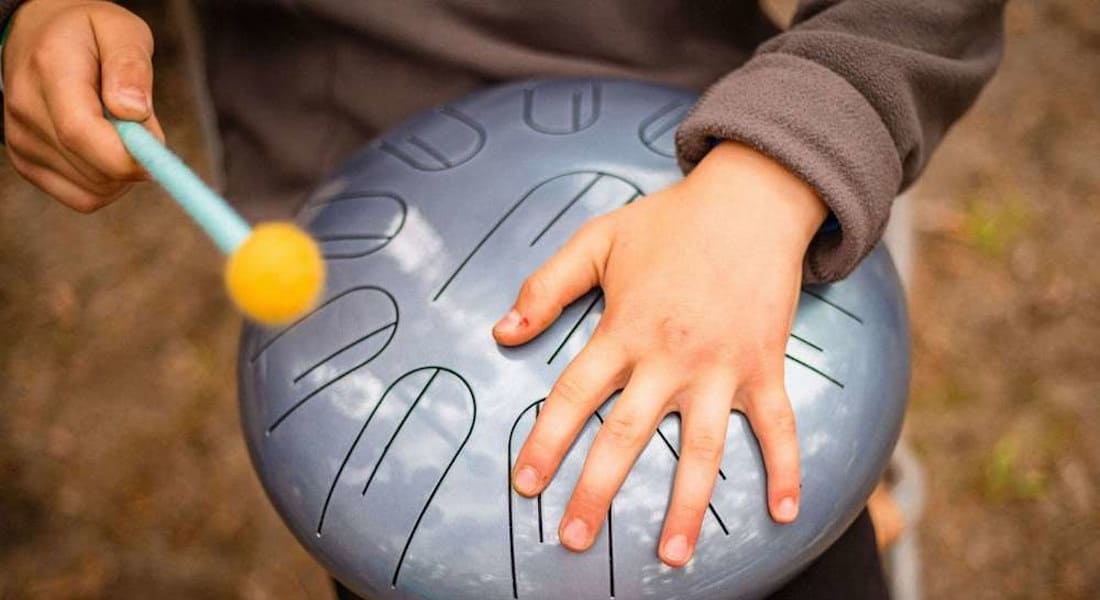
It is entirely possible to play the hank drum using your hands, or more precisely your fingers. However, this technique is much more difficult to master than using mallets. Handpan players should also keep in mind that it’s even more challenging here because the metal of a tongue drum is much thicker.
Playing a tongue drum with your fingers is trickier for one simple reason: while the tip of a mallet is made from a material that bounces off the metal (avoiding prolonged contact), your fingers don’t naturally do that. Beginners often “catch” the tongue and stay in contact too long, which dampens most or all of the vibrations created by the initial impact—much like the deliberate note-stopping technique we covered earlier.
So, to play the tongue drum with your fingers, you need a sharp, quick strike, ideally using a harder part of your fingertip (the bony area near the end of your last phalanx), though you can also use the pad of your finger. The idea is that your finger whips the metal. It will take some time to master this technique. That said, it’s worth the effort: although playing with your hands is harder, it can let you play more than two notes at the same time and be more precise about where on the tongue you strike. This opens the door to more harmonious melodies. Watch the video below to get an idea of what’s possible.
How can you improve your steel tongue drum playing?
Now that you know all the basic techniques, let’s look at what you can do to improve your tongue drum playing.
Playing melodies by instinct
The tongue drum is an instrument that’s meant to be played intuitively. The idea is to let the rhythm and notes guide you once you’re familiar with them. You don’t need to be the next Mozart. Experiment with different note combinations, watch YouTube videos for inspiration from other musicians, and above all, create your own style—one that feels like you and reflects your personality.
Memorising songs with tongue drum sheet music
Some players prefer playing well-known songs on their tongue drum. If you have an instruction booklet that came with your instrument, chances are it includes a few songs to help you get started. However, you may not fully understand how to read that sheet music. Don’t worry—we’ve created a guide that explains how to read these musical documents dedicated to the tongue drum. It’s very simple and completely free, and you’ll be playing beautiful melodies in no time.

Once you’ve learnt the songs in your booklet, it can be hard to find more sheet music. To discover new pieces, such as the Pirates of the Caribbean theme or “The Sound of Silence”, take a look at our tongue drum sheet music collection. You’ll quickly build a richer repertoire.
Producing sound effects with the instrument
As you may have already noticed, some tongue drums have a hole, usually located on the underside of the instrument, opposite the tongues. This hole is normally covered by a plastic cap. Leaving the cap in place increases the resonance of the steel tongue drum. Removing it reduces resonance, but it also lets you cover the hole fully or partially while playing to create a sound effect called “wah-wah.”.
You can only perform this technique if you place the tongue drum on your body and use your thigh to cover or uncover the hole. It takes a specific set-up and some practice to fully master, but it can add a beautiful touch that elevates your melodies.

Take it to the next level with a professional tongue drum
Playing the tongue drum perfectly takes many hours of practice to truly master the instrument. But with the tips you’ve learnt here, you should progress quickly and reach a very satisfying level. You’ll then be able to fully enjoy your steel tongue drum while sharing its soothing sound with the people around you.
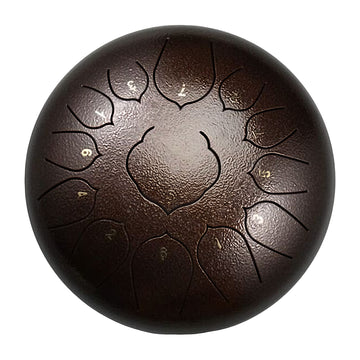
However, if you’re serious about learning this exotic instrument, it’s best to choose a quality model with at least 11 notes so you can develop a richer, more varied playing style. That’s why Instruments du Monde offers this finely crafted tongue drum with a 30 cm diameter, designed to produce pure, crystalline notes.
Treat yourself to this tongue drum by clicking on the image below:
Want to buy a new tongue drum but not sure where to start? Take a look at our article that walks you through all the options for where to buy a tank drum. You can then choose the solution that best fits your situation. Or, take a look at the comprehensive guide to the hank drum.


