



Written by Ambre Montespan on Mar 14, 2023 · Updated on Oct 15, 2026

Table of contents:
You’ve just received your new tongue drum, but there’s one problem: you have no idea where to place the stickers. Maybe you already applied them, they peeled off over time, and now you’re not sure where to put them back. How do you avoid a mistake that could throw off every melody you play later on?
After buying several steel tongue drums, I’ve had the unpleasant surprise of seeing the stickers come loose over time. I’ve also received an instrument with no indication of where they should go. Luckily, I found a reliable way to solve this, and I can show you how to install your stickers correctly, every time.
Tongue drum stickers are placed on the steel tongues of the instrument to show the player where each note is. To place them correctly, you need to match the right sticker to the right note, using a tuner if necessary.
After reading this article, you will understand:
- What the stickers are for and what the markings on them mean
- Where to place the stickers on your tongue drum
- How to remove them without damaging the instrument
Once applied, these small vinyl stickers act as clear visual markers, helping you stay confident you’re striking the right note. As a result, you can learn tongue drum sheet music with peace of mind, without the risk of playing the wrong note.
Let’s start by looking at how to apply the stickers to your tongue drum.

What are the stickers that come with the tongue drum for?
When your tongue drum arrives, among the included accessories you’ll usually find a sheet of stickers—similar to the ones we used in primary school. These stickers are numbered from 1 to 7, and sometimes they include a dot above or below the number.
Here, each number corresponds to a musical note according to the NMCA abbreviated Arabic numeral musical notation system, as shown in the table below:
| solfege | C | D | E | F | G | A | B |
| NMCA | 1 | 2 | 3 | 4 | 5 | 6 | 7 |
The dots indicate to the player which octave they are in. A number without a dot means the note is in the reference octave. For example, on a tongue drum tuned to C major, a "1" on its own is the note C. A "1" with a dot underneath is still C, but one octave lower. Conversely, a dot above a "1" indicates an octave higher. Don’t worry if your stickers don’t have dots—it may simply mean your tongue drum doesn’t span multiple octaves. A 7-note instrument, for instance, may only use stickers numbered 1 to 7, with no notes in higher or lower octaves.
In other words, the stickers are placed on the tongues of the steel tongue drum to serve as visual cues for the player. This makes it much easier to read and play the sheet music, since it’s typically a sequence of numbers that represent musical notes. Because some tongues can be very similar in size, it’s easy—especially for beginners—to confuse two notes without these markers. If you don’t know how to read this type of sheet music, take a look at this article. Once your stickers are in place, you’ll be ready to play beautiful melodies, so it’s worth taking the time to apply them correctly. Let’s look at how to do that now.

How do you apply the stickers to the steel tongue drum?
There are several methods for properly installing stickers on a tongue drum. You can, of course, use the booklet that usually comes with it. However, if it’s missing or doesn’t match your instrument, follow the methods below.
On which tongue of the tank drum should the sticker be placed?
There’s a simple rule with tongue drums: the larger the tongue’s surface area, the lower the pitch. You can test this on your instrument. One way to place the stickers, then, is to use this clue and trust your ear.
You already know the connection between numbers and musical notes. Now keep in mind that the smaller the number, the lower the note. So a "1" (C) will be lower than a "3" (E). In addition, a number with a dot below or above it will be lower or higher in pitch than the same number without a dot. With all this information, you can rank the tongues of the tank drum from largest to smallest and assign the stickers from your sheet accordingly.
However, this method only works if you can accurately judge tongue size and you have a good ear. Also, it falls short if you’re unsure which notes your instrument is supposed to produce. That’s why it’s best to move on to the second technique, which is a bit more involved but works in every situation.
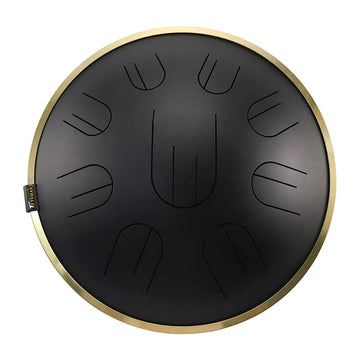
What notes are on my tongue drum?
To position the stickers correctly, you simply need to know the notes your tongue drum produces, and that’s exactly what a tuner is for. This small electronic device listens to the instrument and tells you which note you’re playing. There are also smartphone apps, such as Da Tuner, that use your phone’s microphone to do essentially the same job. These apps are usually less accurate than a physical tuner, but they’re free if you don’t mind a lot of adverts.
Using a tuner is quite simple. Turn it on, play one note on the tongue drum by striking a tongue, and read the result on the tuner’s screen. Write that note down, then repeat the process for each tongue. This lets you “map” your steel tongue drum so you can apply the matching stickers afterwards.
It’s also possible that the tuner won’t give you an exact note and will instead indicate that the sound is a C sharp. There could be several reasons for this: the tuner may not be very precise, the tongue may have been poorly tuned during manufacturing, or that tongue may have been intended to play a C sharp. In any case, we recommend mapping everything out and doing your best based on the results you get. With a C sharp, for example, you could place a sticker labelled 1 or 2 on the tongue in question—unless you have a sticker labelled "1#," which indicates C sharp.

Can the vinyl stickers be removed from the instrument without damaging it?
It is entirely possible to remove the stickers from your tongue drum, whatever the reason. However, be careful with what you use if you can’t remove all traces of glue left behind on the tongues.
While the metal itself can handle a lot, the paint coating typically applied to the instrument may not. So avoid harsh chemicals, paint strippers, or abrasive materials like the green side of a sponge. Otherwise, you may end up damaging your tongue drum. Start with a warm, damp cloth, and if that doesn’t work, use a lubricant spray and gently scrape the glue with a stiff plastic card, like a credit card—this usually removes even the most stubborn residue.
In any case, keep in mind that even if the paint gets damaged, the instrument’s note will remain the same. It’s mainly the appearance that will be affected.

Use a stand to hold your tongue drum for better acoustics
Stickers are a must-have for tongue drum players who don’t yet know the exact position of each note by heart. Once you’ve installed these visual markers, you’ll be able to hit the note you want with confidence. Now that you know how to position the stickers on the tank drum, you’ll build your skills faster on this gentle, relaxing instrument.
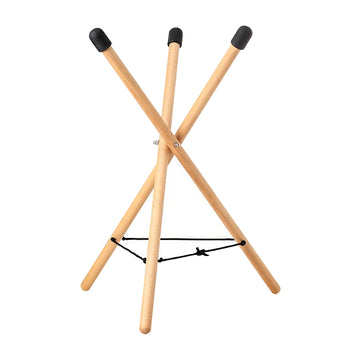
However, to get the most out of your tongue drum’s acoustics, it’s highly recommended to place it on a stand, a type of support that facilitates sound propagation and is used by professionals. The Instruments du Monde store offers a high-quality stand that helps you enjoy deep, pure tones from your tongue drum.
Treat yourself to this tongue drum stand by clicking on the image below:
Now that you know how to place the stickers, do you want to learn how to really play your tongue drum? Check out our article on how to play the tank drum like an expert. Once you’ve read it, you can go even further with this complete guide to the steel tongue drum.


