



Written by Ambre Montespan on Mar 14, 2023 · Updated on Oct 15, 2026

Table of contents:
Have you recently heard the soothing sounds of a rather unusual musical instrument called a tongue drum and wondered how it works? How does this small object manage to produce such surprisingly rich sounds?
Having known this instrument for more than 10 years now, I’ve had plenty of time and opportunity to dig into how it’s made and understand how the tongue drum generates sound. So I can explain clearly how this musical instrument—still relatively unknown to the general public—actually works.
The tongue drum is a percussion instrument that produces sound when its steel tongues are struck. With each strike, the tongues vibrate, creating sound that is amplified by the resonance chamber.
After reading the explanations below, you will understand:
- How a tongue drum is made, to better understand how it works
- How this musical instrument produces sound
- Why it is not necessary to tune a steel tongue drum
- The main difference between a tongue drum and a handpan
As a result, you’ll have a solid understanding of how this unusual—yet wonderfully relaxing and delightful—musical instrument works.
Let’s dive right in.

How is a tongue drum made?
To understand exactly how the tongue drum works, you first need to learn how it’s made and what it’s made of. As you’ll see, it’s a fairly simple instrument in terms of construction.
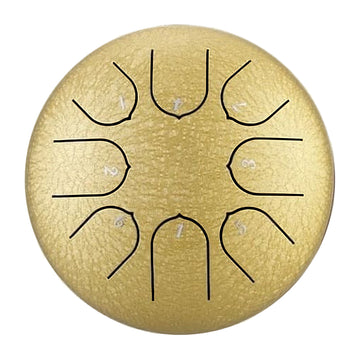
The steel tongue drum is crafted from two convex metal shells that are welded together to create an instrument that loosely resembles a flying saucer. Before welding these two shells together, cut-outs of different sizes are made in the upper shell. These cut-outs were originally shaped like tongues, hence the name "tongue drum." Today, you can find tongue drums with cut-outs in all kinds of shapes. A hole is usually drilled in the lower convex shell. Additional small holes accommodate rubber pads so the drum can rest on a stand while losing as little vibration as possible during play.
This classic tongue, or tank drum, build is still common. That said, makers now offer models with tongues on both shells, as well as designs with the sound port on the top shell instead of the bottom. In other words, a tongue drum really is that simple: two metal shells welded together, with cut shapes mainly on the top.

How does the steel tongue drum work?
To understand how the steel tongue drum works, it helps to start with how it produces sound. We’ll also cover a few key details, like magnets, the sound port, and overall volume.
What is a tongue drum, and how does it produce sound?
The tongue drum is a percussion instrument. To produce sound with it, you strike the tongues with a mallet or directly with your hands. When you do, the tongue you hit vibrates. That vibration also makes the surrounding air vibrate, creating sound. The note changes depending on the size of the tongue: the smaller the tongue, the higher the pitch; the larger the tongue, the lower the note.
The sound vibrations then spread inside the instrument’s resonance chamber, which is formed by two convex shells welded together. The sound is amplified and takes on a timbre, intensity, and sustain that are unique to the tongue drum thanks to the material and the particular shape of the chamber.
Are there magnets in the tongue drum?
You may have heard that tongue drums have magnets inside the resonance chamber. That was often true a few years ago when the instrument was being built by hobbyists, but today most tongue drums do not have magnets.
When Dennis Havlena unveiled his tongue drum prototype in 2007, he used a recycled gas cylinder instead of convex shells and cut the tongues by hand with a small grinder. Working largely by trial and error, he used neodymium magnets placed inside the tongue drum, on the tongues, to fine-tune the pitch. The more weight he added to a tongue, the lower the note became.
Today, however, tongue drum tongues are mostly cut using highly precise machines. With experience, makers can programme the machine to cut the metal to achieve the exact note they want. As a result, magnets are no longer really necessary, although they can still be found on certain multi-scale (multi-tuning) models or used by players who want to tune their steel tongue drums differently.

What is the purpose of the hole below or above the tank drum?
Most tongue drums have a sound port on the bottom, and more rarely on the top. Sometimes, this hole is sealed with a rubber plug. This port is there to improve the instrument’s acoustic properties, which is why some manufacturers place it in different locations. Its position can slightly change the tongue drum’s tone.
Is the steel tongue drum a loud instrument?
The volume of the steel tongue drum varies greatly. Obviously, the smaller the instrument, the quieter it will be, and vice versa. In addition, how hard the player strikes also affects volume. For a medium-sized tongue drum, 25 cm in diameter, when struck with moderate force, the volume is between 70 and 80 decibels, which is roughly comparable to a noisy classroom or a running dishwasher.

Does a tongue drum need to be tuned?
The tongue drum does not need to be tuned, which is one of its biggest strengths, especially for beginners. Unlike a guitar or violin, a tongue drum is made almost entirely of metal, a material that won’t change (or will change very little) over time. So the “tuning” is essentially set during manufacturing—especially when cutting the tongues, which determines their final size and, therefore, the note each one will produce almost permanently.
But this advantage can also become a disadvantage. The tongue drum is a fairly “fixed” instrument in terms of tuning. So if you want to change to a different scale—for example, to play notes that aren’t built into the instrument—it can be difficult or even impossible. The most practical solution is to buy another tongue drum that includes the notes you want to play.

Are tongue drums and handpans the same thing?
From a distance, the handpan and the tongue drum look very similar: they share roughly the same shape and are played by striking them. However, these two instruments are distinct and should not be confused. With a tongue drum, tongues are cut directly into the shell, whereas a handpan’s shell is hammered into shape.
This means that on a handpan, you’ll find indentations on the shell called "tone fields," unlike the tongue drum. This small but fundamental difference dramatically changes the sound and the price. Hammering metal into the desired shape takes far longer and is much more difficult than cutting it, so the price of a handpan is considerably higher than that of a tongue drum.
Listen to the difference between a tongue drum in this first video and a handpan in the second:
You can find all the differences between a handpan and a tongue drum in this article. You’ll learn how to tell the two instruments apart, and you’ll never mix them up again.
Discover this exotic musical instrument
Even though the tongue drum’s mechanics are simple, the sounds it produces are so unusual and mysterious that many people assume there’s a hidden secret inside the instrument. Now you know that’s not the case, and you’ll be able to explain to anyone who’s curious how the tongue drum works.
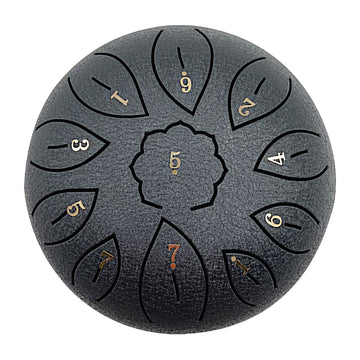
Still, understanding how a tongue drum works is one thing—playing it, feeling the deep vibrations it produces, and soaking in those exotic tones is an indescribable experience you owe it to yourself to discover. That’s why Instruments du Monde invites you to explore this instrument with an 11-note tongue drum, ideal for getting started and enjoying its rich, deep sound.
Get this 11-note tongue drum by clicking on the image below:
As you can see, a tongue drum is simple. However, its history is rather complex and rich. It is the result of several fusions of different musical instruments and prototypes, some of which date back several hundred years. Discover the origins of the tongue drum and learn everything there is to know about this instrument, which is little known to the general public.


