



Written by Ambre Montespan on May 13, 2024 · Updated on Oct 15, 2026

Table of contents:
Already own a tongue drum and wondering what notes it has? Are you considering buying this percussion instrument and want to learn more about which scale or key you should choose? Do you have a specific musical project that requires certain notes and are wondering if a particular steel tongue drum would be a good fit?
I’ve been playing the tongue drum for over 5 years, and since I personally own several models tuned differently, I can easily help you identify all the musical notes on the instrument you already have or are thinking of buying.
The musical notes you’ll find on a tongue drum can vary a lot. They depend largely on the instrument’s scale, and they’re often located between the 3rd and 5th octaves.
By the end of this article, you’ll know exactly:
- Which factors determine the notes on a tongue drum
- The methods you can use to identify the notes on this musical instrument
- How the tuning frequency of a tongue drum affects what you hear
With this knowledge, you’ll be able to confidently choose a tongue drum for any musical project and quickly help others understand the notes on their instruments.
Now, let’s start by looking at what defines the notes on a steel tongue drum.
What determines the notes and scales on a tongue drum?
Several factors influence the musical notes you’ll find on your tongue drum. To make sense of it all, it helps to start by understanding that not every tongue drum carries the same notes. Then we’ll look at diatonic, pentatonic, and chromatic scales, and finally explore the different keys you can come across on a tongue drum.

Why don't all tongue drums have the same musical notes?
First and foremost, it’s important to realise that a tongue drum is a percussion instrument that simply can’t hold a large number of notes the way a piano or a violin can. The tongue drum is limited in terms of musical notes because of its surface area. A small tongue drum can only contain a few notes, while a large tongue drum will usually have around ten, and sometimes close to 20 for the most ambitious models.
Furthermore, the steel tongue drum is not designed to be a tunable instrument like a guitar, so the notes can’t truly be changed, even though there are a few tricks for tuning a tongue drum differently. That means the scale, key, and overall note layout you choose are important decisions, since they’re difficult to change later. On the bright side, it also means the instrument requires virtually no maintenance to keep playing in tune, unlike most stringed instruments, such as the harp, where tuning must be checked very regularly.
Taking these two factors into account—the limited number of notes and the near-impossibility of retuning the instrument—manufacturers now offer tongue drum models in many different tunings to suit every player’s preferences. Each instrument’s note palette naturally shapes the emotions it conveys to listeners. Some tunings invite introspection, while others feel warmer and more joyful. That’s why many tongue drum enthusiasts end up owning several models tuned differently, so every playing session brings something new.
Do instruments in the diatonic, pentatonic, and chromatic ranges have different notes?
In the world of tongue drums, or hank drums, you’ll come across models in pentatonic, diatonic, and—more rarely—chromatic scales. A pentatonic scale has 5 notes, a diatonic scale has 7, and a chromatic scale includes the 7 natural notes plus 5 altered notes (12 total), which can be found in every octave.
However, it’s important to understand that if a tongue drum is in a pentatonic scale, it won’t necessarily have only 5 notes in total. It will always have the same 5 notes, but spread over different octaves. In music, an octave is the interval between two sounds, where one frequency is exactly double the other. For example, if a sound has a frequency of 440 Hz, the sound one octave above it will have a frequency of 880 Hz. The octave is considered a very harmonious interval and is fundamental in Western music, forming the basis of the musical scale. Notes separated by an octave are often perceived as being the “same” note, even though one is higher or lower than the other.
If we return to our example of 440 Hz, that corresponds to A4 (A in the 4th octave). Double the frequency to 880 Hz, and it’s still an A, but now A5 (in the 5th octave). However, to the ear, the A in the 5th octave will sound higher than the A in the 4th octave. It’s worth noting that the human ear can hear around 10 octaves, but in tongue drum music, most people typically stay within about three—namely the 3rd, 4th, and 5th octaves.
It’s also worth noting that there are several types of pentatonic and diatonic scales. Since there are 12 possible notes in an octave, there are countless ways to select 5 or 7 notes. For example, the diatonic scale of C major is made up of C, D, E, F, G, A, and B, while the same scale in D major is D, E, F#, G, A, B, and C#, with the # symbol indicating a sharp. As mentioned above, these notes can be spread over one or more octaves, which is why pentatonic, diatonic, and chromatic scales do not have the same notes on a tongue drum.

What are the different keys and scales that can be found on the tongue drum?
As we mentioned earlier, tongue drum makers have a lot of options. Alongside classic keys like C major or D minor, many builders get creative and offer more “exotic” scales and tunings with attractive names. That’s why you may come across tongue drums labelled Hijaz, Pygmy, Celtic, or Akebono, to name a few of the most well-known. There are even variations like Low Pygmy. These names simply mean the maker chose a specific set of notes when designing the instrument. As a result, the combinations of notes available on a tongue drum can feel almost endless depending on the key and scale chosen. If you’d like to learn more or you’re hesitating before buying your next instrument, read this article to help you select the scale or key for your tongue drum. The most popular options are explained clearly, along with their pros and cons.
How do you know which musical notes are on your tongue drum?
There are two ways to identify the notes on your tongue drum. The first is to use an electronic tuner to help you out. The second is to carefully examine your instrument.
Using an electronic tuner to find the key of your steel tongue drum
If you don’t know the key at all or your tongues aren’t numbered, you’ll need to use an electronic tuner. A tuner is a device that listens to what you play and then displays which note it is. That’s exactly what you’ll do with your tongue drum. Turn on your tuner, make sure you’re in a quiet room with no background noise, play a tongue at random, and the tuner will show the corresponding note. Write it down on the shell of the instrument, then move on to the next tongue. This way, you’ll quickly identify every note on your steel tongue drum.

Examine your tongue drum carefully to find out what notes it has
The key of the tongue drum is sometimes written on the packaging, on the invoice, and occasionally on the underside of the instrument. It often takes the form of a single letter. For example, if there is a "C" written under your tongue drum, it means it is tuned to C major, and a "D" means D major. You can use the following table to help you:
| solfege | Do | Re | Mi | Fa | Sol | La | Ti |
| letter names | C | D | E | F | G | A | B |
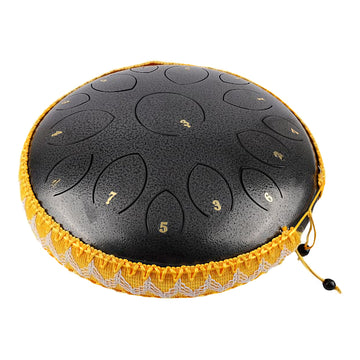
Once you know the key, you can easily find the notes on the instrument if the tongues are numbered. In most cases, numbers are written on each tongue of the drum. These numbers range from 1 to 7, and there is sometimes a dot below or above the number. The dot indicates whether the note is an octave below or above. The number indicates a note that depends on the key of the instrument you discovered earlier. For a tongue drum in C major, 1 corresponds to C and the other notes follow as follows:
| notes | C | D | E | F | G | A | B |
| NMCA | 1 | 2 | 3 | 4 | 5 | 6 | 7 |
On the other hand, for a model in D major, 1 corresponds to D and the other notes follow as follows:
| notes | D | E | F# | G | A | B | C# |
| NMCA | 1 | 2 | 3 | 4 | 5 | 6 | 7 |
The number 1 always corresponds to the main note of the key. In music theory, this is called the tonic. For example, on a tongue drum in E major, 1 will be E. The other notes follow, sometimes with sharps or flats. If your instrument is not tuned to C or D major, I recommend searching Google for the name of the key, then looking up the corresponding notes to match them to your numbered tongues.

Does the frequency of the tank drum affect the notes played by the instrument?
While most tongue drums are tuned to 440 Hz, some models are tuned to 432 Hz or even 528 Hz. Naturally, you might wonder whether the tuning frequency changes the notes on the instrument. In practical terms, the note names won’t change, but their pitch will shift slightly from one reference frequency to another. For example, a C in the 4th octave on a tongue drum tuned to 440 Hz will sound slightly higher than that same C on a model tuned to 432 Hz. But it’s still a C.
So it shouldn’t cause major issues if you’re playing from sheet music. However, if you use a tuner to identify the notes on your tongue drum, make sure it allows you to set the reference frequency. If you try to identify the notes on a 432 Hz tongue drum using a tuner set to 440 Hz, the readings won’t be accurate. And, logically, a 432 Hz tongue drum won’t sound in tune when played together with a 440 Hz instrument. Even if the note names match, the pitches won’t, and the result won’t feel harmonious.
Play a huge number of songs with a 15-note C major instrument
With the many tongue drums available on the market, there are naturally lots of different note layouts. Sometimes the notes aren’t marked directly on the instrument, so you may need to do a bit of digging to figure them out. Thanks to this article, you now know how to find all the notes available on your melodious steel tongue drum.
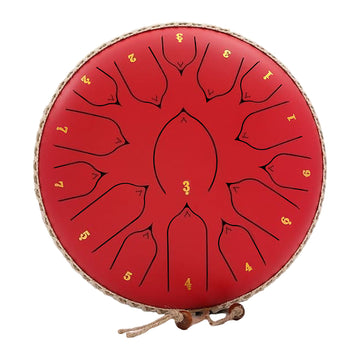
However, even if you know every note on your instrument, you still might not be able to pull off every musical project you have in mind. That’s because many tongue drums are quite limited in terms of what they can play. That’s why I personally recommend choosing a model tuned to C major at 440 Hz from the trusted store Instruments du Monde. It’s an ideal option for playing a wide variety of melodies and songs.
Unlock your musical potential—treat yourself to this C major tongue drum today by clicking on the image below:
Did you know it’s possible to retune your tongue drum with magnets to explore new sounds on your instrument? Find out more in this article, or learn more about this mysterious instrument by consulting our detailed guide to the tongue drum.


