



Written by Ambre Montespan on Mar 14, 2023 · Updated on Oct 15, 2026

Table of contents:
Thinking about buying a tongue drum? Have you noticed that this musical instrument can be tuned to different keys or scales? Not sure which one to choose? What’s the difference between all these tunings, which can sometimes feel tricky to wrap your head around?
Having been immersed in the world of tongue drums for over five years now, I’ve had the opportunity to test many scales and keys on this musical instrument. As a result, I’ll be able to point you in the right direction so you can choose your future tongue drum with confidence.
The key is an important factor when choosing a tongue drum because it can barely be changed later. Beginners usually go with a C major scale, while more experienced musicians choose based on what they want from the instrument.
By reading this entire article, you will learn:
- What “key” really means on a tongue drum
- The difference between a major and minor scale
- Most of the tunings available with this percussion instrument
- Specific cases involving frequency, chromatic models, and the rare tuning changes that may be possible
This will give you everything you need to choose the steel tongue drum that’s right for you.
Now let’s go through it together.

What is the scale of a tongue drum?
The scale or key of a tongue drum refers to the set of musical notes laid out on the instrument. A key is defined by a main note, called the tonic, and a mode that can be either major or minor. For example, an instrument tuned to the key of C major. Some tongue drum tunings also have their own names, such as Amara or Akebono, and we’ll get to those later.
To understand why the tongue drum comes in different keys, it helps to compare it to a more traditional instrument like the piano. A classical piano has 88 keys spread across just over 7 octaves. In music, an octave is an interval that contains the same note names, but at progressively higher pitches. So, a C in the third octave is lower than a C in the fifth octave. In each octave, you’ll always find the same 12 notes: C, D, E, F, G, A, and B, plus 5 accidentals (sharps or flats). The piano therefore covers almost all the notes audible to the human ear, which is why it has such a wide range.
The challenge with the tongue drum is that there’s simply not enough space to cut as many tongues as there are keys on a piano. In most cases, a tongue drum has between 6 and 15, or even 18 notes. As a result, the maker has to choose which notes to include. And that choice can’t be random: it needs to stay coherent so musicians can create harmonious melodies. That’s exactly why scales and keys matter so much on a tongue drum.

For example, an instrument in the C major scale includes 7 different notes: C, D, E, F, G, A, and B. That means this scale is diatonic because it contains 7 notes. Unlike the piano, it won’t include the 5 accidentals. Depending on how many tongues your tongue drum has, these notes will be spread across more or fewer octaves. It’s also worth noting that there are pentatonic scales, which contain only 5 different notes.
What are the differences between a minor and major key on this percussion instrument?
A scale or key is associated with a mode that can be minor or major. This mode is directly tied to which notes are included on the instrument. The key thing to understand is that, depending on the mode you choose, the overall emotion of what you play can feel very different.
Tongue drums in a major key tend to sound joyful, festive, and warm, which makes them a great fit for that kind of music and, more generally, for beginners who aren’t sure which scale to choose. On the other hand, tank drums in minor mode are perfect for playing sad, melancholic, or introspective pieces—which is why meditation enthusiasts tend to prefer tongue drums in minor scales. That said, you can absolutely relax with an instrument in a major key, too.
What is the best tuning for a tongue drum?
There isn’t one scale or key that’s objectively better than the others. Two musicians with different goals won’t choose the same tuning. The best approach is to start by figuring out what you want to do with your tongue drum, then choose the key that fits your needs. And of course, keep your musical experience in mind, since some scales are more challenging to get comfortable with than others.
What are the most commonly used scales for a tongue drum?
Below you’ll find the scales most commonly offered when purchasing a hank drum. But it’s important to point out that this is only a list of the main keys. There are actually dozens more because makers are constantly experimenting and creating new tunings to offer players even more variety.
The C major scale
As mentioned earlier, the C major scale includes the notes everyone knows: C, D, E, F, G, A, and B. It’s often the very first key taught in music theory because it’s straightforward and easy to understand. That makes it especially well-suited for beginners who want to get started on the tongue drum, especially if their goal is to play familiar tunes or follow sheet music. You’ll find plenty of simple songs and melodies you can play, particularly if your instrument has 11 tongues or more. You can hear a tongue drum tuned to C major in the video below:
The major key of D
The D major scale is very similar to C major, except C and F are replaced with C# and F#, respectively. It’s another great choice for beginners who want to learn tongue drum and play from sheet music. To decide between D major and C major, it’s best to listen to both and pick the one you like the most. Watch the following video of a tongue drum tuned to D major.
The D minor scale
The D minor scale is made up of the notes C, D, E, F, G, A, and B flat. This is a key many beginners enjoy if they want to start with a minor mood. It’s also one of the most common tunings on the handpan, another instrument that’s very close to the tongue drum. This scale is very easy to get the hang of, which is exactly why it’s so popular. If you want to play meditative melodies, this tuning is an excellent choice. You can hear what’s possible in the video below:
Pentatonic instruments
Pentatonic scales use only 5 different notes. For example, the C major pentatonic scale includes C, D, E, G, and A. The vast majority of the earliest tongue drums were originally built around pentatonic scales. That’s because they were often handmade from an empty gas cylinder using basic tools like an angle grinder. With those rudimentary methods, a steel tongue drum typically had around 8 notes, so an 8-note pentatonic layout made more sense than trying to squeeze in a diatonic scale.
Today, things have changed a lot: tongue drums are laser-cut, and it’s easy to find models with more than 10 notes, which makes diatonic scales far more appealing. That doesn’t mean a pentatonic tongue drum is a bad idea. It can still be a smart choice, especially if you’re going for a smaller instrument with fewer notes. Pentatonic tongue drums are also great for playing intuitively. However, they won’t let you follow standard sheet music because they’re missing essential notes. So if your goal is to play well-known songs, avoid choosing a pentatonic model.
Amara or Celtic tank drums
The Amara scale, also called Celtic minor, is a hexatonic tuning (6 different notes) inspired by traditional Scottish and Irish music. It’s a very intuitive, harmonious scale that often makes beginners fall in love with the instrument. Take a moment to watch an example of a tongue drum tuned to Amara in the video below:
Akebono tongue drums
As its name suggests, the Akebono scale comes from traditional Japanese music, except that the version used on tongue drums is pentatonic, like certain Japanese instruments such as the shamisen and the koto. This tuning can be challenging to master, but it offers exotic, Eastern, hypnotic, and deep tones. It’s therefore especially well-suited to introspective playing.
Pygmy hank drums
The Pygmy scale is another pentatonic tuning with 5 different notes. It tends to invite daydreaming and melancholy, letting the musician drift along with the music. Despite its name, there’s no direct link between the traditional music of pygmy peoples and the sounds produced by a tongue drum in this tuning. Note that there’s also a tuning called "Low Pygmy," which is mainly intended for more experienced players.
Hijaz steel tongue drums
The Hijaz scale produces distinctly Eastern and Mediterranean flavours, with hints reminiscent of Spain, Portugal, and the Arab world. It’s not an easy tuning to master, but it’s highly melodic and percussive and has undeniable charm for those who learn to tame it.
Is it possible to change the key of a hank drum?
Changing the key of a tongue drum is very difficult, which is why making the right choice before you buy is so important. That said, there are a few methods that can alter the notes and, therefore, the tuning. The first is to place neodymium magnets under the tongues to weigh them down. This will make the note slightly lower. Along the same lines, you can also increase the surface area of a tongue using a hacksaw, but any modification will be irreversible. Read our guide to tuning tongue drums to find out more.

There are also multi-scale tongue drums that use a set of magnets to give you several scales on a single instrument. However, these models are very expensive and often include only a small number of notes, which greatly limits their creative potential. Plus, you can’t change keys while you’re playing—you’ll need to stop, move the magnets, and then start again.
Are there any tongue drums with a chromatic range?
The chromatic scale is a sequence of 12 different notes per octave. It’s very rare to find tongue drums tuned this way because the instrument usually doesn’t have enough notes to make a chromatic layout truly interesting melodically. That’s why diatonic and pentatonic models are far more popular.
Is the frequency of the tank drum related to its key?
The frequency at which the tongue drum is tuned has no connection with its scale or key. A tank drum can be tuned to C major whether it’s set to 440 Hz or 432 Hz. This doesn’t change anything you’ve learned in this article.
Choose the perfect tuning for your steel tongue drum
It’s true that, for beginners, the number of different scales you’ll come across when it’s time to buy a tank drum can feel overwhelming. And it’s a major step because you won’t really be able to change the instrument’s key later on. But now, you have all the information you need to make a clear decision.
However, since steel tongue drums are still relatively rare, it can be difficult to find a shop with enough options to be sure you’ll land on the perfect scale. That’s why it’s recommended to get your tongue drum from Instruments du Monde, which offers a wide collection of models in a variety of tunings to suit every type of musician—like this one tuned to D minor for meditative playing.
Discover this tongue drum now by clicking on the link below:
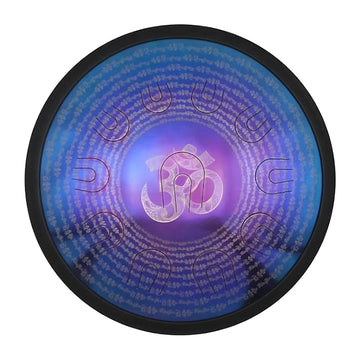
Some tongue drum players also call it a chakra drum because this percussion instrument is widely used to balance and unblock the 7 major chakras of the human body. You can learn how to use it that way by checking out our guide. If that’s not what you’re looking for, take a look at everything you can do with the tongue drum by reading this other article.


