



Written by Ambre Montespan on Mar 14, 2023 · Updated on Oct 15, 2026

Table of contents:
Do you already own a kalimba and want to know what notes this percussion instrument can play? Are you thinking of buying a thumb piano and want to know what notes it comes with so you can work out which melodies you’ll be able to play? Is it possible to play sharps or flats on the mbira?
Having played the kalimba for over 10 years, I know this musical instrument inside and out, and I can easily explain which notes you can play depending on the model you own.
Kalimbas generally play notes between F in the 2nd octave and E in the 5th octave. Depending on the number of tines and the key it’s tuned to, the notes will vary from one model to another.
By reading this article, you will learn:
- The notes on your kalimba
- How to play altered notes with sharps and flats
- What the apostrophes above or below the notes mean
- Why the length of the tines affects the notes played
You will then understand how the thumb piano works and all the notes you can play with it.
Let’s start by looking at the notes you’ll find on a kalimba.

How do you find the notes on your kalimba?
The notes on a kalimba can differ from one instrument to another. This depends on the number of tines it has, but also on the key it’s tuned to. That said, the most common kalimba on the market is the 17-tine model tuned to C major. So, it makes sense to start with 17-tine kalimbas to understand how note layouts work, and then move on to other thumb pianos.
How do you know the notes of a 17-tine kalimba?
Kalimbas work on a simple principle: each tine corresponds to a single musical note. So, a 17-tine kalimba has 17 distinct notes. For musicians who already have some knowledge of music theory, the notes on a 17-tine kalimba in C major correspond as follows:
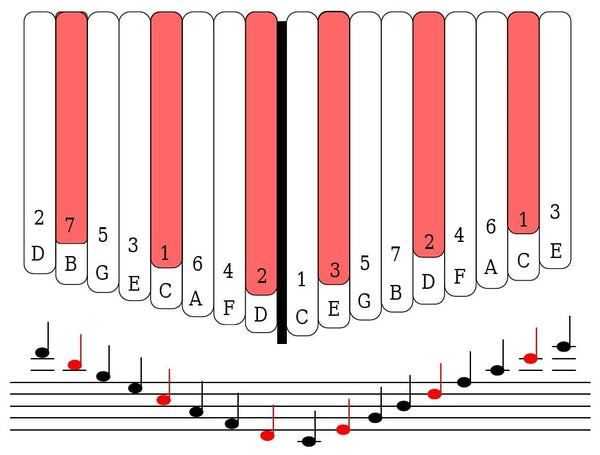
The centre tine—the longest one marked "C" and "1"—corresponds to a C in the 3rd octave. The one just to the left, marked "D" and "2," is a D in the same octave. The one further left is an F, also in the same octave. Here, the letters or numbers refer to a different note-naming system than solfège, as shown in the following table:
| solfège | Do | Ré | Mi | Fa | Sol | La | Si |
| Letter names | C | D | E | F | G | A | B |
| NMCA | 1 | 2 | 3 | 4 | 5 | 6 | 7 |
You may notice that the letters or numbers repeat across the kalimba’s tines. That’s because they represent the same notes, just one octave higher. The note played on that tine is therefore higher pitched because its frequency is doubled.
Therefore, a 17-tine kalimba in C major has the notes C, D, E, F, G, A, and B in the 3rd and 4th octaves, plus C, D, and E in the 5th octave.
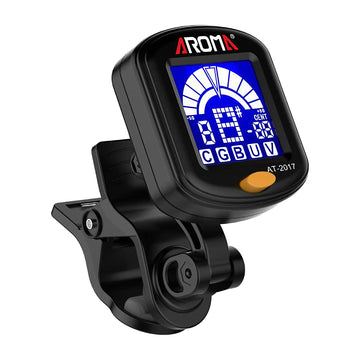
However, some instruments aren’t necessarily tuned to C major. For example, there are kalimbas in B major. In that case, the notes played are different. Often, the steel tines are engraved to help you identify them. So, if you see the marking "C#" on a tine, it means it plays C sharp. If your tines aren’t engraved and you have no idea what note they’re supposed to produce, the only solution is to use an electronic tuner, which will analyse the note and display it for you. Read our guide to the best kalimba tuners to find out which device to buy.
What are the notes on 5-, 7-, 9-, and 21-key thumb pianos?
Kalimbas with 21 tines usually have the same keys as a 17-note model, with the addition of four lower notes: F, G, A, and B in the second octave. However, this only applies to kalimbas tuned to C major.
For models with fewer tines, such as those with 5, 7, or 9 notes, there are no real general rules, as manufacturers offer very different instruments. In this situation, you’ll need to refer to the engraving on the tines or use a tuner, as explained above.
What do the apostrophes on the notes mean for the mbira?
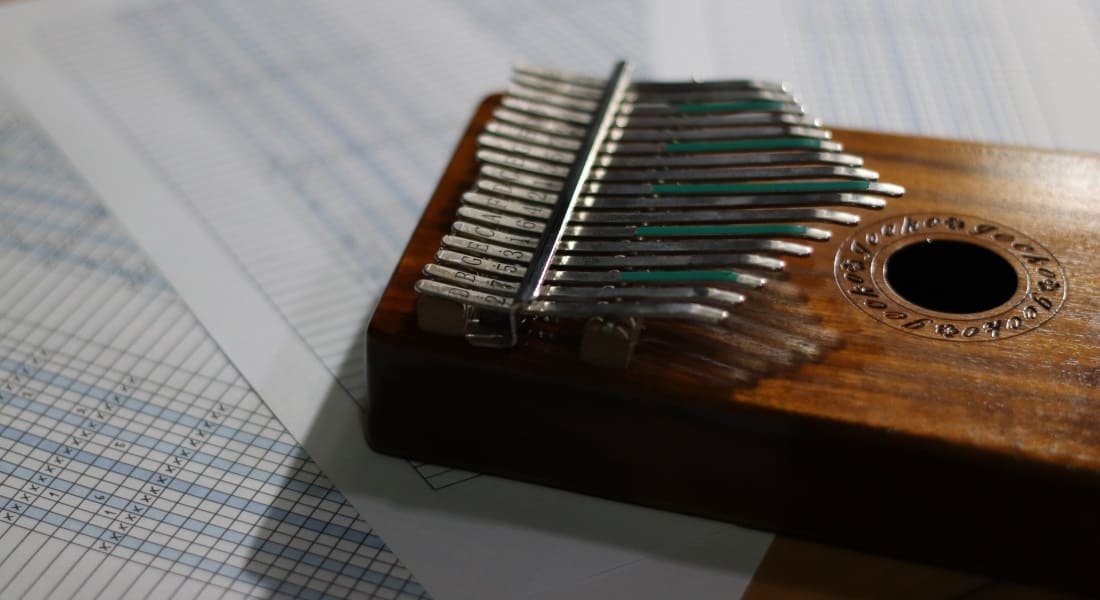
Apostrophes, dots, or stars above or below the notes indicate the octave the note belongs to. If there is nothing written, it means that the note is in the 3rd octave, which is the reference octave on most kalimbas. One mark above indicates the 4th octave, and two marks above indicate the 5th octave. If the mark is placed below the note, it refers to the 2nd octave. Don’t worry if your kalimba doesn’t include any notes from the 2nd octave—this is very common. Often, only models with 21 or more tines have them.
Why don't all the tines on a thumb piano produce the same note?
Physically, tines produce different notes depending on their length. When you pluck a tine with your thumb, it vibrates differently depending on how long it is. A shorter tine oscillates faster, producing a higher frequency and therefore a higher note. Conversely, a longer tine oscillates more slowly and produces a lower note.
What is the ideal blade length for a kalimba?
Kalimba tines are made within a fairly specific length range. If they are too short, they can’t vibrate properly and won’t produce sound, which is why thumb pianos generally only reach up to E in the 5th octave. The same issue occurs with a tine that is too long, which won’t produce a pleasant, harmonious tone—so it’s rare to find models with notes lower than F in the 2nd octave. Thus, the length of kalimba tines measured from the lower bridge is about 2–7 cm (0.8–2.75 in), while their total lengths are about 7–12 cm (2.75–4.75 in). The range of notes an instrument can play is called its tessitura. On the kalimba, it’s generally considered average.
How do you play sharps and flats (semitones) on this percussion instrument?
Many beginner players wonder how to play a flat or sharp on their kalimba so they can tackle pieces that require these notes. You can absolutely play these altered notes (also called accidentals) as opposed to natural notes, which have neither sharps nor flats.
To do this, you need to change the tine’s position. For example, if you want to play F sharps in a piece, locate the tine (or tines) that plays F, then shorten the vibrating length slightly relative to the lower bridge so it produces a higher pitch (a sharp is a semitone above its natural note). For a flat, it’s the opposite, since it’s a semitone below, so you’ll slightly lengthen the vibrating portion of the tine. In practice, this process of shifting tines is called tuning, and it’s explained step by step in this comprehensive guide. You’ll then be able to play any altered notes you want. Also note that a chromatic kalimba already has all of them, with no adjustment needed.
Treat yourself to a chromatic instrument with more notes
The notes on a kalimba are not fixed, because the tines can be moved to change the instrument’s tuning. This can sometimes make it hard to know exactly which notes your thumb piano is producing. But with the tips you’ve just read, you’ll be able to identify all the notes on your kalimba.
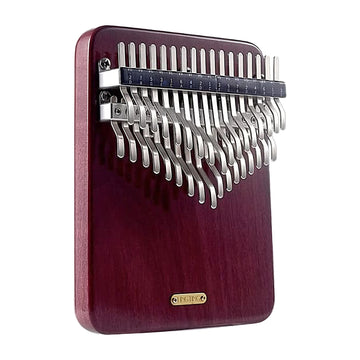
However, it can be frustrating to keep retuning your mbira when it doesn’t include the notes you need for a particular piece. To solve this problem, Instruments du Monde recommends using a chromatic kalimba, which includes the altered notes commonly found in sheet music. Like this 34-note model below, made from luxurious amaranth wood with reddish highlights.
Get this chromatic kalimba by clicking the link below:
Many well-known musicians have already used the kalimba in their compositions. Discover them all in our article that rounds them up. If that topic isn’t for you, check out the kalimba encyclopaedia, which covers everything you need to know about this percussion instrument.


