



Written by Ambre Montespan - Updated on Aug 11, 2026
Table of contents:
Are you wondering if there are several types of djembes in the world of music? Would you like to learn about the many versions of this African drum available on the market? How can you recognize the different kinds of this percussion instrument?
I discovered the djembe more than 20 years ago, and I’ve had the chance to explore a wide variety of djembes and become familiar with each one. So I can easily list the different types that exist and help you tell them apart.
There are many different types of djembes on the market—from traditional to modern models, including miniature, electronic, fiberglass, and children’s djembes.
As you read through this article, you will discover the different types of djembes, including:
- The different types of traditional djembes
- Modern instruments with tension rods and electronic instruments
- Miniature and children’s African drums
- Fiberglass, plastic, and aluminum djembes
By the end of this article, you’ll know which djembe types are available on the market, so you can choose your future musical instrument based on your needs and expectations.
Now it’s time to explore these different types of djembes!
Origins and characteristics of different types of traditional djembes
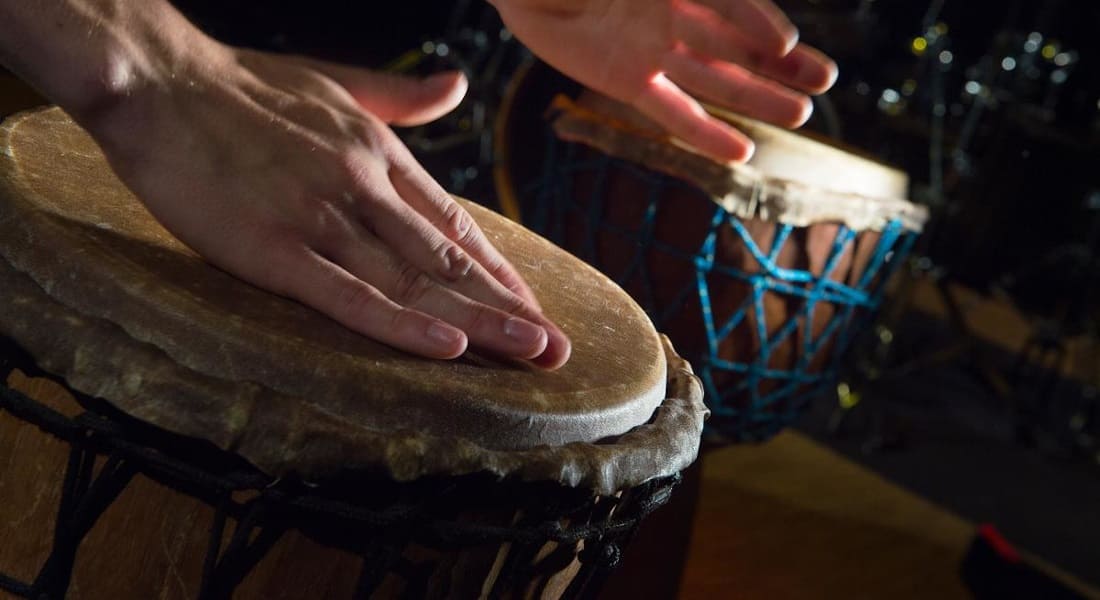
The traditional djembe is a percussion instrument deeply rooted in the history and culture of West Africa. Originating in regions such as Guinea, Mali, Senegal, and Ivory Coast, the djembe is a symbol of African musical heritage. Its traditional shape is simple, but its construction is complex. It typically stands about 20–24 in (50–60 cm) tall with a diameter of roughly 12 in (30 cm). The djembe is carved from a single piece of hardwood, which can be mahogany, lenke, or iroko. Check out our article dedicated to the many types of wood used in the manufacture of djembes to learn more. The traditional membrane is made from goat or antelope skin, stretched taut across the top. Iron tension rings secure the skin in place, and cotton ropes are used to adjust the tension and tune the instrument.
This is clearly the most common type of djembe, even though a few small changes have appeared over time as the instrument adapted to new materials. For example, cotton ropes are often made of nylon nowadays. Likewise, the tension rings may be made of steel for added strength. It’s also worth noting that traditional djembes, while similar in overall shape, can vary subtly depending on where they’re made. For example, Senegalese drums have a base that flares outward, while Malian instruments are perfectly cylindrical. In the same way, some djembes feature a more conical resonating chamber, while others look more rounded.
In general, the traditional djembe is known for its wide range of sounds, from deep bass to piercing highs. This range of tones comes from striking different areas of the head—from the center to the edges—and from adjusting rope tension. The traditional djembe is also known for its ability to express complex rhythms and melodies, making it a central element of ceremonies, celebrations, and social gatherings in West Africa. You can hear a traditional djembe in the video below:
The modern djembe with tension rods and electronic models
The modern djembe has undergone a significant evolution from its traditional roots in West Africa. This transformation has been driven by various factors, including globalization and the search for new sounds and playing techniques. By incorporating musical influences from around the world, the modern djembe has expanded its sonic palette, offering fresh creative possibilities for percussionists.
One of the main developments in the modern djembe is the use of mechanical tension rods instead of ropes to tighten the head, making it easier to adjust tension. In fact, this technology was borrowed from the conga, another percussion instrument similar to the djembe but originating in Cuba, which itself was inspired by a French cooperage technique. While tension rods are convenient, the biggest drawback is that the sound is altered compared to a traditional model, which is why I personally prefer a good rope-tuned djembe over a rod-tuned one. You can see a rod-tuned djembe in action in the following video:
Some djembes now incorporate some or even fully electronic technology. Some are traditional instruments fitted with a built-in microphone, sometimes with a jack output, for amplified performances. Others are actually virtual drums where you can select a djembe sound. In other words, it’s a simple, roughly round pad that simulates djembe tones depending on where the percussionist strikes it. The result is impressive—so is the price—but I feel the djembe’s charm gets lost. In addition, the acoustics aren’t truly the same, and you won’t get the original power of a real instrument.
One of the key features of the electronic djembe is the ability to produce a wide variety of sounds, from traditional to contemporary, using samples and electronic effects. This gives percussionists the freedom to create diverse soundscapes, from ethereal to energetic, while retaining the rhythmic signature of the djembe. In addition, the electronic djembe allows for advanced connectivity, meaning it can be integrated into larger setups, including sound and music production systems. This makes it suitable for a wide range of performances, from live concerts to electronic music in the studio. Watch the video below to see how a virtual djembe is used:
Are there any miniature African drums or drums designed for children?
Miniature djembes are small replicas of their standard-sized counterparts, but often measure between 8 and 16 in (20–40 cm) tall. These compact instruments have gained popularity thanks to their portability and versatility. Even with their smaller size, they can still deliver an impressive range of tones, from low to high, making them fully capable musical instruments. Thanks to their compact format, miniature djembes are perfect for traveling. They’re easy to carry and can be played almost anywhere—outdoors, in the studio, or during intimate performances. This portability makes them especially popular with musicians on the move.
In addition, miniature djembes are commonly used to teach percussion to children. Their smaller size makes them more accessible for young, aspiring percussionists, giving kids a fun way to discover rhythm and music while developing their playing skills. It’s an educational approach to learning percussion that helps children get into music in an enjoyable way. Thanks to its kid-friendly size, a children’s djembe is easy to handle, which encourages kids to explore rhythm and musicality.
Learning to play the children’s djembe can be an ideal introduction to music and percussion, helping young players develop coordination, rhythm, and creativity. By playing the djembe, children gain an early understanding of musical concepts such as tempo and dynamics, while building their self-confidence. It is ideal for schools, music camps, and after-school activities, offering children an enriching musical experience. Enjoy the sounds of a small djembe below:
Instruments made of fiberglass, plastic, and aluminum
Technological advances have inevitably led artisans and djembe manufacturers to experiment with new materials to produce their various models. This is how several other types of African-style drums made of fiberglass, plastic, and even aluminum came into being.
Fiberglass or plastic djembes are a modern alternative to traditional wooden djembes. They’re crafted from synthetic materials, making them remarkably light and durable. This material is both weather-resistant and easy to carry, so it’s an excellent choice for traveling percussionists and musicians looking for practicality. In terms of durability, fiberglass djembes are built to handle tough conditions. They aren’t affected by humidity, heat, or rain, which makes them suitable for outdoor performances. Plus, their fiberglass shell is less prone to dents and scratches than wood, which makes them a good fit for intensive use. Plastic is also durable, but to a lesser extent. However, while plastic djembes remain affordable, fiberglass djembes can easily cost several hundred dollars.
Aluminum djembes also exist. Whether it’s durability, weight, or acoustics, I’m really not convinced by this kind of instrument. Manufacturers don’t seem convinced either, since these models are relatively rare compared to classic solid-wood drums. The main advantage of synthetic djembes is that they are completely vegan, as even the head used does not come from animals. This may be an important point if you’re particularly sensitive to this cause.
Choose the djembe that’s right for you today
Together, we’ve explored a wide range of djembes, including some that aren’t widely known. After all, it’s not every day you’ll run into a virtual djembe or a metal model at concerts or festivals. But now, thanks to this article, you know all the different types of djembes that exist.
Still, it’s not easy to find a trusted specialist who can offer enough options to meet every expectation. Whether you’re an experienced percussionist or you’d like to discover the magic of African percussion, tracking down the right model isn’t always simple. That’s why I recommend the Instruments du Monde store, which offers a solid selection of quality djembes. You’re sure to find the African drum that suits you perfectly.
Check out the collection of djembes offered by Instruments du Monde now!
If you already own one of these African drums, one essential step in proper maintenance is learning how to replace the head. Read our article on repairing and replacing the skin on a djembe. You’ll learn exactly how to do it, so you can be fully self-sufficient with your percussion instrument.
