



Written by Ambre Montespan on Sep 2, 2024 · Updated on Sep 25, 2026

Table of contents:
Thinking about buying a handpan to play beautiful melodies? You’ve probably noticed that this percussion instrument comes in two main tuning frequencies: 440 and 432 Hz. What do these numbers actually mean, and is there any real reason to choose one over the other?
After playing songs on several of my handpans and Hang drums for over 10 years, I now own models tuned to both 440 and 432 Hz. Because I know exactly what these two frequencies mean, I can help you make the right choice.
440 Hz is the international standard, which makes it easy to play with other instruments. 432 Hz is often associated with supposed health and “spiritual” benefits, but none of that has been clearly validated by science.
In this helpful article, you’ll discover:
- What the frequency listed on a handpan really means
- The differences between an instrument tuned to 440 and 432 hertz
- The advantages and disadvantages of each of these frequencies
With this knowledge in hand, you’ll be ready to choose the perfect handpan, since this setting can’t be changed once the instrument is yours.
Let’s start by explaining what tuning frequency means for a handpan.
What does the tuning frequency for a musical instrument correspond to?
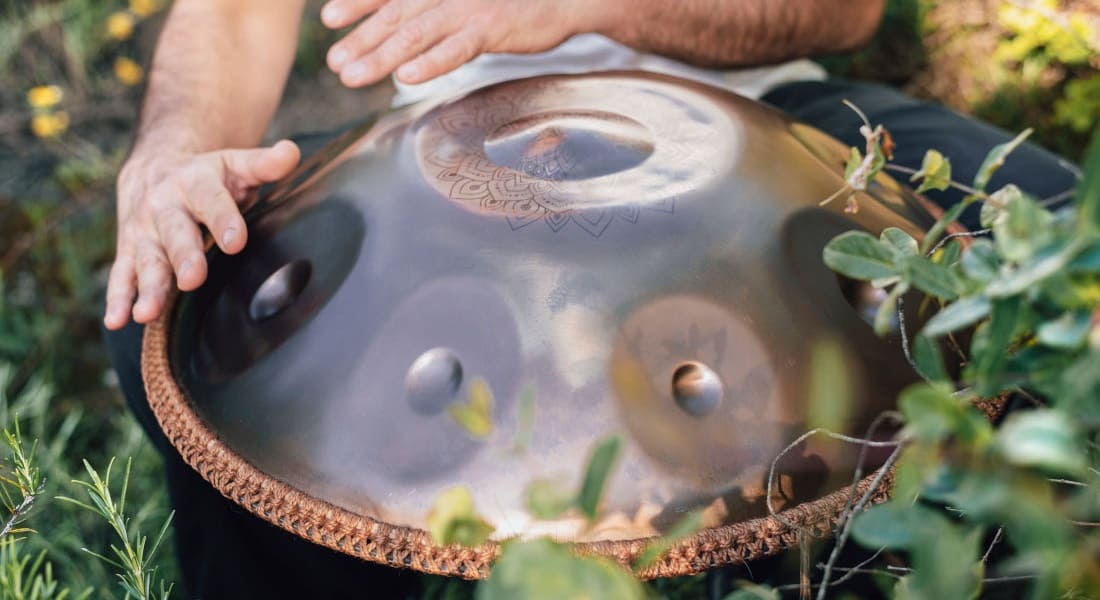
When we say a musical instrument or a song is tuned to a certain frequency, it means the reference A (concert A, the A above middle C) vibrates at exactly that rate. For example, a handpan tuned to 440 Hz will have its reference A tuned precisely to 440 hertz. A hertz (Hz) is the unit used to measure frequency: it represents the number of cycles (oscillations) per second in a periodic phenomenon, such as a sound wave or an electrical signal. For example, a frequency of 50 Hz means there are 50 cycles per second. In acoustics, the higher the frequency, the higher-pitched the sound you hear.
To understand why handpans exist in both 432 and 440 hertz, we need to go back in time. In the 11th century, the Italian monk Guido d’Arezzo developed, in his treatise Micrologus, the idea that musical notes should have names (do, re, mi, fa, sol, la, and si) and that they should always keep the same pitch, meaning the same frequency. These ideas heavily influenced how music evolved in the West. But one key question remained: which reference note should all the others be based on? The answer became A. And then came the next question: what exact frequency should that A be? That reference pitch is what we call concert pitch, and it’s exactly where opinions differed for a long time.
In fact, until the mid-20th century, the frequency of A varied depending on the country, the instruments, and the era. In the 16th century, A was tuned to 466 Hz. In 18th-century French Baroque music, A was tuned to 392 hertz, while Johann Sebastian Bach tuned his instruments to an A at 415 hertz. The important thing to remember is that there were many different A notes used as a reference, which made it difficult when musicians from different nations wanted to play together.
In 1884, Italian composer Giuseppe Verdi was one of the first to push for a standardized A at 432 hertz, a pitch formally adopted by most Italian musicians and later dubbed “Verdi’s A” or “Verdi’s tuning fork.” But in 1939, it was decided worldwide that the standard tuning frequency for music and instruments would be 440 hertz, despite protests from the French and Italians, who were very attached to Verdi’s A. This controversial decision was revalidated first in 1953, then again in 1975 with the publication of the ISO 16:1975 standard. Since then, the vast majority of instruments such as the Hang drum, piano, violin, and many others have been tuned to 440 Hz, the internationally standardized frequency.
Now let’s get to the heart of the matter and explore the differences between a handpan tuned to 440 Hz and another tuned to 432 Hz.

What are the differences between a handpan tuned to 440 Hz and another tuned to 432 Hz?
The first thing to mention is that the only difference between a handpan tuned to 432 Hz and another tuned to 440 Hz is the sound. Similar instruments will have the same size, weight, number of notes, and scale, but the notes will sit at slightly different pitches. So it’s impossible to tell just by looking whether a handpan is tuned to 440 or 432 Hz, unless this information is written directly on the percussion instrument by the maker.
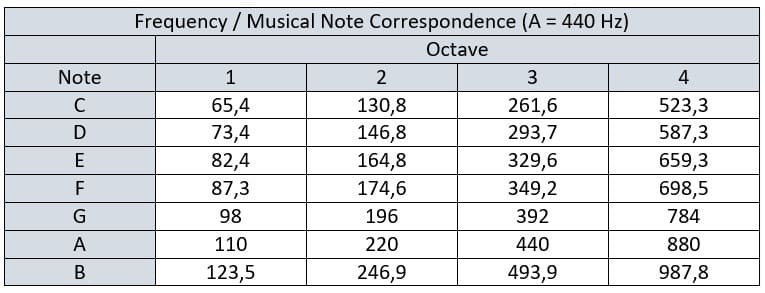
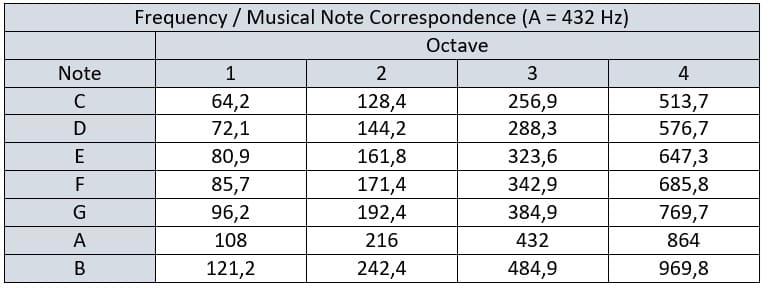
It’s important to understand that the reference pitch chosen when making the handpan doesn’t only affect the A. In reality, all the other musical notes are calculated based on the frequency of that A. So, on a 440 Hz handpan, a C on the same instrument will be tuned to 261.6 Hz. On a 432 Hz model, that same C will have a pitch of 256.9 Hz. You can find and compare all the frequencies of the different notes in the following two tables.
The first table shows handpans tuned to 440 Hz:
And the second one is for instruments tuned to 432 Hz:
Since lower frequencies produce lower pitches, a handpan tuned to 432 Hz will sound slightly deeper than the same model tuned to 440 Hz. This is the fundamental difference between these two types of handpans, although the effect is subtle. You can hear it in the video below, which shows the same melody played on a 432 Hz handpan on the left and a 440 Hz handpan on the right.
You probably noticed that the handpan on the right sounds a bit brighter (higher) than the one on the left. But that’s not the main reason so many people seek out 432 Hz handpans. To dig deeper, let’s look at the advantages and disadvantages of each frequency.
What are the advantages and disadvantages of a handpan tuned to 440 and 432 hertz?
Let’s step into a debate that can get pretty heated between fans of 440 and 432 Hz. What are the pros and cons of these two tuning standards? As we’ve seen, 440 Hz was chosen as the international standard. So why did 432 Hz stand out compared to other historical pitches like 466 or 392 Hz? According to its supporters, 432 Hz is a more natural tuning frequency, more pleasant to listen to and to play, and more soothing than 440 Hz, which they describe as more “mechanical.” Some even claim it relates to the golden ratio (phi) and resonates with the universe’s acoustic phenomena. You may also come across claims that a 432 Hz handpan produces softer, rounder, more harmonious notes than one tuned to 440 Hz. Personally, I don’t agree: in my experience, those qualities depend far more on the material the handpan is made of than on its tuning frequency.
The issue with 432 Hz is that you’ll find a lot of exaggerated (and sometimes questionable) claims about it. For example, on the Esprits Science et Métaphysiques website, you can read: “Studies reveal that 432 Hz tuning vibrates the golden ratio of the universe, PHI, and unifies the properties of light, time, space, matter, gravity, and magnetism with biology, DNA code, and consciousness,” without citing the sources of those studies. You’ll also sometimes see claims that music at 432 hertz can make water “vibrate” or crystallize more harmoniously, using this photograph as proof:
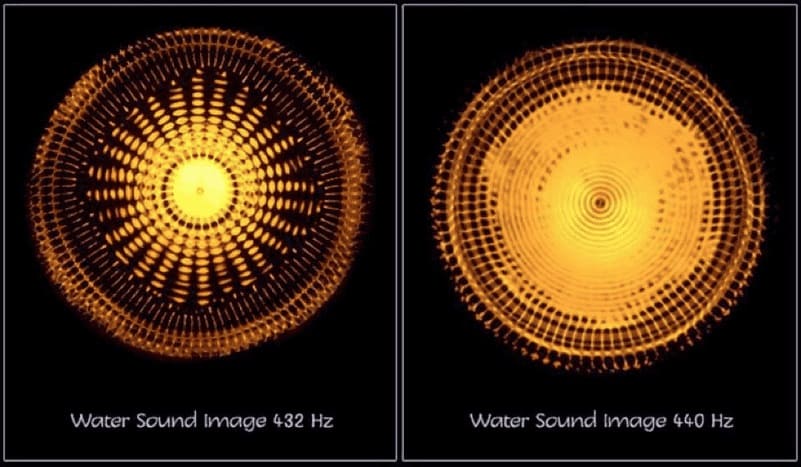
However, what’s often left out is that results like the one shown in this photograph are highly dependent on factors such as temperature and humidity during the experiment. And beyond the fact that 432 Hz may simply look “nicer” in this comparison, there’s no strong scientific takeaway here.
Others also attribute benefits to it for the body and mind, especially in terms of relaxation and calm. In May 2022, German researchers published a book titled “Musik & Marken,” with a chapter focusing on perceived arousal when listening to music at 440 vs. 432 Hz. They played six 30-second music clips to 54 subjects, once at 440 Hz and once at 432 Hz. Participants then rated how “excited” they felt after each listening session. The results found that perceived arousal was actually higher at 432 Hz than at 440 Hz, which could suggest the opposite of what many 432 Hz advocates claim.
Another study, published in July 2022 by Professor Branislav R. Tanasic in Serbia, examined the impact of music tuned to 432 Hz vs. 440 Hz on the brain using electroencephalography (EEG). The results suggest that music at 432 Hz may produce slightly higher activity in the left prefrontal cortex, an area associated with positive emotional responses and long-term memory, compared to music tuned to 440 Hz. However, the differences observed were very subtle, and the experience remains subjective, depending on each participant’s individual perception. In my opinion, science still hasn’t proven meaningful 432 Hz benefits in terms of relaxation and calm. That said, you may naturally prefer the sound of one frequency over the other. This is completely subjective, and even if the pitch difference is small, some percussionists clearly prefer either 440 Hz or 432 Hz. It’s best not to attribute “effects” to 432 Hz that are far from established.
That said, there’s another factor that’s entirely objective: availability and compatibility. Since 440 Hz is the standard, you’ll find more models designed for this frequency than for 432 Hz, even though more makers now offer both options. As a result, 432 Hz models can be a bit harder to find, especially if you’re looking for a very specific scale and number of notes.
What’s more—and this is a crucial point—an instrument tuned to 440 Hz can only play with other instruments that are also tuned to 440 Hz. If you mix instruments tuned to different frequencies, the result won’t sound harmonious. In the handpan world, just like with most other instruments, the vast majority of musicians you’ll meet will be tuned to 440 Hz. So if you choose a 432 Hz model, you’re much more likely to be “out of tune” in a group setting compared to a 440 Hz instrument. Of course, if you plan to play only solo, this doesn’t matter. But you might be surprised how many people have told me they eventually regretted choosing 432 Hz because it kept them from spontaneous jam sessions and musical meetups. And as I mentioned earlier in this article, don’t expect to convert your 432 Hz handpan to 440 Hz (or vice versa). It’s too expensive, and most players end up buying a second instrument instead.
To wrap up: if you feel a special connection with 432 Hz, go for it. Just keep in mind that the supposed benefits haven’t been proven at this stage of scientific research, and you’ll be limited to playing only with other instruments tuned to 432 Hz as well. That’s why frequency is an important criterion when choosing your handpan.
Choose the frequency that inspires you for your handpan.
If you’re new to handpans, choosing a frequency can feel confusing. The instruments look nearly identical, and their tone can be very close, which doesn’t make the decision any easier. Still, this isn’t a minor detail: it will stay with you for as long as you own the instrument. With what you’ve learned in this article, I’m confident you’ll be able to make the right choice between 440 and 432 Hz.
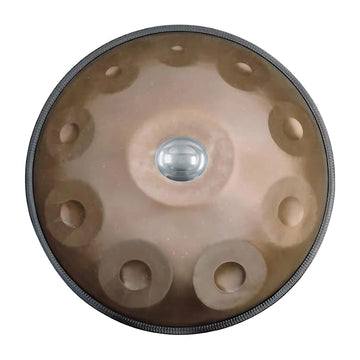
However, as I mentioned earlier, makers that offer both 440 and 432 Hz models are still relatively uncommon. That’s why I recommend the online store Instruments du Monde, which offers dozens of models in either frequency, so you can be sure to find the handpan of your dreams—like this beautiful golden handpan, available in both 440 Hz and 432 Hz.
Discover this beautiful instrument now by clicking on the image below:

Another common sticking point when choosing a handpan is how many notes it should have. Should you get as many as possible, or keep it reasonable so you don’t make learning harder than it needs to be? Find out now by reading my article dedicated to the number of notes on a handpan. Once you’ve read it, everything will feel much clearer when it comes to selecting your future drum.


