



Written by Ambre Montespan on Sep 23, 2024 · Updated on Oct 6, 2026

Table of contents:
Thinking about buying a handpan? Have you noticed that prices for this instrument can vary wildly? Wondering what explains the price gap, and which model makes sense for your budget?
I’ve been playing handpan for over 10 years. Over the years, I’ve owned plenty of models at very different price points. Based on that experience, I can help you make sense of this price “jungle” you’ll find with this percussion instrument.
A handpan can cost anywhere from a few hundred to several thousand euros. For a solid, handcrafted 9-note model, prices typically start around €1,000.
Once you’ve finished reading, you’ll have clear answers to all your questions about:
- The price of a handpan
- The reasons why this instrument is so expensive
- The second-hand market for Hang drums
As a result, you’ll be able to choose your future handpan with confidence and, above all, know whether your budget truly matches your goals for buying this one-of-a-kind instrument.
Now, let’s break down what a handpan can actually cost.
How much does a genuine handpan cost?
As I mentioned earlier, the price of a handpan varies a lot. Entry-level models now start around €400, while higher-end builds can reach €3,000 or even €5,000. And that’s not even counting collector’s pieces, such as the first-generation Hang developed by PANArt Hangbau SA, which can sometimes sell for over €10,000. If handpan prices swing that much, it’s largely because build quality, the number of notes, the scale, and even the type of metal used can differ dramatically. Let’s go through each factor.
Does the quality of manufacture influence the price of a handpan?
Absolutely—the manufacturing method has a major impact on the instrument’s final price. But don’t be fooled: an expensive handpan isn’t automatically a good one. Some makers play on pricing to create the illusion of “premium,” even when the quality doesn’t follow. On average, a good, handcrafted 9-note handpan in a common scale will run about €1,000. If you see much cheaper models, it’s usually because the process isn’t truly handcrafted. Take a look at the infographic below:
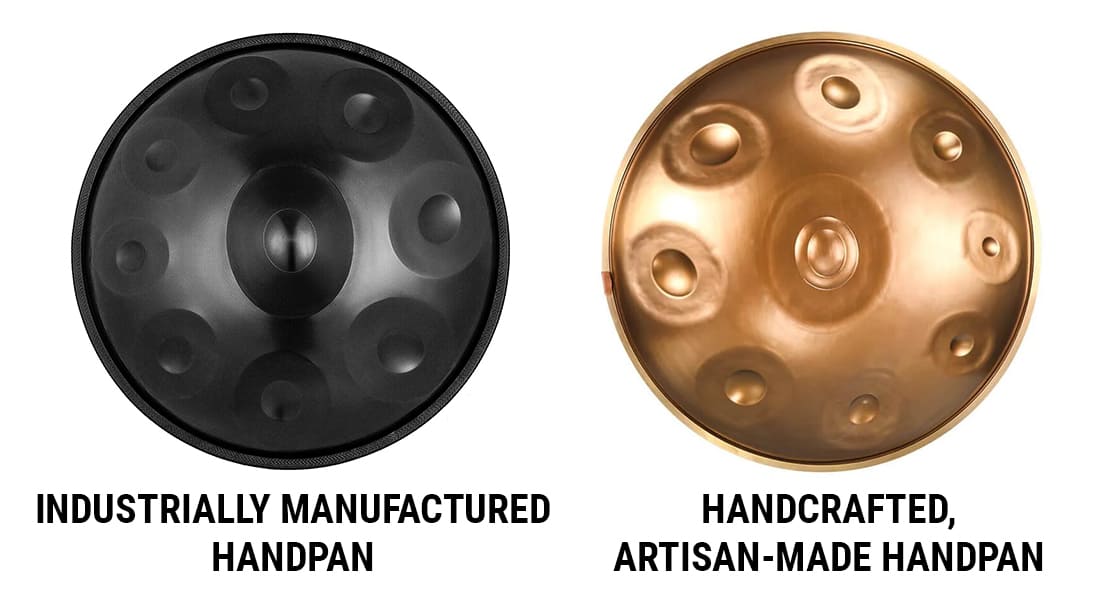
Looking at the black handpan on the left, you can see the circles—known as tone fields, the ding, and the shoulder for those in the know—are almost too uniform and “perfect.” That one wasn’t shaped by hand, but pressed by a machine to form the metal. The gold handpan on the right shows multiple irregularities, which points to real handwork. Artisans strike the handpan with both handheld and pneumatic hammers to tune it very precisely. That means thousands of accurate hits, backed by experience, over many long hours. You can watch the process in fast motion in the video below:
I don’t want to spark a debate about the pros and cons of mechanization, but when it comes to handpans, fully machine-made models have never convinced me in terms of acoustics. Having owned a few, I’ve found the notes can be pretty hit-or-miss. Maybe in a few years, progress will change that and machine-pressed handpans will become truly solid instruments, but for now, that hasn’t been my experience. So if you come across a model priced at €500 or less, there’s a good chance it’s industrially manufactured—because the many hours of a maker’s work inevitably have a cost that gets built into the final price. My advice: prioritize instruments that have genuinely been through a craftsman’s hands. They’re more expensive, but the tuning is typically far better.
Does the number of notes affect the price of this percussion instrument?
As you’d expect, the more notes a handpan has, the higher the price. Quite simply because it takes longer to hammer, shape, and tune the musical instrument. Once you’ve established a baseline price—around €1,000—you can generally add between €100 and €200 per additional note. So a 12-note handpan will cost significantly more than an otherwise similar model with only 9 notes. The price can also rise if the instrument includes bottom notes (notes added on the lower shell). Read this article to find out the ideal number of notes for your future handpan. That way, you’ll know what budget to plan for.
Why can the scale change the final cost?
The scale of a handpan is a specific, well-defined sequence of notes tuned onto the instrument during the build. In other words, the scale determines which notes the instrument can play and, as a result, the atmosphere the melodies will evoke. If you choose a popular, widely loved scale, such as D Kurd, prices tend to be lower because almost every maker offers it. On the other hand, if you’re after a very specific scale, or you want to design the note layout yourself, then you’re looking at a custom model—and quotes can climb fast. So if you want a handpan at a reasonable price, it’s usually best to stick with a classic, widely available scale. My personal recommendation is D Kurd, because it adapts beautifully to just about any playing style.
How does the metal used in the handpan affect the budget?
Because a handpan is made entirely of metal, pricing is closely tied to the cost of that raw material. Today, three main metals are used to build this instrument: nitrided steel, stainless steel, and Ember Steel. While nitrided and stainless steel models are often priced fairly similarly, that’s not really the case for Ember Steel handpans. They’re relatively recent and can be harder to find. On top of that, the steel itself costs more and requires more work time to build with. It also needs to be heated to a higher temperature, which means higher energy use. All of that can push the price of an Ember Steel handpan to nearly double that of an equivalent nitrided or stainless steel model—so it’s an important factor to consider. Read this article for a full breakdown to choose the metal for your handpan. In particular, you’ll discover the acoustic properties of each alloy.
Why are Hang drums so expensive?
As we covered earlier, handpans are so expensive because of the massive amount of hands-on labor required to make a single instrument. That’s also why industrial handpans can be sold for much less. When a build takes dozens of hours, there’s simply no way to drastically reduce the final price without cutting corners on quality.

Is it worth buying a second-hand instrument to save money?
If you don’t have enough money to buy a new handpan, it can be tempting to shop the second-hand market for lower prices. However, I’ve noticed a significant rise in attempted scams on platforms such as Craiglist and eBay, so it’s important to stay alert. Also, many used handpans are out of tune due to poor maintenance or a hard impact. My advice is to always see (and play) the instrument in person before buying—don’t rely on photos and videos alone. And when you go, don’t go by yourself. Few sellers will accept a check, so you’ll likely need to bring cash, which can unfortunately attract the wrong kind of attention. In general, I don’t recommend beginners buy a used handpan. Once the transaction is done, you usually have no real way to undo it or hold the seller accountable. Plus, you need at least some experience with handpans to judge whether a used instrument is truly a good deal.
Trust a qualified professional to help you purchase your future handpan
Handpans are clearly among the more expensive instruments, with prices that can quickly climb into the thousands of euros. It’s not always easy to tell whether a price tag truly matches the quality of the instrument being offered. But with what you’ve learned in this article, you now have a solid understanding of how much a handpan can cost. That means you’ll be able to make the right choice for your wallet.
That said, many online stores aren’t trustworthy. Between shops that never deliver and others that sell low-quality models at outrageous prices, it can be hard to separate the good from the bad. That’s why I recommend the French store Instruments du Monde, which offers many handpans with excellent value for money and responsive customer service. This 9- or 10-note model tuned to D Kurd is the one I would personally choose.
Discover this handpan now by clicking on the image below:
 Our pickMake the right choice by investing in this high-quality handpanView the high-quality handpan
Now that you know how to estimate the right price for your instrument, you still need to understand all the criteria that matter when choosing one. Read my other article to learn how to choose your handpan. That way, you’ll get the best instrument possible for your needs.


