



Written by Ambre Montespan on Dec 16, 2024 · Updated on Oct 15, 2026

Table of contents:
Curious about the handpan? Wondering how an instrument with such rich, mesmerizing tones is made? How do artisans make a handpan or Hang drum? And what tools and technology go into crafting this sound sculpture?
After falling in love with the wonderful world of handpans over 10 years ago, I’ve had the chance to connect with various makers and visit several artisan workshops, where I observed different ways to build this percussion instrument. So I can walk you through, step by step, how a handpan is made.
To make a handpan, you first choose the metal, then shape it into a dome. Next, each note is tuned over many hours. Finally, once the two shells are glued together, the maker applies the finishing touches.
By exploring this article in its entirety, you will learn:
- Why handpan-making remains relatively secret and mysterious
- How a hang drum is made
So when you hold a handpan in your hands, you’ll know exactly how much time and care it takes to bring one to life, and you’ll be able to tell anyone who’s curious about how this unique instrument is made.
Now, let’s tackle this fascinating subject together.

Why does the manufacturing process for this instrument remain a mystery?
Not long ago, detailed information on handpan-making techniques was extremely rare—and even today, it can still be difficult to find specifics. That’s no surprise, since many makers closely guard their methods. Originally, PANArt, the company that invented the Hang between 1999 and 2000, shared very little about its process. And since this company has been in legal conflict with all other handpan manufacturers worldwide since 2020 over intellectual property issues, it’s very likely that the techniques used to manufacture the Hang will remain under wraps.
So when artisans started producing handpans in larger numbers around 2007, they had to begin almost from scratch to make their own instruments. Naturally, a certain secrecy formed around the craft, even if, in recent years, some makers have opened their doors and shared parts of their process. Let’s look at those techniques next.
How is a Hang drum made?
To make a Hang drum or handpan, you first choose the metal, then shape the steel shells, forge and tune the notes, glue the shells together, and finish the surface. Let’s go through each step.

How do you choose the metal to make the handpan?
The metal you select is a key factor, because it affects the instrument’s final tone as well as its sustain—how long a note rings after it’s struck. Traditionally, the maker has two options:
- Standard steel, which must then be nitrided
- Stainless steel
There’s also a newer type called Ember steel, which is actually stainless steel with different properties than conventional stainless. Check out this other article if you want to understand exactly what steel does to a handpan. For the artisan, the steel choice also affects the building process because each alloy responds differently to stress and may require higher or lower temperatures in the oven. Once the steel is chosen, it has to be shaped into the handpan’s signature dome. Let’s take a closer look.
How are the steel shells of this percussion instrument formed?
At the start, the future handpan is simply a perfectly flat sheet of steel about 0.04–0.05 in (1–1.2 mm) thick. Before shaping it, the sheet may be polished if the maker feels it isn’t smooth enough. Over time, artisans have developed several ways to transform this sheet into a convex shell, including manual hammering, spinning, stamping, and hydroforming. Each method is explained below.
1 – Manual hammering: which hammer should be used to shape a handpan?
As the name suggests, manual hammering is the most traditional approach: the maker either shapes the metal by hand with a hammer or uses a pneumatic tool called a pneumatic planishing hammer, which delivers rapid, controlled strikes without tearing the steel. In practice, the sheet is held firmly in a support that allows the metal to sink and curve. The maker lays out reference marks, then delivers thousands of blows to gradually achieve that iconic dome shape.
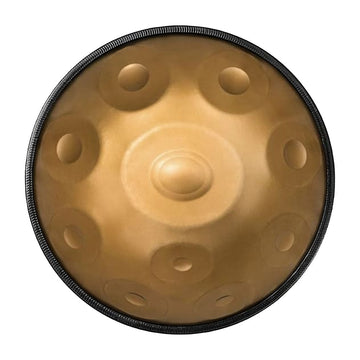
This method has the advantage of requiring very little expensive equipment, since pneumatic planishing hammers can be found for a few hundred euros used and a few thousand new. Fully manual hammers are also easy to source and often come from other trades—some are even made of wood. And because the shell is shaped by hand, no two instruments are ever truly identical. That uniqueness can be part of the charm, but it can also surprise buyers who expect the exact same sound they heard in demo videos.
It’s also important to understand that this work is physically demanding, even with pneumatic assistance. That’s why many professionals choose to buy pre-formed shells from larger manufacturers. A set of upper and lower shells can be purchased for less than €150, which can be a smart compromise if a maker doesn’t want to take on this long, difficult step. Watch a video showing the creation of a handpan shell by hand hammering, at 50× speed.
2 – Spinning
Spinning is similar to the manual method in that a fully pneumatic arm presses down on the metal to give it its dome shape. Much like a CNC lathe, the sheet metal rotates at high speed while the arm presses down gradually, moving back and forth several times to apply uniform force. This method offers greater consistency with minimal human effort. However, producing a single shell still takes considerable time. You can see this manufacturing technique in the video below:
3 – Stamping
Stamping is currently the most popular method thanks to its simplicity and speed. It was also the method PANArt originally chose for creating the Hang. The principle is straightforward: two convex molds—one male and one female—are placed on either side of the sheet, then a hydraulic press forms the metal to match the molds exactly. This can produce a shell in just a few seconds, as you’ll see in the video below:
4 – Hydroforming
Hydroforming is very similar to stamping, except that instead of a female mold pressing and curving the sheet metal, it uses pressurized water. The pressure is so high that it pushes the metal into the shape of the mold below. Sometimes there’s not even a mold underneath—just a sensor that detects when the metal has reached the correct shape. The speed and result are almost identical to stamping. The choice between these two technologies mainly comes down to the manufacturer’s upfront purchase and ongoing maintenance costs. I haven’t been able to find reliable numbers on that, but you can see the machine in action in the video below:
How are the notes on the Hang created?
Once the metal has been shaped into a dome, the musical notes must be created. To do this, manufacturers place the notes on the instrument using magnetic templates or simply by hand-marking them with a felt-tip pen. Depending on the notes chosen, the handpan will have a specific scale that can’t be changed later. This is also when the instrument’s reference pitch—often chosen between 440 and 432 hertz—is decided.
Next, the professionals start by creating the dimples—the precise indentations in the center of each note. These dimples are not random; they are almost always made using a hydraulic press, though some artisans still shape them by hand with a hammer. Makers typically use large metal balls that press into the shell to create the characteristic dimple shape. The center of the ding (the central note) is made the same way.
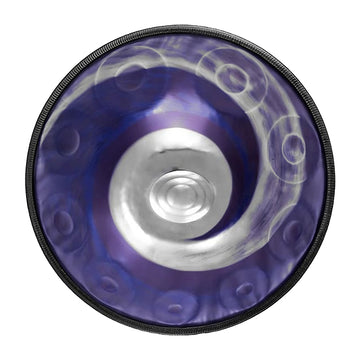
Next, the tonefields of the notes and the shoulder of the ding must be shaped. This is the flat area surrounding the dimples and the ding, and it’s where the maker’s skill truly comes into play. Thousands of precise hammer blows, done entirely by hand, are needed to achieve the desired sound. In general, the artisan will use a strobe tuner, which is far more accurate than a standard tuner. That’s how each note is tuned to match the intended scale. This is where the real secrets of handpan makers are found: everyone develops their own approach to achieve the best tone, the richest harmonics, and as little interference between notes as possible. It’s incredibly precise, time-consuming work—which is a big reason the price of a handpan is so high. Watch a video of the notes being hammered in fast motion right here:
But once the initial tuning is complete, the maker’s work is far from over. It’s important to understand that once the notes of the handpan have been formed, they’re under a great deal of invisible mechanical tension, and the metal naturally wants to return to its original shape. Because of this, the notes tend to spring back ever so slightly—like a rubber band returning toward its resting position. Over time, the metal can slowly shift on its own. This deformation is invisible to the naked eye but clearly audible, as the instrument gradually drifts out of tune.
To counteract this effect, once the handpan has been tuned, it is either placed in an oven at around 392°F (200°C) for a few hours or heated with an industrial torch or blowtorch for a few minutes. These ovens are identical to those used in pottery and are also called kilns. The heat accelerates the metal’s tendency to shift, and then the maker lets the shell rest for a few days to several weeks. Once that waiting period is over, the instrument is retuned. Several cycles of tuning and heating may be needed. In general, the more the handpan has been “baked,” the more stable it tends to remain over time, because the metal is more firmly set into the configuration imposed by the maker—except, of course, in the event of a hard impact.
As for the lower shell, the hole underneath, called the Gü, is created by piercing a hole in the center of the shell and enlarging it so that the protruding metal folds back into the instrument. To ensure it isn’t sharp, this section is filed down and then curved with a hammer. In addition to improving the handpan’s acoustics and resonance, the Gü also allows the maker to make final tuning adjustments once the two shells are assembled. Sometimes notes are shaped on the lower shell, called bottom notes; they are created in exactly the same way as those on the upper shell. The craftsman’s skill lies in adding these extra notes without creating interference.

How are the two convex shells assembled to create a handpan?
Now that the two shells are finished, they need to be joined to form the instrument. To do this, makers typically use a high-strength adhesive applied to the rims of both shells. The shells are pressed together, then dozens of small clamps are placed all around the handpan to give the glue time to set. After a few hours or days (depending on the adhesive), the clamps are removed and any excess glue is cleaned off. At this stage, the handpan is fully functional, although the maker may do a final tuning touch-up with a small hammer—or at least verify that everything is still in tune.
How is the finishing touch added to this musical instrument?
The final stage in handpan-making is applying the finishing touches. These details often come down to design choices: some makers, who are artists at heart, add engravings. More rarely, some apply paint. A protective rubber strip and/or braided cord can also be added around the rim, which can add both protection and style. Finally, the handpan is cleaned with alcohol and treated with wax or oil so it stays well protected until it reaches its new owner.
Treat yourself to a handpan made to perfection
Shrouded in mystery, the handpan is an instrument that takes time to make, with specific steps—some of which require a great deal of skill and experience. Now that you’ve read this article, you know absolutely everything there is to know about making a handpan.
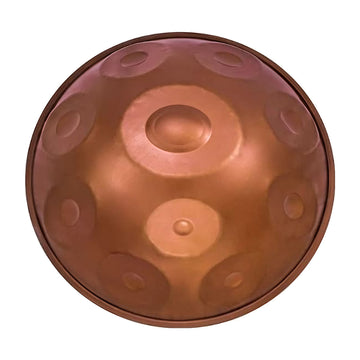
As you’ve seen in this article, crafting this percussion instrument is anything but improvised. A handpan requires incredible precision to deliver a high-quality instrument with warm, balanced vibrations and harmonious overtones. So, if you’re thinking of buying a handpan, I recommend the professionalism of Instruments du Monde, which offers dozens of high-end handpans, including this excellent 10-note model designed for meditation.
Click the image below to discover this fabulous handpan:
All the information about manufacturing concerns acoustic handpans only. However, there are also electronic handpans that are quite interesting to discover. Read my article dedicated to this 100% digital instrument.


