



Written by Ambre Montespan on Jul 10, 2023 · Updated on Oct 15, 2026

Table of contents:
Are you new to the ocarina and eager to improve your mastery of this musical instrument? Do you want to produce beautiful, crystal-clear notes by learning how to control the airflow coming from your breath? Do you want to know how to blow into an ocarina properly?
For over 10 years now, I’ve been playing the ocarina regularly for my own enjoyment and that of my loved ones. With this experience, I can help you blow into your instrument correctly so you, too, can play melodious, harmonious tunes.
To blow properly into an ocarina, it’s important to adopt the correct posture and adjust your airflow based on the instrument model you have. A few exercises are also recommended to help you improve.
After reading this article, you will learn:
- Why it’s important to control your breath when playing the ocarina
- The method for achieving perfect breath control
- Some essential exercises to help you improve
You’ll soon be blowing into this wind instrument in the best possible way, coaxing out consistently pleasant tones that make your ocarina a source of pure joy.
Now, let’s look at the right way to blow into this type of flute.

Why is it important to learn how to blow into your ocarina?
Breath control is a crucial element when it comes to playing the ocarina. Unlike the flute or oboe, the ocarina requires greater precision in terms of the airflow you send through the mouthpiece, as this directly affects the notes produced. With most ocarinas, each note requires a specific breath intensity in order to be in tune. The higher the desired note, the stronger the breath must be. Therefore, a C and an F in the same octave will require different airflow on the same ocarina. If you blow too hard or not hard enough, the instrument won’t produce pleasant tones, which can frustrate beginners who then assume their instrument is poorly designed or low quality.
That’s why mastering a few simple techniques will ensure your ocarina responds the way it should. Your breath must be at the right intensity and, above all, steady. It’s also important not to run out of air, or you may not be able to finish the melody you started. Finally, it’s worth noting that the correct way to exhale into the instrument isn’t very intuitive. As a result, it’s truly important for every new player to learn how to control their breath.
What are the methods for achieving the right breath with this wind instrument?
Even before the mouthpiece of the ocarina touches your lips, it’s important to adopt a good posture so you can breathe correctly. The ocarina is best played standing up straight (if you play seated, keep your back straight). Your shoulders, pelvis, and feet should be aligned as much as possible without causing discomfort. The position must be comfortable to maintain, so respect your body shape and avoid slouching. As we’ll discuss later in this article, playing the ocarina requires breath control and endurance. Slouching reduces your lung capacity and compresses your abdomen, which makes breathing harder.
Next comes the placement of your lips on the mouthpiece of the ocarina. Your head should always stay perpendicular to the instrument’s axis when playing a transverse ocarina. Next, purse your lips as if blowing out a candle on a birthday cake. This lip position helps create a focused airstream directed exactly where it needs to go. Finally, gently place your lips against the mouthpiece of the ocarina so that it seals without pressing too hard. Don’t put the mouthpiece directly in your mouth, and keep your teeth from touching the instrument—this will make it easier to catch your breath.
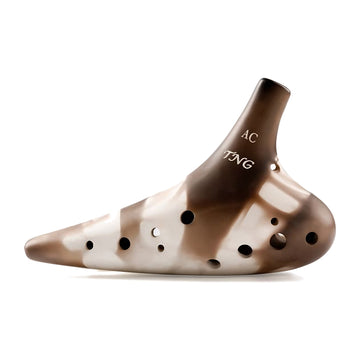
Once you’ve found the right position using the steps above, go ahead and blow into the ocarina. This breath should be deliberate, not random. As a wind instrument, the ocarina is played with what’s called abdominal breathing: only your abdomen should move, not your shoulders or chest. Imagine your navel moving as far away from your spine as possible when you inhale. This engages your diaphragm, giving you a strong, controlled breath. Your abdominal muscles do most of the work, contracting to adjust the power of your exhalation. When exhaling, your cheeks should stay still, or inflate only slightly. Use your tongue as a valve to let air in or block it. To produce sound, keep your tongue flat; to stop the sound, lift it toward the roof of your mouth.
Don’t hesitate to blow hard into the ocarina. Most instruments require real power to reach their full potential, especially on high notes. It is a common mistake for beginners not to dare to blow vigorously enough into the instrument. When blowing, it’s important to remain consistent. The airflow must stay steady throughout the duration of the note, which will require you to engage your abdominal muscles. If, despite everything, the sound of your ocarina still isn’t harmonious, it may be a good idea to clean it, as dirt can clog the instrument and affect its tone.
Are there any exercises to learn how to blow air into the instrument properly?
The first useful exercise to improve your technique is to “attack” or “articulate” the notes. This means that at the very beginning of each note, you blow slightly harder, as if you were pronouncing the syllable “too.” This will help you develop breath control and train yourself to play each note more precisely, as if there were a separation between them.
A second exercise that I consider essential is to use an electronic tuner or a smartphone app that does more or less the same thing to help you practice hitting the right note. It’s important to note that two different ocarinas, even if they are both tuned to the same key, will not necessarily require the same breath intensity for the same notes. That’s why it’s useful to get to know your ocarina. To do this, turn on your tuner and play a note that you will try to hold for as long as possible. As you blow, keep an eye on the tuner and adjust your airflow to lock in the correct pitch. This way, you will practice both your airflow and its duration.

If you find it difficult to breathe from your stomach because it doesn’t feel very natural, it’s a good idea to practice without a musical instrument. To do this, lie on your back and take a breath. It should be as deep as possible, and only your belly should fill with air. You can close your eyes to better notice what your body is doing and imagine your navel rising upward. When you exhale, blow as if you were playing an ocarina and hold this exhalation for as long as possible, keeping the intensity of your breath steady. Once you have mastered this technique, you can also use a lit candle, which you will place in front of you while standing. Stand about 8 in (20 cm) away and blow on the candle. The goal is to tilt the flame with the airflow without extinguishing it. The tilt must remain constant for the exercise to be effective.
Finally, for perfectionists, you can also quickly contract and relax your abdominal muscles while blowing to create a slight fluctuation in the airflow entering the ocarina’s mouthpiece. This produces a sound effect called vibrato that can be pleasing in certain songs.
Blow into a high-quality ocarina for perfect sound
The way you blow into an ocarina, along with finger placement, is a fundamental part of mastering the instrument. It is therefore essential to learn how to blow correctly into this type of flute in order to play beautiful pieces. Now that you have read this entire article, you know the correct blowing technique and have a list of exercises to help you practice.
However, even with the best breath control, a low-quality ocarina will only produce unpleasant sounds. To avoid that, choose a model from the Instruments du Monde online store, which offers more than 50 high-quality instruments. For example, this traditional ocarina offers captivating tones that are sure to satisfy you.
Treat yourself to this ocarina now by clicking on the image below:
Did you know that it is possible to learn how to make an ocarina with your hands in just a few minutes? This technique is described in detail in our article and will allow you to produce several whistling sounds very quickly.


