



Written by Ambre Montespan - Updated on Sep 25, 2026

Table of contents:
Do you own a Tibetan singing bowl, but you don’t know what note it produces when you make it sing? How can you find out what tone this musical instrument emits? Why is it useful to know the note of your Tibetan singing bowl?
With a dozen Tibetan bowls in my collection, I’ve often found myself unable to remember which musical note each one produces, so I developed a few reliable ways to identify it. I’ve also helped several friends discover the note of a Tibetan bowl they’d just purchased. So I can easily share my techniques with you, too, so you can confidently enjoy your Asian musical instrument.
To identify the note of a Tibetan bowl, first look for an inscription or a specific color on the bowl. If none is found, you’ll need to analyze the sound with an audio spectrum analyzer.
As a result, you’ll soon learn:
-
Why it’s particularly useful to know your singing bowl’s note
-
That bowls don’t actually emit a single note, but a whole range of musical notes
-
The different techniques you can use to find your instrument’s tone
That way, you’ll have a clear idea of how you can use your singing bowl once you know the main note it’s associated with.
Now, let’s get right to it.
Why is it interesting to know the note emitted by a Tibetan bowl?
The musical note associated with a Tibetan bowl matters most when you’re interested in the physical and mental benefits this instrument may offer. In many chakra-based approaches, the seven notes in music—C, D, E, F, G, A, and B—are each associated with a specific chakra in the human body. You can see this correspondence in the image below:
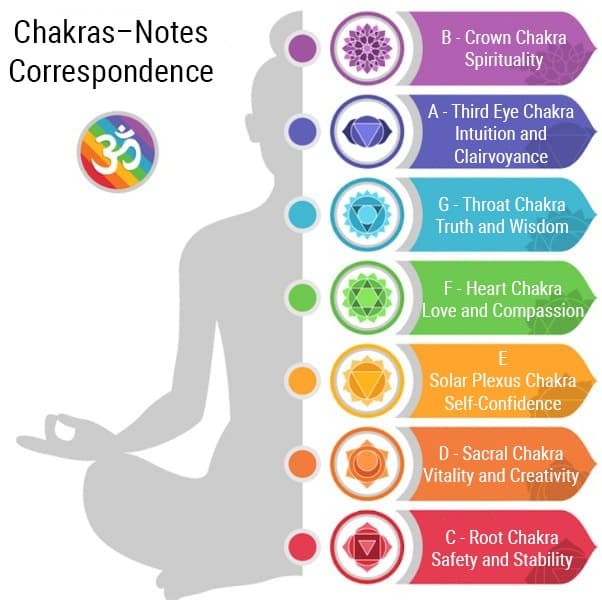
So if you’re focusing on Muladhara, the root chakra, a Tibetan bowl tuned to C can be especially relevant. That’s why energy-healing professionals usually keep several bowls on hand to adapt to their clients’ needs. We detail all the benefits associated with the different chakras in this other article, which explains how to choose the note of your Tibetan singing bowl. After reading it, you’ll have a very good idea of the note or notes that suit you best depending on your situation.
Now you know why it’s useful to know the musical note emitted by the Tibetan bowl you own.
The tone of a 7-metal singing bowl can sometimes be difficult to identify
It turns out that the note of a 7-metal singing bowl can sometimes be difficult to pin down. It’s important to understand why before we get into how to determine the tone.

Singing bowls actually produce a range of notes
First, it’s important to dispel a common misconception among beginners: a Tibetan singing bowl made of seven metals does not produce just one musical note. In reality, it produces many, simply because the different metals in the alloy don’t resonate at the same frequency. However, it is possible to identify a main or fundamental note, which is generally the note attributed to the Tibetan bowl, along with several harmonics.
That’s also why you’ll find singing bowls made of 99.9% quartz crystal: they’re far more precise in the note they produce because they’re made almost entirely from a single material resonating at one frequency. The sound is clearer and more “crystalline.” So while a metal Tibetan bowl may generally engage several chakras, with an emphasis on one, the crystal singing bowl focuses much more directly on a single energy point to concentrate its effects there.
Different sounds depending on how they are used
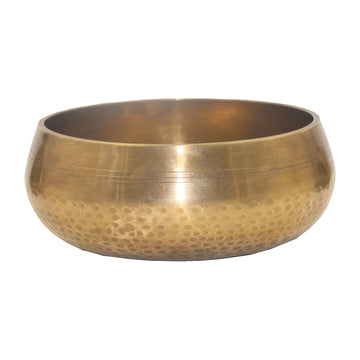
You may have already noticed that, depending on how you play it, a Tibetan bowl doesn’t produce exactly the same musical note. When you simply strike the bowl with a mallet, for example, one note is produced. But when you make the same instrument sing, a different note rings out. This means it’s often possible to attribute two notes to a single Tibetan singing bowl.
How can you determine the musical note of a Tibetan singing bowl?
Now that you understand the subtleties of the musical notes produced by Tibetan bowls, it’s time to explore the different ways you can discover the tone of your own bowl.
Check the invoice or the bowl itself
The easiest option is to look at the invoice (if you still have it) or at the Tibetan bowl itself to see whether there’s an inscription that can help you. However, it’s important to note that solfège syllables aren’t used everywhere. So you might see only a letter (letter-name notation) or a number (numeric notation, sometimes called NMCA) on the bowl. You’ll find the correspondence between the different systems in the table below:
| solfège | do | ré | mi | fa | sol | la | si |
| letter names | C | D | E | F | G | A | B |
| NMCA | 1 | 2 | 3 | 4 | 5 | 6 | 7 |
So if the letter “E” is written on your bowl or on the associated invoice, it most likely means it’s tuned to the note E (mi). The same applies if the number “3” is written.
Is there a color on the instrument?
Another way to find out the musical note of your Tibetan singing bowl is to check whether a specific color has been applied to the instrument. Just like musical notes, each color is associated with a chakra through a specific correspondence:
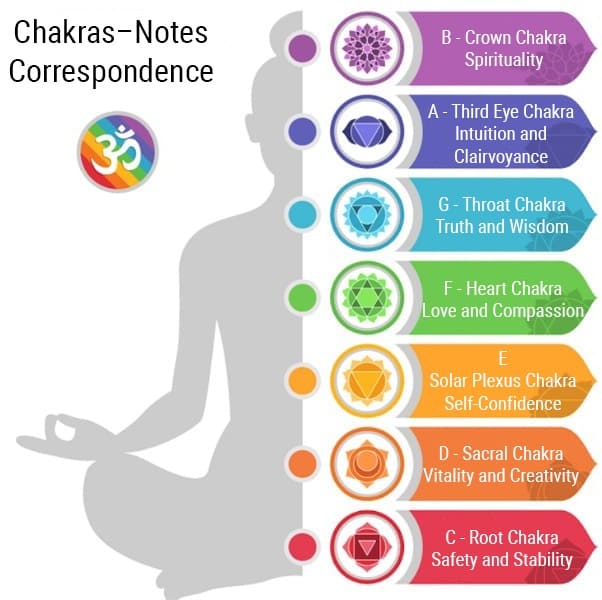
If your Tibetan bowl features a color, simply refer back to the image earlier in this article, which shows the link between each chakra and its associated musical note. For example, if your bowl is red (or has a red mark), there’s a strong chance it’s linked to the root chakra and therefore to the note C (do).
Test the bowl to find out what note it produces
The most reliable, but also the most involved, method to find out the musical note of a Tibetan bowl is to test it and then analyze the sound it produces. First you’ll find its frequency, then you’ll match that frequency to a musical note.
1 – Find the frequency emitted by the Tibetan bowl
To do this, you can use a tuner, which is a device used in music to tune various instruments such as a guitar. However, for a Tibetan singing bowl, this isn’t very accurate, and it’s strongly recommended to use a sound spectrum analyzer instead.
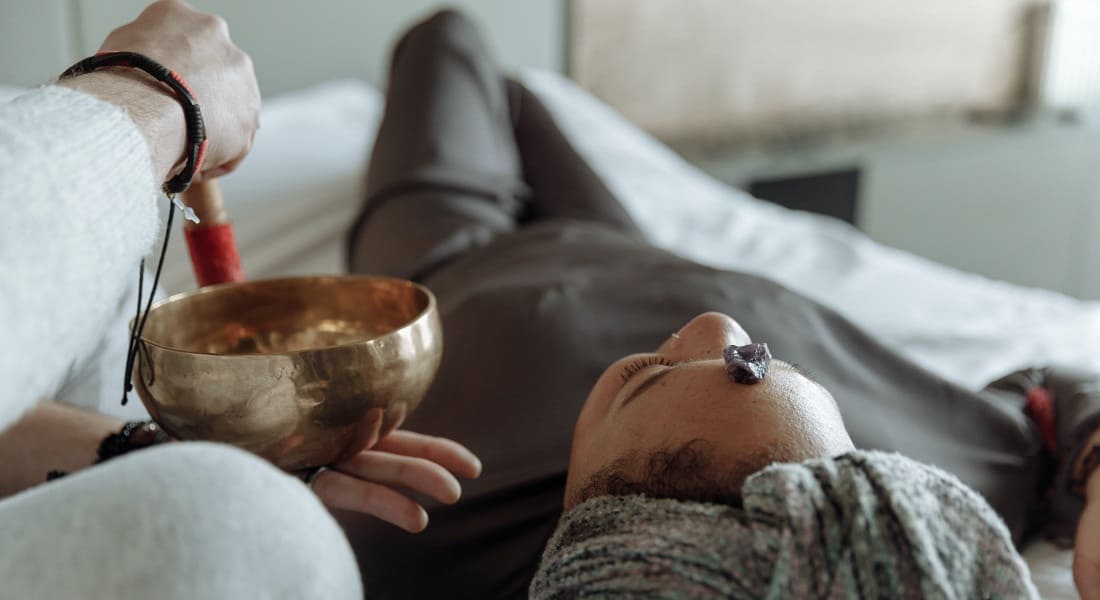
Don’t worry—the name sounds intimidating, but it’s actually fairly simple to use. To avoid purchasing a pricey professional device, use a smartphone and install the free apps Spectroid for Android or Audio Spectrum Analyzer 4+ for iOS. The idea is to use your device’s microphone to examine the sound produced by the bowl.
Find a quiet place with as little background noise as possible. Launch the app, allow it to use your microphone, take your Tibetan bowl, and use it as you normally would. Then simply look at the spectrum displayed by your smartphone. You’ll get a result like the one below, which was produced with a 12-inch (30 cm)-diameter Tibetan bowl made of seven metals:
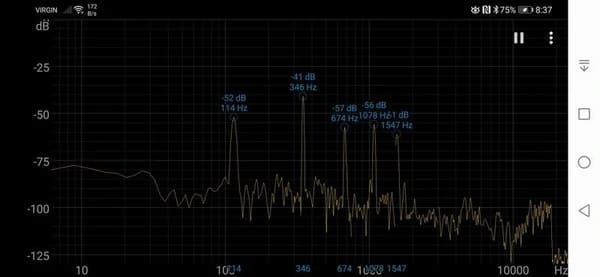
You’ll notice several peaks in the audio spectrum. The peak on the far left corresponds to the fundamental or main note of the bowl, while the others correspond to harmonics. In this example, the bowl is tuned to 114 hertz, which corresponds to the frequency of the first peak. The highest peak, here 346 hertz, will be the strongest note and, therefore, the one you’ll hear most clearly. It’s best to take several measurements and average the results for greater accuracy. Also keep in mind that Tibetan singing bowls are generally between 100 and 900 hertz. If you find a result that isn’t anywhere near that range, something is definitely off.

2 – Match the frequency of the bowl to a musical note
Now that you know the frequency produced by your singing bowl, you need to identify which note that frequency corresponds to. Each musical note has its own specific frequency. For Western classical music tuned to 440 hertz, here is the correspondence table:
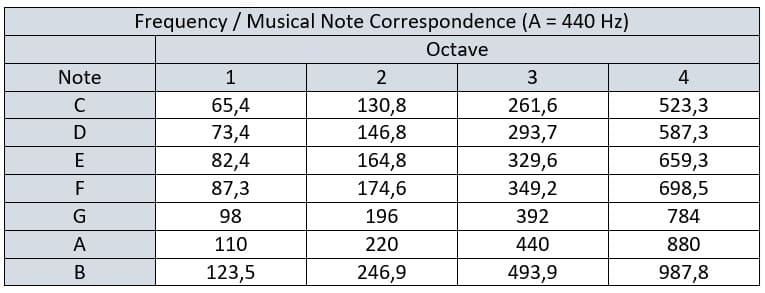
Returning to our previous example, we found a frequency of 114 hertz, which corresponds roughly to a bowl tuned to A in the first octave. It’s true that this doesn’t perfectly match, since ideally the result would be 110 hertz. But between measurement approximation (smartphones aren’t really designed for this kind of analysis) and the difficulty of tuning a metal bowl down to the exact hertz, it’s reasonable to say that our example Tibetan bowl is tuned to A.
Keep in mind, too, that the artisan who shaped your metal singing bowl may not have intended a specific pitch. Add to that how difficult it is to hand-hammer a bowl to land on one exact note, and it’s entirely possible to have a bowl that sits between two notes. However, this shouldn’t be the case for Tibetan crystal bowls, because their purpose is precisely to produce a specific note. So if you’re offered a crystal bowl for sale without knowing what note it’s tuned to, walk away without looking back.
You may have noticed that the table includes a row labeled octave. If you’re unfamiliar with the term, here’s a simplified way to think about it: the same note in a higher octave (and therefore at a higher pitch) is produced by doubling the frequency of the previous octave. When using a Tibetan bowl, octaves aren’t a deciding factor, and once you know your bowl’s note, it’s generally fine to ignore them.
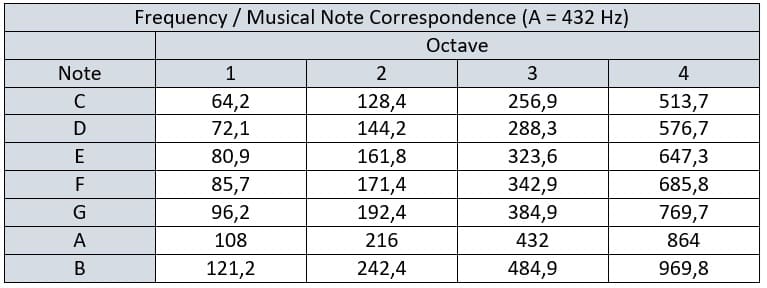
Finally, it’s also worth knowing that a singing bowl can be tuned to a different base frequency. Besides 440 hertz, the best known is 432 hertz (and there are others, such as 528 hertz). Some people associate these alternative tunings with nature and claim they’re more effective for harmonizing chakras and promoting well-being. This isn’t meant to spark a debate between 440 and 432 hertz—the best approach is to make up your own mind. In any case, at 432 hertz, all note frequencies change. Here is the corresponding table:
Is it possible to change the note of a Tibetan singing bowl?
Unfortunately, no. I’ve seen people try to change the tuning of their Tibetan bowl by adding magnets or removing material, but the results were never convincing. Your only real option is to get another bowl in the note you want.

Choose an instrument that fits your needs
As we mentioned earlier, the note associated with a Tibetan singing bowl is an important factor that can greatly influence the benefits you may experience from using this instrument. So it’s perfectly normal to want to know the tone of the one you own. Now you know all the techniques that will allow you to determine the note of your singing bowl.
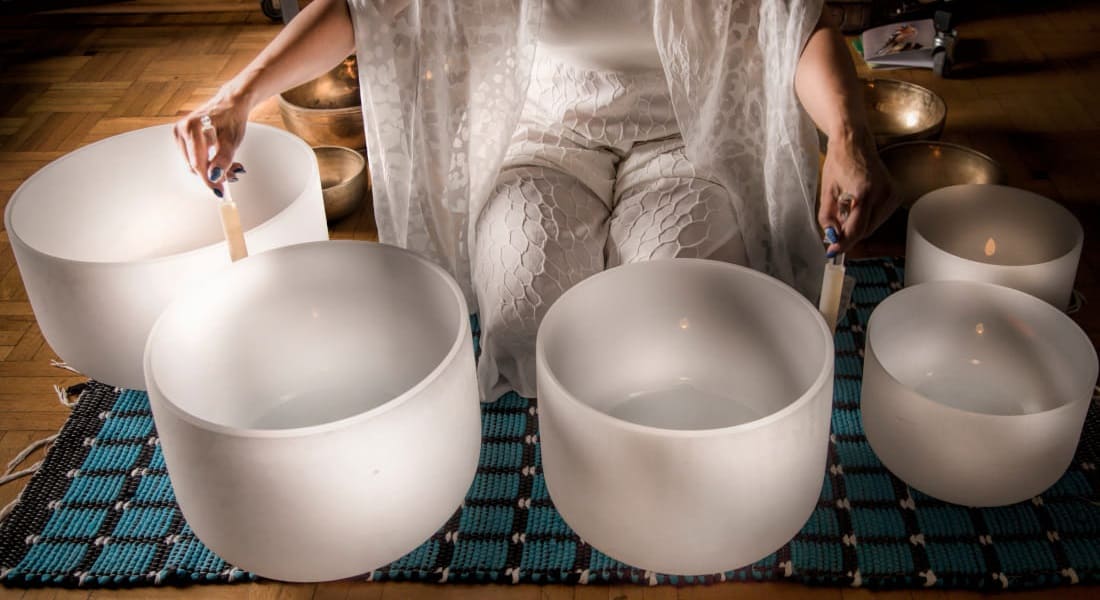
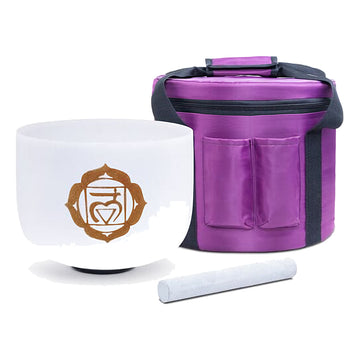
However, the note you’ve discovered may not match your needs or the chakra you want to work on. If you want deeper harmonization and truly precise chakra targeting, a crystal singing bowl is often recommended. The Instruments du Monde store suggests this frosted quartz crystal Tibetan bowl, which lets you choose both the note and the base frequency to match your own requirements.
Treat yourself to this crystal singing bowl by clicking on the image below:
You now know all there is to know about determining the note of a singing bowl, but did you know that the dimensions of this instrument can radically change some of its characteristics? Learn all about this by reading our article on how to choose the right size for a Tibetan bowl. You’ll then be sure to select the right diameter for your intended use. If you’ve already decided on the size, browse our guide to Tibetan bowls to learn everything you need to know about them.


