



Written by Ambre Montespan - Updated on Jan 28, 2026
Table of contents:
Are you planning to buy a Tibetan singing bowl soon, or do you already own one? Do you want to know how to spot a genuine singing bowl versus an imitation? What criteria can you use to determine whether this Asian musical instrument is authentic? And does the origin of a Tibetan singing bowl actually affect the benefits it may provide?
For more than 10 years, I’ve been deeply fascinated by the origins and history of Tibetan singing bowls. I’ve also spent a lot of time learning how manufacturing methods have evolved in recent years. So I can help you figure out whether the singing bowl in front of you is genuine or not.
A genuine Tibetan singing bowl, which is a very ancient object, can be distinguished from a counterfeit by clues provided by the manufacturing method, its design and color, its overall wear, and its price.
After reading this entire article, you will finally learn:
- How to identify a genuine Tibetan singing bowl
- The different techniques for recognizing a genuine singing bowl
- Whether a traditional bowl is more effective than a counterfeit
- Where to buy an original instrument
You'll then be able to identify whether the object you intend to buy, or the one you already own, is a genuine Tibetan singing bowl or not. You'll also be able to advise your friends who would like to discover this fabulous instrument.
Let's take a look at how to determine the authenticity of a singing bowl.
What Is a Real Tibetan Singing Bowl?
This is a great question. What are the factors that determine whether a Tibetan singing bowl is genuine or not? Should we take into account the manufacturing method, meaning it must be hammered by hand? Does the instrument have to be made from the famous seven-metal alloy, which is said to have remarkable therapeutic properties? Or does the geographical area where the singing bowl was made also matter? In that case, should we limit ourselves to Tibet, which is part of the People's Republic of China, or can we accept that some bowls are made across the Himalayan range, extending into India, Nepal, and even Bhutan?
In reality, there are no strict specifications that determine whether a Tibetan bowl is authentic or not. So, in many ways, it comes down to your own perspective and what “authentic” means to you. Some experts claim that only instruments that are 50 to 60 years old can be considered genuine because they were made before Western demand really took off. As a result, they were still produced using traditional methods, whereas afterward, production became increasingly industrialized to meet growing demand. The problem is that bowls over 50 years old are very rare and expensive. Others believe that if the singing bowl is made using the hammering technique in Tibet, it is authentic, regardless of the number of metals used. Finally, some are convinced that only Tibetan bowls made of seven metals can be considered genuine.

So, the answer is far from simple. For the rest of this article, we’ll assume that a genuine singing bowl is one that most closely resembles those used in the past, based on historical research. However, just because a bowl doesn’t fit that definition doesn’t automatically mean it’s fake or a bad instrument. In that case, it simply means it was made using a less traditional method.
How can you tell if a singing bowl is authentic?
Now that we have a clear understanding of what a genuine singing bowl is, let's take a look at each criterion that will allow you to recognize it compared to a less traditional model.
Recognizing a genuine Tibetan singing bowl by its manufacturing method
The first obvious criterion that will help you determine whether a Tibetan bowl is genuine concerns its manufacturing method. Originally, these instruments were crafted using a technique called hammering. It requires the presence of three workers and a foreman. The workers strike a heated metal disc (sometimes called a blank) at a steady rhythm, while the foreman regularly rotates it to change the striking angle. You can see an example of this technique in the video below:
This manufacturing technique doesn’t produce a completely smooth, uniform Tibetan bowl. In fact, all antique singing bowls show small hammer marks. However, to mass-produce these instruments, some are molded. That means molten metal is injected into a mold, which is much faster and easier than the time-consuming process of hand-hammering. Molded bowls are perfectly smooth, unlike those forged the traditional way. So if you’re shopping for an authentic Tibetan bowl, look for slight surface imperfections—they suggest the bowl was hammered, not molded.

Discovering whether a Tibetan bowl is authentic based on its origin
Historical research on Tibetan bowls suggests that these objects were found mainly throughout the Himalayan mountain range, as well as in nearby regions with strong Buddhist influence. So, if you’re able to learn where your singing bowl was made, it should come from China (Tibet has officially been a Chinese province since 1950), Nepal, Bhutan, or India. If the instrument comes from another country, it’s unlikely to be a genuine Tibetan singing bowl.
How to tell if a singing bowl is fake by looking at its design
Ancient and traditional singing bowls share a very similar look. None feature elaborate engravings, detailed imagery, or mantras. Occasionally, you may find a simple inscription etched directly into the bowl, which might indicate the owner’s name, a deity’s name, or a short prayer.
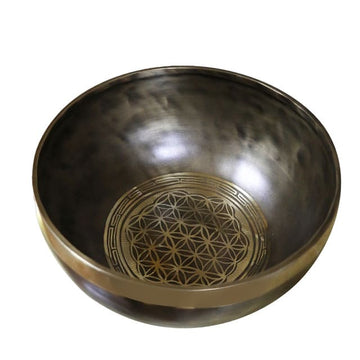
However, it’s very common to find Tibetan bowls that are richly decorated on the inside and/or outside. These engravings, made using an etching process with nitric acid, are certainly beautiful and show real craftsmanship, but they are not traditional. They’re added mainly to enhance the bowl’s visual appeal and emphasize its cultural, “ethnic” aesthetic. Even though I personally love how these engravings look, if you’re searching for a truly traditional Tibetan bowl, you should choose a simple instrument without embellishments.

Analyze the composition to identify a possible counterfeit
Several scientific studies have examined the original composition of Tibetan bowls. Although popular belief suggests that an alloy of seven metals has always been used, this is absolutely not the case. In reality, the first singing bowls were made from bronze, a mixture of copper and tin, with iron added in rare cases. This important historical detail is discussed in our article on the composition of Tibetan bowls. The myth surrounding seven metals developed when Westerners became widely interested in these fascinating objects starting in the 1960s.
As a result, owning a Tibetan bowl made of only two metals (a bronze alloy) should not be seen as a sign that it’s not genuine. Especially since, when other metals are added, they’re often present in truly tiny amounts, typically less than 1%. However, some modern singing bowls are made from brass, an alloy of copper and zinc—and zinc was never used in the traditional making of this instrument. So if your Tibetan bowl is made of brass, it cannot be considered authentic. To tell bronze and brass apart, look at the color of the metal. Brass tends to look yellow, golden, or even silvery, while bronze usually leans much more brown.
Compare prices to identify genuine instruments
Price isn’t, by itself, a reliable way to recognize an authentic Tibetan bowl because some sellers may inflate prices to take advantage of buyers who don’t know what to look for. However, one thing is certain: a low-priced Tibetan singing bowl, around $30, cannot be a traditionally hand-hammered instrument. It will almost certainly be a molded model, which doesn’t really fit the profile of a genuine, traditionally made Tibetan singing bowl. So this is still an important factor to consider when choosing your instrument.
How can you tell if it is a genuine Tibetan bowl by its condition?
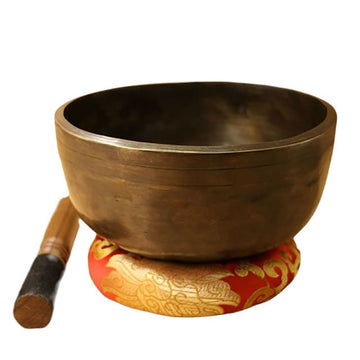
If your goal is to purchase an authentic antique Tibetan bowl, you’ll inevitably need to pay close attention to its overall wear. The bowl may show handling marks, a patina that reflects the natural aging of the metal, or cracks, which are often found inside the instrument. Be careful, though, because some sellers deliberately dip bowls in acid to create an “aged” appearance. So if you have the opportunity to purchase a genuine antique Tibetan bowl, examine it closely and pay attention to the smallest details.
Listen to the bowl’s sound to confirm its authenticity
It’s true that for experienced players, it can be possible to recognize a genuine Tibetan bowl by listening to the sounds it produces. The tones should be deep and rich in harmonics. However, this kind of ear takes real experience, and you typically need to have heard dozens, or even hundreds, of different bowls to confidently tell the difference by sound alone. You can also use a sound-spectrum analyzer. So for beginners, this criterion is hard to rely on, and it’s usually better to focus on the other signs mentioned above.
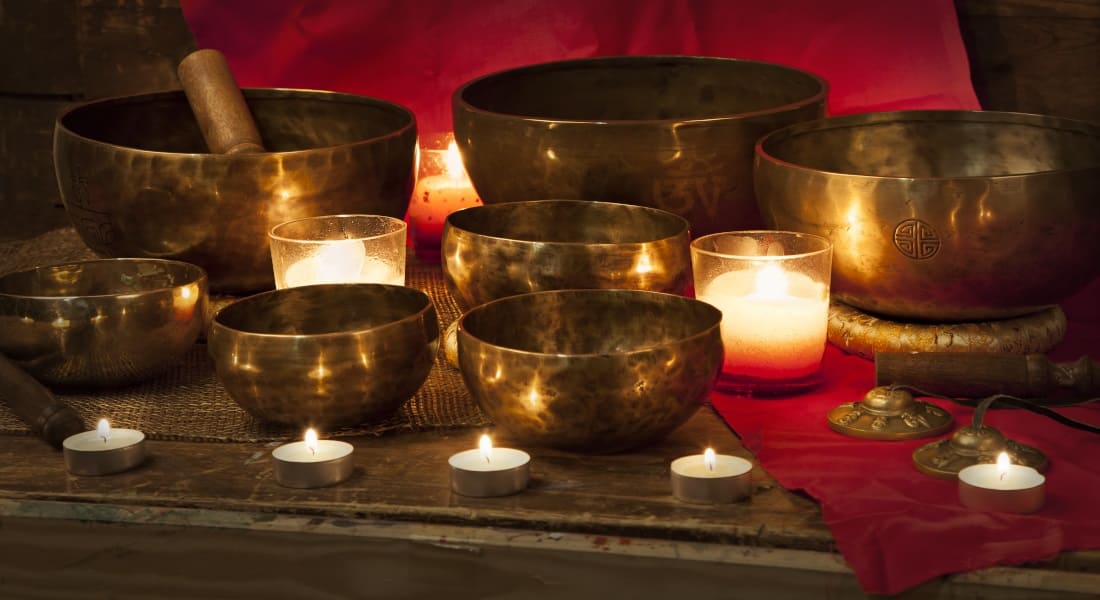
Are handmade Tibetan bowls more useful than industrially manufactured ones?
Tibetan bowls offer many benefits that have been supported by a number of scientific studies. This topic is covered in detail in our guide to the virtues and benefits of singing bowls. It’s often said that “genuine” bowls provide the most benefits. On the one hand, as we’ve seen, it can be difficult to clearly define what a genuine Tibetan bowl is. On the other hand, a scientific study has emphasized that benefits have been achieved using quartz crystal bowls, which are far from traditional. Finally, based on my personal experience, I’ve been able to enjoy the benefits of meditation with all types of singing bowls.
So if your main reason for buying a Tibetan bowl is well-being, current research suggests you don’t necessarily need to invest a huge amount to get an original, traditional bowl. If you know how to use it for healing, you can absolutely benefit from this instrument with a more affordable model that may be considered less “authentic.” In other words, it’s often better to focus on technique rather than on the supposed superior effectiveness of a genuine bowl.
Is there an organization that certifies the authenticity of this musical instrument?
Unfortunately, no. There is currently no organization or institution that verifies how Tibetan singing bowls are made or what their true composition is. So trust matters: a relationship of confidence needs to exist between the person who wants to buy a singing bowl and the professional selling it. Still, this article can help you form a solid opinion about the authenticity of the instrument you’re being offered.
Where can you buy a genuine Tibetan singing bowl?
The safest way to be sure that you have a genuine Tibetan bowl is still to travel to the Himalayas and visit a workshop to see the manufacturing methods for yourself. Even then, you can never be 100% sure that the metal disc used to make the instrument contains the seven metals some people expect. That said, you now have all the key knowledge you need to recognize a genuine Tibetan singing bowl, which should make things much easier.
However, traveling to Tibet in person to pick out an instrument is far from affordable for everyone and isn’t necessarily economical—or environmentally friendly, either. To address this authenticity issue, Instruments du Monde offers seven-metal models made using traditional manufacturing techniques. That way, you can choose a Tibetan singing bowl that’s as close as possible to the originals.
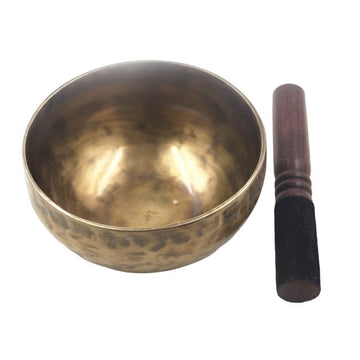
Get your genuine Tibetan bowl now by clicking on the image below:
Tibetan bowls are relatively expensive instruments, so it’s important to care for them so they last as long as possible. Read our article on cleaning and maintaining singing bowls to learn practical tips for preventing rust and keeping your bowl in great condition over time. And that’s just one of the many free resources we offer on Tibetan bowls. Feel free to explore everything we’ve put together for you.


