



Written by Ambre Montespan on Mar 14, 2023 · Updated on Oct 15, 2026

Table of contents:
Want to buy a tongue drum but not sure which one to pick with so many models out there? With prices often being fairly high, you don’t want to make a mistake when buying this relaxing instrument. How many tongues? What size? What tuning? How do you choose the right tongue drum?
As someone who personally owns more than a dozen steel tongue drums, I’ve wrestled with all of these tricky questions too, and I know how hard they can be when you’re just getting started. That said, with the tips I’m going to share in this article, you’ll quickly understand which instrument fits the way you plan to use it.
To choose a tongue drum, start by defining how you’ll use it. Depending on its size, tuning, and number of tongues, you won’t play the instrument the same way. Once your intended use is clear, it becomes much easier to choose the right steel tongue drum.
By reading this guide from start to finish, you’ll be able to make the right decision about your future tongue drum based on:
- The number of tongues
- Its size
- Whether or not it comes with accessories
- Its tuning frequency
- Its brand
- Its material
- Its scale
- And finally, the budget you want to spend
With these factors in mind, you’ll have everything you need to choose the instrument that truly matches your needs and expectations. You won’t be disappointed with your purchase, and you’ll get a lot of enjoyment out of playing it.
Let’s start exploring the perfect steel tongue drum for you right away.

How many tongues should a tongue drum have?
The first question beginners often ask before buying their first tongue drum is how many tongues to choose. The number of tongues directly determines how many notes you can play on the instrument. For example, if your tongue drum has 11 tongues, you’ll only be able to play 11 different notes—no more.
So if your goal is to play well-known pieces on the hank drum, you’re better off choosing a model with a higher number of tongues. For instance, sheet music for “The Sound of Silence” can only be played on a tongue drum with 15 notes or more. Don’t expect to pull it off on a 6-tongue instrument—it simply won’t be possible. In short, the more tongues you have, the more songs you’ll be able to play.
If, on the other hand, you prefer intuitive playing—following your mood and letting your hands explore—the number of tongues isn’t as decisive. Some musicians get a huge amount of enjoyment from a tongue drum with only 6 or 8 notes.

The number of tongues also has a big impact on the instrument’s overall difficulty. It’s generally easier to get the hang of a 6-note tank drum than an 18-note one. For a child, it’s usually best to choose a model with no more than 11 notes. For an adult beginner, going up to 15 notes is absolutely doable. Models with even more tongues tend to be better suited to experienced musicians.
Finally, keep in mind that the number of tongues also affects the instrument’s size, how complex it is to build, and therefore its price. For an unbranded tongue drum with around ten tongues, you can find one for under €100, while 15-note models typically sell for around €200. This is important to consider when choosing your tank drum, and we’ll come back to budget a bit later.
What size steel tongue drum should you choose?
The size of a steel tongue drum is a key factor when it comes to choosing the instrument that fits you best. Obviously, the smaller the tongue drum, the easier it is to carry around. Under about 10–12 in (25–30 cm) in diameter, it will fit in most backpacks and typically won’t weigh more than about 4 lb 6 oz (2 kg). Above that size, it starts to feel bulkier and heavier. It’s up to you to decide whether you’ll be using your tongue drum more on the go or mostly at home.
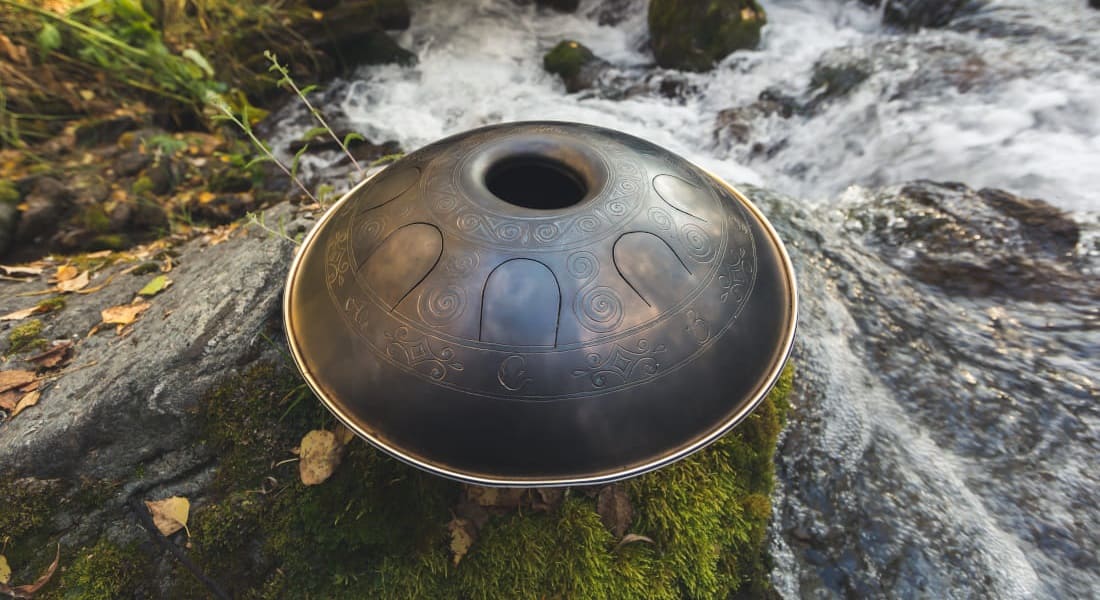
But size also has a major impact on tone. The larger the instrument, the larger its resonance chamber. So, a smaller tongue drum is usually best for players looking for fast, energetic melodies, while a larger one leans more toward deep, soothing sounds for a zen, relaxing vibe.
One last detail to consider is the relationship between size and number of tongues. The smaller the instrument is (while still having a high number of tongues), the tighter the spacing between tongues will be. That means when you strike one tongue, vibrations can spread partly to nearby tongues, triggering their notes at a lower volume. For some musicians, this can be frustrating if they want clean, isolated notes with no overlap. Others love the natural, layered effect. Just remember: the closer the tongues are to each other, the more “bleed” you’ll hear. That’s why you’ll find large tongue drums with only 6 or 8 notes and, on the flip side, smaller models that look like the maker packed in as many tongues as possible.
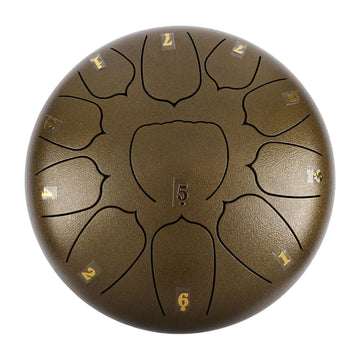
Should you prioritize accessories with your tank drum?
Some tank drums come with several accessories, while others do not. The most common accessories include mallets (so you can strike the tongues like drumsticks), finger protectors or picks (so you can play with your fingers instead of mallets), stickers to label the notes, an instruction booklet and/or sheet music, and a carrying case.
That said, we don’t recommend choosing a tongue drum primarily based on accessories. If one model feels like the right fit for you but comes with fewer extras than another, we suggest going with the one that truly suits you—you can always buy accessories separately later.
Hank drum: what frequency should you choose?
Tuning frequency is another question that comes up often when choosing a steel tongue drum. There are countless options, since makers aren’t really limited here, and you’ll find tongue drums tuned to 528, 417, or even 396 Hz. However, the two most common tunings by far are 440 Hz and 432 Hz. If the frequency isn’t listed on the tongue drum’s product page, it’s most likely 440 Hz.

The 440 Hz tuning is the standard pitch used in Western music, where 440 refers to the number of cycles per second of the reference note A (A4, the 4 indicating the octave). It’s currently the international reference for tuning musical instruments. By contrast, 432 Hz means that this reference A is set to 432 cycles instead of 440, which slightly shifts every other note that’s tuned relative to it.
There’s still an ongoing debate among musicians about the 432 Hz tuning. Some people believe it has beneficial effects on the body and mind, while others remain unconvinced. In practice, 440 Hz is typically favored for making music in the conventional sense, while 432 Hz is often associated with relaxation, wellness, yoga, or music therapy. It’s important to point out, however, that no scientific studies have validated any proven mental or physical health benefits specifically linked to 432 Hz.
One practical consideration: if you plan to jam with other musicians, it’s not enjoyable to hear two instruments tuned differently at the same time. Since 432 Hz instruments are less common, buying a tongue drum tuned this way can make it harder to find playing partners. Also, tongue drums tuned to 432 Hz are generally more expensive than their 440 Hz counterparts. That said, you can still find a few techniques for tuning a tongue drum differently, but it’s more of a “DIY” workaround than true tuning.
Below is a video of two identical tongue drums: one tuned to 440 Hz (right) and the other tuned to 432 Hz (left), so you can hear the difference for yourself. Keep in mind, though, that it’s fairly subtle.
Is one brand of Zen drum better than another?
Since the tongue drum is a relatively recent musical instrument, the number of brands making them is growing rapidly. Today, you can find zen drums from brands such as Himalaya Blessings, Zenko, Nataraj, Rammerdrum, and Rav Vast.
What’s certain is that buying a well-known brand can significantly raise your budget, doubling it or even tripling it. Sometimes the brand name is only affixed to the instrument, when in reality it’s a generic model that can also be found without branding for much less.
In the end, it comes down to personal preference—some players want to invest in a brand, and others don’t. Still, unbranded tongue drums are often an excellent choice because they offer very solid value for money, especially when buying a first instrument. Spending more than €700 on a branded tongue drum that ends up sitting in a closet isn’t necessarily a great investment—and if you resell it, don’t expect to recover more than half of what you paid.
Does the material the instrument is made of matter?
Tongue drums (also called vibe drums) are made of metal, but the specific metal can vary by model. You’ll find instruments made of steel, stainless steel, copper, or nitrided steel—an alloy that offers better impact and corrosion resistance. That said, nitrided steel tends to be fairly expensive. A great middle ground is a steel-titanium alloy, which offers a nice balance between tone and durability.
The material usually isn’t a make-or-break buying criterion, since the sound doesn’t change dramatically from one metal to another. However, if your budget allows, choosing a nitrided steel tank drum can be worthwhile if you want an instrument that will hold up for years in outdoor conditions such as humidity.
How to choose the scale of your tongue drum?
Have you noticed that there are countless “scales” for tongue drums, such as "Akebono," "Hijaz," "Celtic," "Ionian," or "Tribal"? In many cases, these are names used by brands to indicate what notes you’ll get on the tongue drum—or simply to make you want to buy, a bit like car model names. That’s why you’ll see scales called "Happy," meant to sound uplifting, "Zen" for relaxation, or "Melancholia" to add a more wistful color to your melodies. Let’s be clear: some of these names are mostly marketing.

Whatever the name, a scale will generally be classified as either a minor or major scale. Tongue drums in a minor scale tend to produce more melancholic, dark, introspective, and hypnotic tones, while those in a major scale feel warmer and more joyful. You may also see scales described as pentatonic, diatonic, or chromatic. Pentatonic tongue drums use only five different notes, repeated across different octaves. Diatonic models are similar but use seven notes—the classic C, D, E, F, G, A, and B—while chromatic scales include 12 different notes: the seven diatonic notes plus five in-between notes altered with sharps or flats, such as F♯, for example.
Not sure which scale to go for? In that case, choose a tongue drum tuned to C, D, or F major. These work well for the vast majority of players and are often considered the “default” choice when nothing is specified on the product page. C major is my personal favorite thanks to its simplicity and the warm feel of its notes. More specific scales like "Akebono" or "Hijaz" are usually better suited to players who already know and love the unique character of those sounds.
Finally, there are also so-called multi-scale tongue drums, which let you slightly shift the instrument’s scale by adding or removing magnets placed on the tongues inside the resonance chamber. The idea is appealing, but in practice, this kind of tongue drum costs between €400 and €500—and with that budget, you could buy several drums in different tunings. As a result, this type of instrument is only recommended in very specific situations that apply to very few musicians.
How much should you budget for a vibe drum?
When it comes to budget, it all depends on what you expect from your steel tongue drum. Entry-level small tongue drums start at around €50 and can gradually climb to about €200 for larger models with a higher number of tongues. If you choose a well-known brand, prices can go well above €1,000.
Budget shouldn’t be the main driver when choosing a tank drum. First, define what you want based on the criteria we covered above, then check whether your budget can realistically follow. If it can, great. If not, it may be better to wait, save up, and buy later. As mentioned earlier, if you really want to play well-known melodies like Alan Walker’s “Faded” on the tongue drum, don’t expect to do it on a small 6- or 8-note model.

Make the right choice for your tongue drum
Even though the tongue drum is a percussion instrument known for intuitive playing, buying one should still be a thoughtful decision based on your own criteria and what you expect from it. Now that you’ve read this article, you know exactly which tongue drum is right for you. You’ll be able to buy the perfect instrument—and even help friends and family avoid making the wrong choice.
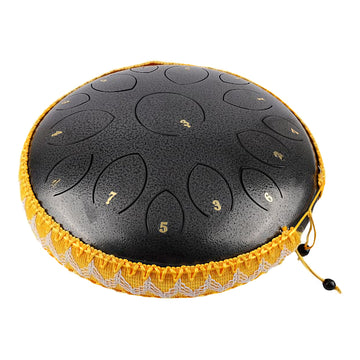
That said, what you want today may not be what you want tomorrow. You’ll naturally evolve as you practice and learn this soothing instrument. That’s why it’s smart to think a bit ahead and choose a model that gives you more than you think you’ll need right now. The Instruments du Monde shop offers this beautiful 15-note tongue drum with perfectly balanced tones, promising long hours of playing with plenty of room to grow.
Treat yourself to this tongue drum by clicking on the image below:
Now that choosing a tongue drum is just a formality, do you know how this instrument actually works? How does it produce sound? We invite you to find out in our next article that explains how the tongue drum works. You’ll learn what makes up this unique instrument and how it creates its signature tones. Or learn all the secrets of the tongue drum by reading this guide.


