



Written by Ambre Montespan on Jul 21, 2025 · Updated on Oct 15, 2026

Table of contents:
Are you wondering if Chinese handpans are truly well made? Thinking about buying one in the next few days? Have you already bought an Asian-made model and are now wondering whether it was a good deal? Can you trust musical instruments made in China?
With more than 10 handpans, some of which were made in Asia, I now have a clear idea of the quality you can realistically expect from a model made in China. That means I can quickly help you figure out whether buying a handpan from this part of the world is worth it.
It’s simply not true that all Chinese handpans are low quality. As with many things, some are beautifully handmade with real care, while others are far more questionable in terms of tone.
So, by reading this comprehensive article, you will learn everything you need to know about:
- The quality and price of Chinese handpans
- The environmental impact of these Hang drum models
- Whether or not these instruments can be retuned
This will help you decide whether it makes sense to buy a handpan from China or whether you should look for another option.
Now, let’s take a detailed look at handpans that come straight from Asia.

Are Chinese handpans high-quality instruments?
When browsing the internet, I often read that Chinese handpans are automatically low-quality instruments, mass-produced in factories, which gives them a bad reputation. That’s partly true for some models, but it would be very reductive to assume every handpan from China falls into that category. In reality, like everywhere else in the world, there are makers who take pride in their work and build excellent instruments, and others who focus mainly on volume. China—and Asia more broadly—is no exception to this rule, just like France, Germany, and the United States. So it’s entirely possible to find Chinese handpans of good quality, others of poorer quality, and even French, German, or American handpans with terrible sound. It’s naive to think that a maker “close to home” will automatically do flawless work.
A great example is the Yatao brand offered by Malte Marten, a world-renowned German handpan player. He uses his well-earned reputation to highlight his line, sold between CA$1,600 and CA$4,900, which is made in China. Malte Marten doesn’t hide this at all, clearly stating on his website: “We collaborated with an experienced handpan manufacturer in Guangzhou, China, to bring this unique instrument to life.” The same is true for many other brands, such as Nebula, promoted by handpan player Marcel Hutter, as well as SELA, NovaPan, and many others that are less transparent about it. Yet reviews for these brands are positive, and millions of people enjoy Malte Marten’s or Marcel Hutter’s videos, which supports the fact that excellent instruments can be made in China, just like anywhere else. You can hear a Chinese handpan in the video below. You’ll notice the tone is excellent:
In reality, Chinese and Asian handpans mainly have a bad reputation because YouTube is full of comparison videos that “prove” a Chinese handpan sounds worse than another brand. Very often, these videos are made purely to promote the creator’s own brand or to go viral. I find these videos dishonest because they frequently compare the cheapest Chinese handpan they can find on a marketplace that sells everything to a carefully selected handcrafted instrument that can cost several thousand dollars.
By analogy, that would be like comparing a Dacia to a Lamborghini. It obviously makes no sense, and of course the Dacia’s fit, finish, and performance will be below the Lamborghini’s. What’s more, I find it surprising to denigrate the craftsmanship of an entire country, or even a continent, just to promote one’s brand. They’d be better off highlighting the real advantages of buying from them, but maybe they’re short on solid arguments. In any case, just because the cheapest Chinese handpans are bad doesn’t mean every instrument made in that country is bad too—far from it.
In short, we should approach handpans the same way we approach people: don’t discriminate based on origin. Judge what’s in front of you. Just like people, there are great Chinese handpans and not-so-great ones.

Is the price of handpans from China an indicator of quality?
There’s a natural psychological bias that makes us assume anything high-quality must be expensive. But to understand the price gap between Chinese handpans and those from Europe or North America, it helps to break down the cost of making one. A handpan is two steel shells worked by a maker for many long hours. So it’s not the price of the raw material that matters most, but the cost of labour. Without getting into political considerations, Asia—and especially China—has a major advantage in this area, since labour costs are 6 to 7 times lower than in the West. In other words, for every hour spent working on a handpan in the West, a Chinese craftsperson can spend 6 or 7 hours for the same labour cost.
That’s why Chinese handpans can be priced lower than most European and American models. It’s not about the quality of the metal, but about the time spent hammering during manufacturing. Even when you factor in shipping and customs, labour in China is still inexpensive enough that, at the same final price, a Chinese maker can often spend more time refining the instrument. In reality, when you pay more for a handpan from Europe, you’re not necessarily paying for better craftsmanship, but largely for taxes and a higher cost of living.
However, there are limits to this, in the sense that you will never find a quality Chinese handpan for less than CA$800. Between import costs and VAT in the European Union, it’s impossible to produce a model with good acoustics at that price point. That’s also why the cheapest handpans (sometimes under CA$300!) sound awful. People who make comparison videos know it, and they intentionally pick those budget models to make their own brands look better. So don’t assume you need to spend several thousand dollars to get a good handpan: you can easily find convincing instruments around CA$1,600. Watch how a handmade handpan is produced in China in the video below:
What are the environmental constraints of Asian handpans?
One argument against Asian handpans I sometimes hear is that it’s not environmentally friendly to ship instruments from far away when they could be made closer to home. That argument needs nuance. Shipping a handpan from Asia to the West does create pollution. However, steel is needed to make a handpan. But where does the steel used to make handpans come from? Strangely, I don’t know any local artisan makers who specify this, even though they strongly emphasize that their instruments are hammered in France, Germany, or Switzerland. Without getting into political considerations, steel mills are gradually closing down in Europe and being replaced by factories... in China. According to official statistics, the European Union now produces only about 7% of the world’s steel. And this figure has been steadily declining for several decades.
Statistically, the steel in your handpan is therefore very likely to come from China. So whether that steel is shipped to you after being hammered by a maker or not doesn’t really change much in environmental terms. And I’m only talking about steel here. Handpans are also often sold with a protective case, a stand, drumsticks, or other accessories. Again, I don’t know any local makers who highlight the origin of these accessories, and for good reason: they likely come from China or Asia as well, which accounts for more than 70% of global textile production. In reality, wherever you buy your instrument, there will be an environmental impact.
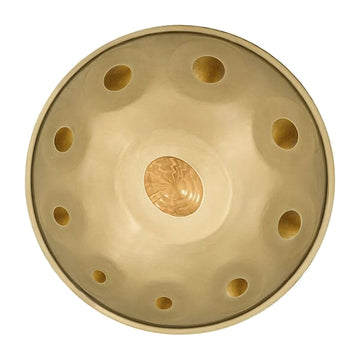
Can Hang drums from Asia be retuned?
When it comes to Asian handpans, you’ll sometimes read that they can’t be retuned. In reality, you should plan to check the tuning of your handpan every 3 to 5 years, depending on how you play and how you store it. Some sellers play on people’s fears by claiming it must be retuned every year and that a Chinese handpan can’t be tuned again because the steel is too thin. That may be true for very low-end models sold for a few hundred dollars, but it’s obviously not true for every instrument (as a guideline, choose a model around 1–1.2 mm (0.04–0.05 in) thick). This kind of message is often used to push you toward one seller rather than another.
On the other hand, some makers essentially boycott retuning by stating they won’t retune a handpan unless it comes from their own workshop. I don’t want to get into that debate, but to stick with the car analogy, it’s like a Volkswagen-approved mechanic refusing to change your oil because your car is a different brand. It’s up to you to decide whether you think that’s normal and to draw your own conclusions about that professional. In any case, there are makers who retune, when possible, all handpans without discriminating based on origin, such as Rivera Steel Tuning. In fact, I think there’s a real opportunity in this field. If you enjoy hands-on work and music and want to get into handpan retuning and repair, I’d be happy to highlight your services. Please contact me.
How can you tell the difference between good and bad Asian percussion instruments?
Now that it’s clear there are excellent Chinese handpans as well as bad ones, how do you tell them apart? As I mentioned earlier, price is a small indicator. Don’t expect to find solid models for under CA$800. Next, it’s essential that there is a video presentation of the handpan so you can judge the instrument’s acoustic potential. Finally, the advantage of buying your instrument online is that reputable sellers will offer a window of time to try the handpan and return it if it’s not right for you. That way, you can buy with confidence.

However, you should be careful about how much you trust the professional you want to order from. You should always check the legal notices, which, as their name suggests, are required by law. These notices must include certain information, in particular:
- The company registration number
- The VAT registration number for the European Union
- A physical address
- A phone number
- The name of the person responsible for publications
If even one of these details is missing, you may be dealing with a website that isn’t very trustworthy and may not honour its commitments if you need to return the handpan. Others, even less scrupulous, may not ship orders at all! It can also be useful to consult online reviews, even though fake reviews are still possible.
Treat yourself to a handpan with exceptional sound quality
When it comes to Asian handpans, there are both good and bad models, even though the current trend among local artisans is to disparage all instruments from this continent without making any distinctions. That’s unfortunate, but you now have all the information you need about Chinese handpans to make the choice that’s right for you.
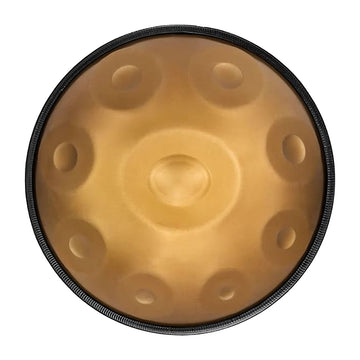
However, sorting through dozens of handpans from Asia can sometimes be complicated. That’s why the Instruments du Monde store works, among others, with Chinese professionals who have been producing handpans for over 10 years—often longer than most local makers. This way, you can enjoy beautiful sound at the best price, plus the peace of mind of a 30-day trial period. With that in mind, I absolutely recommend this Asian model tuned in D Kurd, which will transport you into an incredible sound world.
Discover this sublime handpan by clicking on the link below:
Now that you’ve read all this advice about handpans made in Asia, perhaps you’re thinking about buying one? To help you make your choice, I’ve written another article listing the top 10 best handpans currently available on the market. I encourage you to check it out as soon as possible.


