



Written by Ambre Montespan on Mar 14, 2023 · Updated on Oct 15, 2026

Table of contents:
Thinking about treating yourself to a kalimba? You’ve probably noticed there are two main types: kalimbas with a chromatic scale and those with a diatonic scale. Not sure which thumb piano will suit you best? What are the real differences between these two scales, and how do they change what you can do on a kalimba?
I personally own several instruments in both scales and have been playing them for over five years to learn and perform all kinds of songs. So I can give you clear, practical advice to help you choose your next kalimba with confidence—so you end up with a model that truly matches what you want and enjoy playing.
Choosing between a chromatic and a diatonic kalimba mostly comes down to what you expect from the instrument. A chromatic mbira is typically more expensive, heavier, and more challenging to learn, but it offers far more musical possibilities than a basic diatonic model.
Once you’ve read this article in full, you’ll know exactly:
- The differences between a chromatic and a diatonic kalimba
- How to choose your next thumb piano based on what you want to play
That way, your thumb piano will be a perfect fit, and you’ll be set up to make progress as smoothly as possible.
Let’s dive in.

What are the differences between a diatonic and chromatic instrument?
First, a quick note for beginners: in music, “chromatic” has absolutely nothing to do with colours. On some instruments, such as the accordion, the difference lies in both the design and the notes that can be produced. With the kalimba, the manufacturing method is very similar between diatonic and chromatic instruments, so the key difference is simply which notes you can play.
Let’s start with the simplest case: a thumb piano tuned to a diatonic (heptatonic) scale, which is the most common type. It has seven notes, also called degrees. These are the familiar notes C, D, E, F, G, A, and B. They’re called natural notes and repeat in cycles, either higher or lower. When a new cycle of 7 notes begins, you move to a different octave. So, a classic 17-tine diatonic kalimba includes all the notes of the 3rd and 4th octaves plus the first 3 notes of the 5th. That’s 7 + 7 + 3, for a total of 17 notes.
With a chromatic scale, you don’t have 7 notes—you have 12 notes (or degrees). It’s the 7 natural notes listed above plus 5 in-between notes, sometimes called “altered” notes. In music, these are shown with a sharp (#) or flat (♭). A sharp is a semitone above the note, and a flat is a semitone below. To visualize this, in the tempered scale diagram below, a chromatic kalimba includes every note shown, while a diatonic kalimba includes only those on the left.
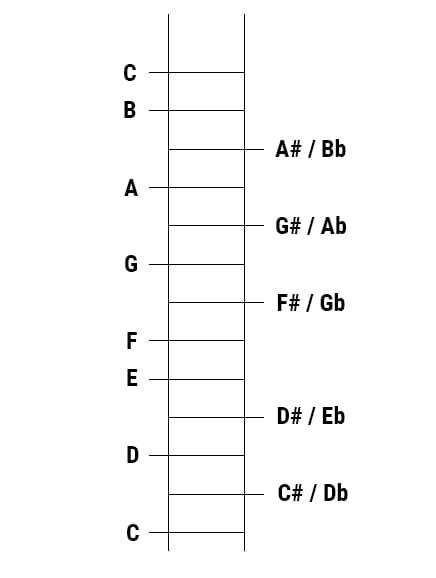
If you’re wondering why there’s no B♯ or C♭, it’s because modern music is built on a tonal system with very strict relationships between notes. Between two notes, there can only be a whole tone or a semitone. Between B and C, the interval is already a semitone, so there’s no “space” for an extra note—hence the absence of B#. The same idea applies to E♯ and F♭.
At this point, you now know that chromatic kalimbas let you play 5 more notes per octave than diatonic ones. Now let’s see which instrument makes the most sense for you.
Is it better to choose a chromatic or diatonic kalimba?
There’s no one-size-fits-all answer when choosing between a chromatic and a diatonic kalimba. The right choice depends mainly on what you want from the instrument, based on a few factors we’ll go through right now.
1 – The musical potential of the mbira
Obviously, if your kalimba (or mbira) is chromatic, it gives you 5 extra notes per octave compared to a diatonic model—which opens the door to more nuanced, complex melodies. For example, if you want to play “Für Elise” the way Beethoven actually wrote it, you’ll need a chromatic kalimba. There are diatonic adaptations of “Für Elise” for standard thumb pianos, but they’re less harmonically rich because some sharpened notes get replaced with natural notes.
In short, the biggest advantage of a chromatic kalimba is its wider musical range compared to a similar diatonic model.
2 – The difficulty of mastering the sanza
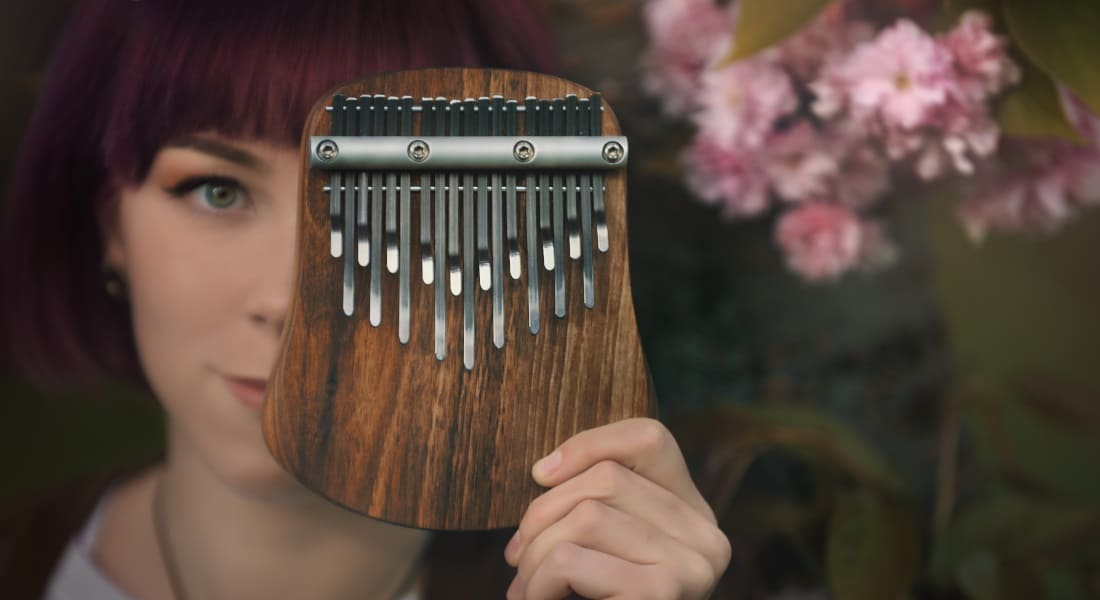
Logically, the more sanza (or kalimba) tines you have, the more challenging it becomes to play cleanly and confidently. In theory, a chromatic kalimba could have just 12 tines—12 notes within a single octave—which could make it simpler than a standard 17-tine diatonic model. In reality, though, chromatic thumb pianos usually have far more than 12 or 17 tines. The average is 34, and some models go up to 42, typically arranged across two rows.
This means that a diatonic kalimba will be easier to use than its chromatic counterpart. That said, it’s worth adding an important nuance: some 34-tine chromatic models are built with two rows, where the bottom row matches the familiar 17-tine layout of diatonic kalimbas. The extra 17 tines on the top row are often the in-between notes. So if you’re hesitating but choose this kind of chromatic model, you can start by playing only the bottom row (like a diatonic), then gradually add the top row when you’re ready. It’s a great way to learn step by step while still having the full chromatic option available.
3 – The price of the thumb piano
If there’s one point that’s not up for debate, it’s the final price, which varies significantly between a chromatic and a diatonic kalimba. While you can easily find an entry-level diatonic model for under CA$80, you can expect to pay CA$160–CA$300 for a chromatic model. That’s easy to understand: chromatic kalimbas are rarer, take more labour to build, and include more components, which naturally drives up the cost.
4 – The weight and size of the kalimba
One of the best things about the kalimba is how easy it is to take with you—so you can play on a walk in the woods or up in the mountains. That’s still possible with a chromatic kalimba, but keep in mind that both the weight and the overall bulk go up.
Compared to a diatonic thumb piano that weighs about 400 g (14 oz), a chromatic model typically weighs about 600–700 g (1 lb 5 oz to 1 lb 9 oz). It’s also usually a few centimetres (about an inch or so) deeper because the double row of tines requires makers to raise the upper row with a specific bridge design.
5 – The presence of a soundboard
Another key factor is whether or not it has a resonator box. In practice, the vast majority of chromatic kalimbas don’t have one (likely because it’s not as cost-effective for manufacturers), while you’ll have plenty of choices with diatonic models. So if you want to create effects like vibrato or wah-wah, a diatonic kalimba tends to be the better fit.
6 – The material of the kalimba body
Just like chromatic kalimbas rarely come with resonator boxes, to our knowledge there are no chromatic thumb pianos made from clear acrylic—that transparent material that gives the instrument such a distinctive look. As a result, if you absolutely want a chromatic model, you’ll need to choose a wooden model instead of an acrylic one.
Play every melody with a chromatic thumb piano
If you’re new to music or to the kalimba, choosing the right instrument can feel confusing, especially when specific terms like “chromatic” and “diatonic” come up. Now you know exactly what to consider when picking your next kalimba—and you’ll even be able to help friends who are in the same situation you were in.
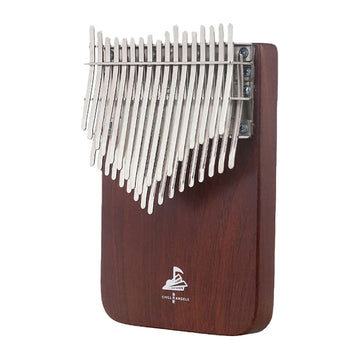
That said, as we’ve highlighted, a chromatic kalimba can be much harder to master because of its high number of tines arranged in two rows. That’s why Instruments du Monde recommends this clever 2-in-1 kalimba, where the lower row matches a diatonic layout. You can start by practising on that simpler row, then gradually level up and bring in the upper row as you improve.
Treat yourself to this superb kalimba by clicking on the image below:
Have you finally made your choice between a chromatic or diatonic instrument? Excellent—but there are still several options within each category. To find the right one for you, check out our top 10 best kalimbas. You’ll be sure to pick a quality model that truly stands out from other thumb pianos. And if you’d like to go further, take a look at our guide to the kalimba.


