



Written by Ambre Montespan on Apr 24, 2023 · Updated on Oct 15, 2026

Table of contents:
Do you own an ocarina and wonder if it’s possible to tune it differently? Are you crafting your own version of this wind instrument from scratch and don’t know how to handle the crucial tuning step?
I’ve been passionate about the ocarina for nearly 10 years, and I asked myself the same questions. After spending many hours researching, I can help you achieve the tuning you’re aiming for on your instrument.
Once it’s made, an ocarina’s tuning isn’t meant to be changed. However, it’s still possible to make slight adjustments to the pitch of certain notes.
By reading this entire article, you’ll learn how to change an ocarina’s tuning:
- whether you bought it in a store
- or you’re crafting it by hand
As a result, in every situation, you’ll know how to play in tune on this small instrument, which is often made from ceramic or clay.
Now, let’s dive into it together.
Is it possible to change the tuning of an ocarina purchased in a store?
When it comes to ocarinas, it’s helpful to first discuss classic models and then those that include a built-in mechanism for changing the tuning.

How can you change the pitch of the notes played by a classic ocarina?
It’s not possible to significantly change the tuning of a store-bought ocarina. That’s simply because the range of notes you can play depends largely on the size of the chamber. The smaller the chamber, the higher the range of notes. Conversely, the ocarina will play lower notes if its chamber, and therefore the overall size of the instrument, is larger.
However, there are a few techniques you can use to vary a note’s pitch very slightly. The first is a matter of breath control: you blow with more or less air pressure into the mouthpiece. The second is to partially cover one of the ocarina’s holes to alter the note being played. Of course, you need a good ear when using these techniques to tell whether you’re still in tune. For extra precision, an electronic tuner can help. That said, if your ocarina is well made, the notes should already be in tune right out of the workshop.
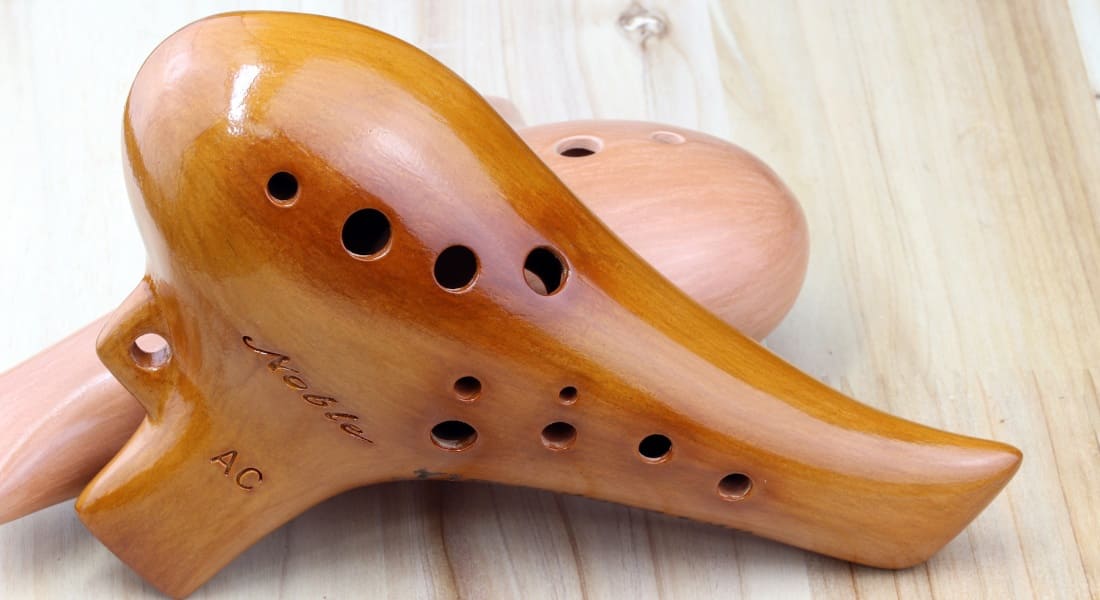
Since you can’t shrink or enlarge the chamber (the resonating cavity), ocarinas come in many different sizes. Professional musicians often use several models in different sizes, and I recommend the same if you want to explore a wider range. You may also be interested in making your ocarina tunable using a specific device. Let’s look at that option now.
The special case of tunable instruments
Some ocarinas are sold with a piston system that lets you increase or decrease the air volume in the chamber. This system sits at the back of the ocarina and can be activated by either pulling on it or screwing/unscrewing it. You can see an example of a tunable ocarina with this device in the photograph below:
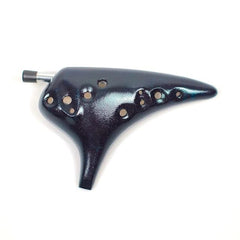
The handle on the left side of this ocarina can be pulled or pushed, causing a metal cylinder inside the instrument to occupy more or less space in the chamber, which changes its volume. By doing so, you can get a tunable ocarina. This system isn’t new, either—19th-century ocarinas have been found with similar mechanisms.
You could, for example, install such a system on a classic ocarina. However, this isn’t a solution I personally recommend. For one thing, you risk seriously damaging or destroying your instrument, especially if it’s made of ceramic. For another, the system isn’t particularly effective. The piston only takes up a limited amount of space inside the chamber, so while the idea works, it’s difficult to turn an alto C ocarina into a bass C. In theory, you could install a larger piston, but it has been shown that this throws off the instrument’s original tuning and upsets the overall balance of the ocarina.
Finally, it’s worth noting that models designed with this system from the start can be unreasonably expensive. For example, it often costs less to buy two ocarinas (alto and soprano in C) than to purchase a single tunable one. So, for now, the best option is still to own several different ocarinas.
How do you tune a handmade ocarina?
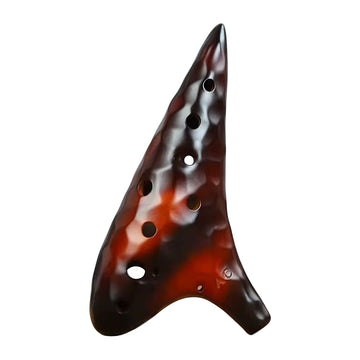
If you’ve decided to make your own ocarina, there will inevitably come a time when you need to tune the instrument. Normally, makers use moulds to get a precise result. In your case, you probably don’t have one, so you’ll need to proceed by trial and error with an electronic tuner.
Once you have created the base of your ocarina, whether it is made of clay, wood, or metal, it will resemble a whistle that produces only one note. This is the fundamental (base) note, which depends on the overall dimensions of your instrument and the size of the air outlet. You can fine-tune the pitch by adjusting the size of this hole: the larger it is, the higher the note. To verify the pitch, simply turn on a tuner and play the note on your ocarina. The tuner will then display the note you’ve played. Once you’re satisfied, move on to the next step.
Next, decide how many holes you want and where to place them, based on your preferences and the size of your ocarina. You can mark the locations with a marker, for example. The notes you create this way will inevitably be higher than the base note determined in the previous step. For example, let’s imagine that we want to make an ocarina in C major: the base note will be C, and the next note will be D.
At the location where you have decided to place the D note, make the smallest hole possible using a drill bit and a drill. Once the hole has been made, test the instrument again, taking care not to cover any holes with your fingers. If the tuner shows the note D, you should not modify the hole any further. If the note is slightly lower than D, you need to increase the diameter of the hole and test it again. Finally, if the note played is higher than D, your hole has become too large and there is probably no way to fix it. This is why it is very important to start with the smallest hole possible and then gradually enlarge it to obtain the desired note.

To finish tuning the ocarina, you will need to repeat this process for each of the holes you have decided to place on your instrument. It’s very important to follow the order of the holes from lowest to highest, because if you adjust a hole’s diameter after the higher-note holes are already finished, you’ll also change their pitch and end up out of tune.
Get yourself a perfectly tuned instrument
The ocarina isn’t the easiest instrument to tune. That’s due to its very nature, especially the fact that pitch is largely determined by the overall size of the resonating chamber. Thanks to this article, you now know all the little tips and techniques to tune this type of flute accurately.
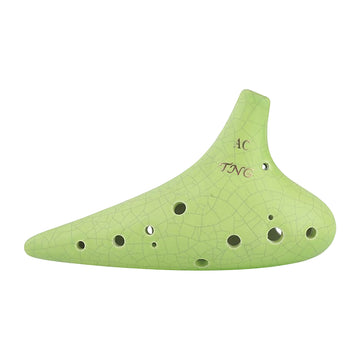
However, changing an ocarina’s tuning will never let you access a truly wide note range. For that, you’ll need several instruments, which will ultimately expand what you can play with your ocarina set. That’s why Instruments du Monde offers a variety of ocarinas tuned in different keys and scales to suit every musician, like this 12-hole model available in alto or soprano.
Choose the tuning you want and treat yourself to this superb ocarina by clicking on the image below:
The ocarina is a relatively simple wind instrument in terms of design. That’s why it’s possible to make one from clay or any other material you choose. Read this tutorial to make your own ocarina with a step-by-step method, complete with images, to ensure your project is a success.


