



Written by Ambre Montespan - Updated on Sep 25, 2026

Table of contents:
Are you interested in this incredible Asian instrument known as the Tibetan singing bowl? Want to learn everything about it, especially how it’s made? How do artisans create a singing bowl, whether it’s metal or crystal?
I’ve been passionate about Tibetan singing bowls for over 10 years, and I’ve travelled to Tibet several times to witness traditional artisans crafting these instruments by hand. Thanks to that firsthand experience, I can walk you through every step of the process and help you picture what makes this tradition so unique.
Metal Tibetan bowls are traditionally made either by hammering or by casting, with molten metal worked using one of these two methods to achieve the desired shape. Crystal bowls, on the other hand, are made exclusively by casting.
By reading this article, you will learn:
- The method of making Tibetan metal bowls by hammering
- How these same instruments are made by casting
- The specific process used for quartz crystal (rock crystal) singing bowls
You’ll then know every step involved in producing a Tibetan bowl the traditional way, and you’ll better appreciate the demanding work of the artisans who create these fascinating instruments.
Let’s dive into it.
How are Tibetan metal bowls made?
There are two main techniques for making Tibetan bowls from metal alloys. The first, and most traditional, is to shape the bowl by hammering. The second is simpler: casting it in a mould.

What is the technique for forging a singing bowl by hammering?
The hammering method can be broken down into four steps. First, a metal-alloy disc is made, then the bowl is shaped, then it’s deburred, and finally it can be engraved if desired.
Forming the metal alloy disc
If you didn’t know, Tibetan bowls are made from several metals that are blended together. That’s why the first step in making a singing bowl is forming the disc that will later be shaped into an instrument. Artisans use a crucible—a container generally made of limestone or metal—in which several metals are melted in a furnace at around 1,800°C (3,272°F).
Officially, Tibetan bowls are made from seven metals—gold, copper, silver, mercury, lead, tin, and iron—in proportions that are closely guarded secrets among artisan forges. However, metallurgical analyses of singing bowls have shown a composition of about 77% copper and 22% tin. The other five metals (when present) account for less than 1% of the instrument’s alloy. In particular, gold and mercury appear only in trace amounts—under 0.03%. If you’re curious about the seven metals used in Tibetan bowls, take a look at our in-depth article that explores this unique alloy in more detail.
The metals are added to the crucible in order of increasing melting point. Lead and tin melt first at around 300°C (572°F), so they go in first. Iron, with a melting point just over 1,500°C (2,732°F), is added last. This sequence helps create a fully liquefied, uniform mixture. The temperature is raised to about 1,800°C (3,272°F) to ensure every metal melts completely in the crucible. Once the alloy is ready, the contents of the crucible are poured into a disc-shaped mould. The artisans then let it cool until it’s no longer liquid but not yet fully solid. At that stage, it’s still glowing red, and they can begin hammering it. They can also let it cool completely to room temperature and reheat it later—in which case the disc takes on a greyish appearance.
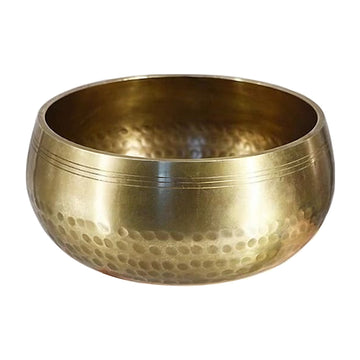
Shaping the Tibetan singing bowl by hammering
Once the disc is hot enough, a group of workers use tongs and hammers of different sizes to shape what will later become a Tibetan bowl. The most experienced worker usually holds the tongs and acts as the true conductor of the operation. His role is to position the disc at the perfect angle so the hammerers can shape the instrument correctly. The other workers hammer in tight coordination. The impact of the hammers creates a rhythm, almost like a captivating melody. The number of hammerers depends on the workforce, available tools, and the disc’s diameter, but it typically ranges from 1 to 5.
During hammering, the disc naturally cools as it meets the surrounding air. That’s why it’s moved back and forth several times between the furnace and the artisans’ hammers, so it stays hot enough to remain malleable. During shaping, a steel template is sometimes placed under the disc to serve as a guide, helping the craftsmen shape the final form of the Tibetan bowl more easily. Once the hammering is finished, which can take several hours, the instrument is dipped in clear water to remove impurities. Finally, a few hammer blows may be added once the bowl is cold to refine its shape. You can watch a video showing the hammering work just below:
Deburring and polishing the musical instrument
At this stage, the Tibetan bowl has roughly the right shape, but it isn’t finished. First, it needs deburring (also called deflashing). In other words, the excess metal and rough edges that are inevitably created during forging and hammering must be removed. This is done using a machine called a lathe, which spins the bowl at high speed. As the percussion instrument rotates, the artisan applies a metal tool to the surface to remove extra material evenly.
Next comes polishing. The goal is to make the surface of the Tibetan bowl smooth and shiny. This can be done by hand or with a dedicated polishing machine if the workshop has one. Beyond appearance, polishing also softens the rim and edges, which helps prevent the player from cutting their fingers or hand during use. Once polishing is complete, the Tibetan bowl is finished. However, an additional step may be added: engraving.
How are engravings made on singing bowls?
Engraving is an optional stage for Tibetan bowls. It’s done using a process known as etching. Concretely, artisans hand-draw patterns or writing on the inside or outside of the singing bowl using black liquid wax. Once the wax is dry and hardened, the instruments are immersed in a bath of nitric acid or ferric chloride for several hours. The acid etches the metal wherever there is no wax. Once the bath is complete, the singing bowl is washed to remove acid residue and any wax still stuck to the instrument’s surface. The Tibetan bowl is now finished.
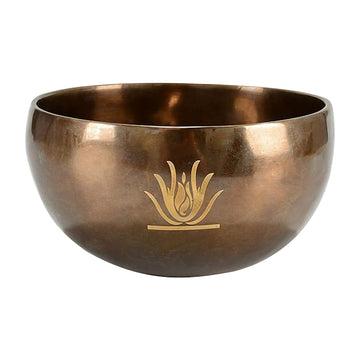
Some might argue that acid-bath etching is a fairly harsh, modern process and therefore doesn’t match the traditional spirit of the Tibetan singing bowl. In reality, that’s not true: etching is a centuries-old technique that was already used to create engravings in the Middle Ages. So it’s not surprising that Tibetan artisans adopted it to enhance the visual beauty of their craftsmanship.
How is a moulded Tibetan bowl made?
The second method of making a Tibetan bowl is to cast it rather than hammer it. The first step—creating the molten metal—remains the same, except that instead of forming a disc and striking it with hammers, the liquefied seven-metal alloy is poured directly into a singing-bowl-shaped mould. The artisan then removes the piece from the mould, revealing an almost finished instrument. After that, deburring, polishing, and any engraving are done the same way as described above. You can see a worker making a Tibetan bowl by casting in the video below:
This method is much faster and easier than hammering, and it requires only one craftsman to complete. Does that mean the sound will be lower quality? Some people say yes, while others don’t hear any difference. In my opinion, it really comes down to personal perception.
What is the method for creating a crystal singing bowl?
When it comes to quartz crystal singing bowls, the only manufacturing method is casting. It includes purifying the raw material first, then shaping it.

Purification of quartz crystal
Quartz, also known as rock crystal, is one of the most common minerals on Earth’s surface. It’s mainly composed of silicon dioxide (more simply called silica), along with small amounts of other elements such as iron, aluminum, and calcium. Before making a singing bowl, the goal is to keep only the silica. So the first step is purifying the quartz to obtain silica powder that’s 99.9% pure (or even higher), which is then used to create the instrument. Strictly speaking, that means a quartz crystal singing bowl is essentially a silicon dioxide crystal bowl—but “quartz crystal” is definitely the more poetic name, and it’s the one that stuck.
Moulding and polishing the rock crystal singing bowl
Once the silica powder has been obtained, it’s heated to around 2,000°C (3,632°F), since its melting point is roughly 1,700°C (3,092°F). The silicon dioxide is melted in a machine called a crystallization furnace, which is essentially a large heated centrifuge. As it cools, the silica crystallizes into a solid form. Various chemical or thermal treatments may then be applied (or not) to change the bowl’s appearance, transparency, or texture. For example, gas treatment can produce transparent singing bowls with beautiful, iridescent highlights.
As with metal-alloy bowls, crystal bowls are removed from their moulds, then trimmed and polished. As a finishing touch, patterns or designs may appear on the inner or outer walls. The following video shows the manufacturing of a crystal singing bowl.
If you’re unsure which material to choose for your next singing bowl purchase, read our article comparing metal alloy and crystal bowls. You’ll quickly understand the subtle differences between these two musical instruments.
Choose a high-quality percussion instrument
The Tibetan singing bowl remains a mysterious object in many people’s minds, still surrounded by an air of secrecy. However, its manufacture hasn’t been a mystery for a long time, and artisans are often happy to open their doors and showcase their skill. With everything covered in this article, you now know how this Asian percussion instrument is traditionally made.
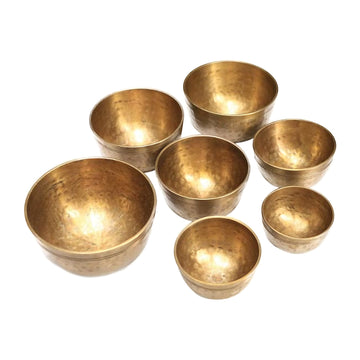
That said, don’t expect to make a Tibetan singing bowl yourself at home. As we’ve seen, a truly authentic bowl requires a powerful furnace capable of reaching nearly 2,000°C (3,632°F), along with the risks that come with that kind of heat. On top of that, a high-quality singing bowl demands real experience and know-how that a beginner won’t gain in just a few attempts. For that reason, if you’re looking to buy a Tibetan bowl, we recommend the Instruments du Monde store, which offers over 200 models of this instrument, including these stunning bowls with beautifully rich tones.
Discover these Tibetan bowls by clicking on the image below:
What is a full moon singing bowl? Find out in this article, which will teach you everything there is to know about Full Moon Tibetan bowls. You may also be interested in our comprehensive guide to this percussion instrument of Asian origin. The Tibetan singing bowl will then hold no more secrets for you.


