



Written by Ambre Montespan on Nov 4, 2024 · Updated on Oct 15, 2026

Table of contents:
Do you own a handpan and want to perform live? Want to learn how to amplify the sound of this percussion instrument, or record your own compositions? Which microphone should you use to mic up your Hang drum?
I’ve been playing handpan for over 10 years, and I’ve had the chance to perform live with this musical instrument. In this guide, I’ll show you how to boost and capture its acoustic vibrations so your audience can hear you clearly.
To amplify a handpan properly, you’ll need to choose the right microphone, optionally connect it to an audio equaliser (EQ), and then run the signal to a speaker.
So, by taking the time to read this article in its entirety, you will learn:
- Which microphone is best for your handpan
- Which speaker works best with this instrument
- Whether it’s useful to add an equaliser or effects pedals
- The different ways to record the sound of your Hang drum
With all this knowledge in hand, you’ll be ready to share your artistic creations with anyone who wants to listen. You’ll know how to perform in public or capture the sounds of your Hang drum to share them widely online.
Now it's time to look at choosing a microphone for your handpan.
Which microphone should you choose to amplify a handpan?
There are four main types of microphones you can use to amplify the sounds of your handpan: pickup (contact) microphones, dynamic microphones, condenser microphones, and ribbon microphones. Each has advantages and disadvantages you’ll want to weigh. Let’s go through them together.
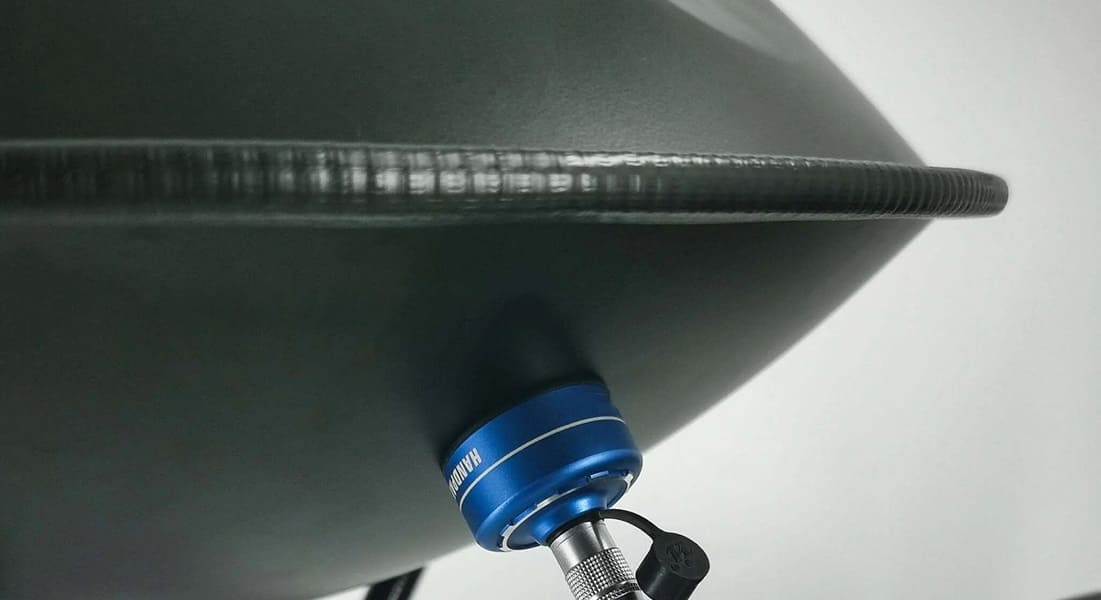
Pickup or contact microphones for recording handpan sounds
As the name suggests, these microphones attach directly to the metal surface of the instrument—either to the upper or lower shell—using adhesive or magnetism. They capture sound not through air vibrations, like the other mic types we’ll cover later, but through vibrations that travel through the instrument’s metal. That means you can’t get feedback with a contact mic, which is a major advantage. What’s more, it only picks up the instrument itself, so contact microphones are completely unaffected by surrounding noise. It doesn’t matter if other people are talking, singing, or making noise next to you—the only sounds that will be amplified are those coming from the handpan.
This type of microphone also picks up strikes on areas without handpan notes very well, making it ideal for percussive playing. On the other hand, you’ll need to experiment a bit to find the best place to position it. The sound will vary slightly depending on the mic’s location, so it’s up to you to determine what works best on your handpan acoustically. Finally, microphones that attach without magnets can leave marks that need to be cleaned off when you remove them—a problem that doesn’t occur with magnetic models. With all its advantages, this is the contact microphone I recommend in most situations.
Dynamic microphones for recording the instrument
A dynamic microphone contains a thin membrane (or diaphragm) attached to a moving coil placed inside a magnetic field. This design produces a rugged, versatile mic that performs well in noisy environments, and it’s generally less expensive than other options. On the other hand, dynamic microphones are less sensitive to subtle details than other types, and their frequency response is more limited. The result can sound less natural, and you’ll usually need to place it very close to the handpan. As a result, you’ll often need a precisely adjustable stand, which can raise the total cost of your setup.
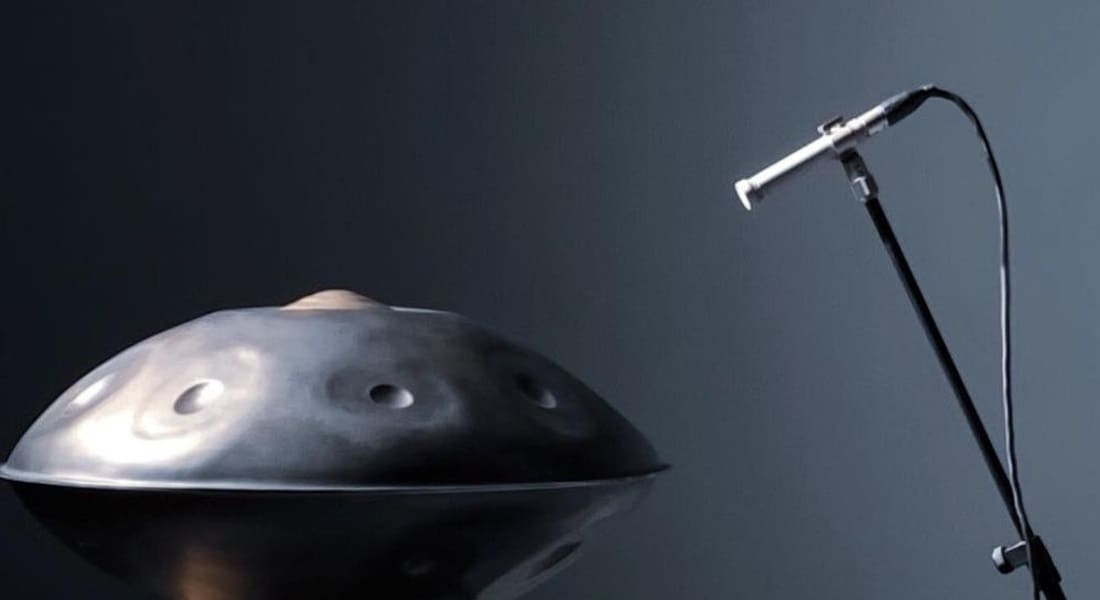
Condenser microphones for capturing the sounds of the Hang drum
Condenser microphones work with a different technology than dynamic microphones. The big advantage of this type of mic is the sound quality it can capture: it’s very sensitive, has a wide frequency response, and delivers a result that stays true to the original tone. On the other hand, condenser microphones are expensive and very fragile. That same sensitivity can also be a drawback, because they tend to pick up everything and aren’t ideal in noisy environments. Finally, unlike the other types mentioned above, these microphones require power, usually 48V phantom power. Without it, the condenser system won’t work. In practice, condenser microphones are mainly used in studios with good sound isolation and quick, easy access to power.
Ribbon microphones for capturing handpan vibrations
Ribbon microphones use a unique design based on a thin metal ribbon to capture sound waves, and the approach is fairly similar to condenser technology. They’re valued for a smooth, natural sound that’s especially well suited to certain kinds of studio recordings. However, they’re even more fragile than condenser microphones, they’re very sensitive to high frequencies, and they also require external power to operate. In short, ribbon microphones share many of the same pros and cons as condenser models—the main difference is the character of the sound, which may lead some players to prefer one over the other. As with condenser mics, studio use is strongly recommended.
Combining several types of microphones for the instrument
It’s also possible to set up multiple microphone types to take advantage of what each one does best. They become complementary and can work together in synergy. For instance, you might pair a pickup mic with a dynamic, condenser, or ribbon model. Of course, this approach requires a bigger budget. Setup will take longer, and you’ll need to balance the sound each mic captures, which requires some audio-mixing know-how. You’ll also want to address phase issues that often pop up when using multiple microphones.
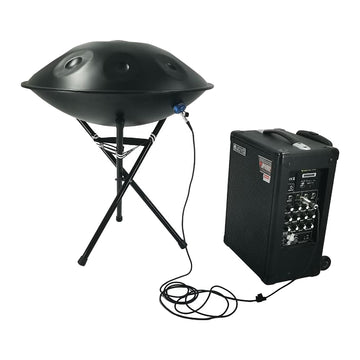
Which speaker should you choose to amplify the sound of this percussion instrument?
Once the sound has been picked up by the microphone, it needs to be amplified through a speaker. There are several solutions available, but personally, I recommend two. The first is a portable PA system, which lets you play outdoors for a small audience. A battery is built into the unit, giving you great portability and freedom. The second option is a powered (active) speaker, which has a built-in amplifier—unlike passive speakers that require an external amp. Powered speakers make wiring simpler and setup more convenient. You can find solid mid-range models from Bose, JBL, or Marshall for around £450.
Should you add an equaliser or effects pedals to enhance the acoustics of the Hang drum?
Between the microphone’s signal and the speaker, you can insert several devices to process or shape the sound. Equalisers (EQs) let you filter or boost specific frequency bands, so adding one can help refine your tone. Effects pedals can alter the sound through saturation, processing, modulation, or spatialisation. If you want to add reverb, tremolo, or even vibrato, an effects pedal can add real character to your melodies. Neither an EQ nor effects pedals are truly required, but they can help experienced players fine-tune their sound and add variation in their compositions. Finally, some speakers even include built-in EQ or effects such as reverb, delay, or chorus.
How to record a handpan?
Even if you don’t plan to amplify it, you can record your handpan to share your performances with the world, such as by posting videos on YouTube. There are two main ways to do this: recording directly on a computer or using an external device.
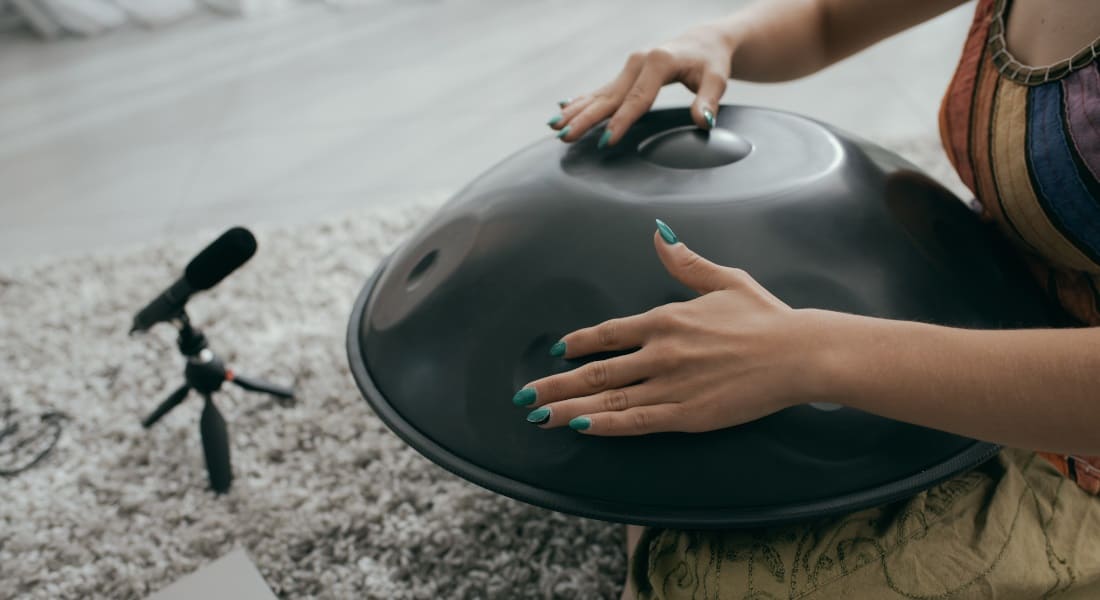
Record the sound of a handpan on your computer
This solution is relatively simple and affordable. Just plug in the microphone and connect it to your computer’s audio interface. Most interfaces currently on the market are perfectly adequate if you’re not an audio professional, and almost any desktop computer will do the job very well. What’s more, it’s easy to upgrade your setup by purchasing a higher-quality interface. So, with a relatively small budget, it’s entirely possible to record your handpan using a desktop computer. The downside is that you’ll need a power source nearby.
Other devices for preserving the sound of your instrument
These devices may or may not have a built-in microphone. If not, you can use one of the microphones mentioned earlier in this article. Otherwise, you’ll want a recorder with the best possible audio quality. The advantage of these devices is that they’re extremely quick to set up: in just a few seconds, you can capture the sound of the handpan. What’s more, you can use them almost anywhere, whether out in nature or in more unexpected places. However, you’ll need to watch your battery level. Also, if you use a device with a built-in microphone, you can’t simply upgrade the mic the way you can with a computer setup—you’ll need to buy a whole new unit, which can get expensive over time.
Amplify your handpan with an excellent microphone
Given the multitude of options available on the market, amplifying a handpan is far from simple at first glance. There are many types of microphones that are more or less suitable for this task, and few percussionists have the know-how of a sound engineer. But thanks to the information you’ve read in this article, you’ll be able to choose the right mic for your needs and expectations.
However, not all microphones are equal in terms of quality. They come in all price ranges, and some deliver truly disappointing results compared with higher-quality models. That’s why I personally rely on the magnetic contact microphone sold by Instruments du Monde. It’s very easy to use and employs patented technology to deliver professional acoustic performance.
Go for quality and pure sound—order this microphone by clicking on the image below:
Now that you can capture your handpan’s sound, why not explore other instruments that pair beautifully with it when you play together? Read my article on instruments that accompany the handpan perfectly. You’ll come away with plenty of ideas for your next musical compositions.


