



Written by Ambre Montespan on Jun 6, 2022 · Updated on Oct 15, 2026

Table of contents:
Have you noticed that some Tibetan singing bowl players fill the instrument with water and make the liquid “dance”? Wondering if you can do the same with your own singing bowl? And what’s the purpose of using liquids like this?
As someone who’s been fascinated by these curious, mystical objects known as Tibetan singing bowls for over 10 years, I’ve personally tried making water quiver with this instrument many times, almost as if it were boiling. So I can show you exactly how to do it yourself and explain the different reasons people choose to vibrate water with a Tibetan singing bowl.
You can fill a Tibetan singing bowl with water, then make it sing so the vibrations transfer into the liquid, causing it to tremble as if it were boiling. This technique can be used to purify and energise the water, and it can also change the note produced by the singing bowl.
Once you have read this entire article, you will understand:
- How to make water vibrate in your Tibetan bowl
- Why use your instrument in this way
- Which types of singing bowls are best suited to this practice
As a result, you’ll have everything you need to understand the relationship between water and Tibetan bowls. You’ll know exactly how to make water ripple in any singing bowl and be able to decide whether this practice is worth incorporating into your work with the instrument.
Let’s now take a look at the relationship between water and Tibetan bowls.
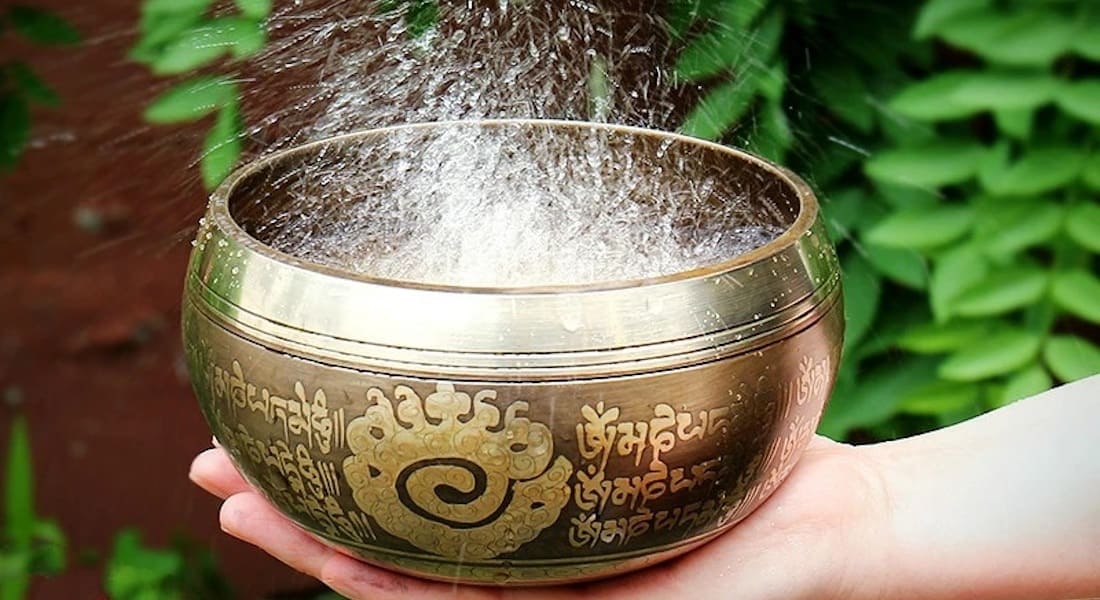
Is it possible to vibrate a liquid in a Tibetan bowl?
Vibrating a liquid in a container by subjecting it to vibrations is far from a new phenomenon. In fact, as early as 1831, physicist Michael Faraday observed that above a certain frequency, the surface of a liquid stops being flat: it first begins to ripple, then intensifies until droplets can even leap out of the container. This hydroacoustic phenomenon was named Faraday waves.
The same principle applies to Tibetan singing bowls. As the musician plays, the metal walls vibrate, and those vibrations travel through the water, making it quiver and form complex, captivating patterns once a certain frequency is reached. You can see this phenomenon in the video below:
You have to try this experiment yourself to understand why it’s so fascinating—for a moment, it’s easy to believe the droplets are actually levitating above the water, making the Tibetan bowl seem truly magical. It’s a mesmerising spectacle that adds to the enduring legend of this instrument. In fact, this phenomenon of quasi-levitation is mentioned in a study on Tibetan bowls published on 1 July 2011, by two scientists from MIT (Massachusetts Institute of Technology) and the Free University of Brussels. The aim of these two researchers was to find mathematical formulas applicable when a liquid is subjected to Faraday waves. According to them, the droplets can bounce off the surface, creating the illusion of levitation.
Why put water in a Tibetan bowl?
Beyond enjoying this seemingly supernatural spectacle, there are several reasons for vibrating water inside a Tibetan singing bowl. Some are very practical, while others are more esoteric.
Purification and energisation of liquids by the Tibetan bowl
Some practitioners of complementary and alternative medicine, along with certain ancient Eastern cultures, believe that vibrations can purify and energise, rejuvenating the body and mind and offering therapeutic benefits. This is one reason Tibetan bowls filled with water are used. By making the liquid inside the instrument tremble, it is said to become charged with positive energy through the vibrations produced by the singing bowl. This “charged” water can then be used in different ways: for washing, watering plants, or even drinking, although I don’t really recommend the latter option, as we’ll see later.
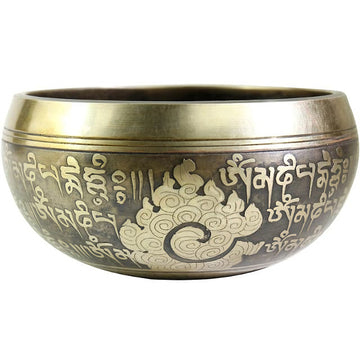
1 – Is there a scientific basis for water purification?
The first question asked by people who discover the medicinal uses of water that has been purified or energised in a Tibetan bowl is: does it really work? This is a legitimate question, and scientific research on the subject has not yet reached a definitive conclusion.
In 1988, renowned physician and immunologist Jacques Benveniste published research on what he called the memory of water, the idea that water retains a kind of “imprint” after coming into contact with certain substances or phenomena. Without going into too much detail, this theory sparked major controversy in the scientific community. Some experts even accused him of fraud, especially since Jacques Benveniste was working at the time for a laboratory specialising in homeopathy. As a result, the hypothesis of water memory is considered invalid by mainstream science today.
That said, several researchers, including Professor Luc Montagnier (winner of the 2008 Nobel Prize in Medicine), have published studies suggesting that certain changes in water can be observed at the nanoparticle level, which they argue supports Benveniste’s theory. So it’s difficult to be completely certain that the vibrations produced by Tibetan bowls have an effect on the water inside. However, it wouldn’t be the first idea dismissed by science that later turns out to be true. The best approach is to form your own opinion based on personal experience.
2 – Can you drink the water from a Tibetan bowl?
Once the water has been “purified,” it’s natural to want to drink it. While I’ve never personally seen any cases of poisoning linked to water from a singing bowl, I still can’t recommend drinking it for one simple reason.
According to Tibetan tradition, the instrument is made from seven metals, which we discuss in detail in this other article. Within this metal alloy, lead and mercury may be present, even if in reality it’s often in extremely small amounts (or even none in some cases). As a result, if you drink water that has been sitting in a Tibetan bowl, you could be ingesting trace amounts of these two metals, which are harmful to your health. That’s why this practice isn’t recommended unless you’re certain your instrument is bronze or you’re using a quartz crystal singing bowl, which generally poses far fewer health concerns.
The change in the note played by the singing bowl
You’ll also quickly notice that the note played by the Tibetan bowl changes when it’s filled with water. That’s perfectly normal, since adding liquid changes the instrument’s acoustic properties.
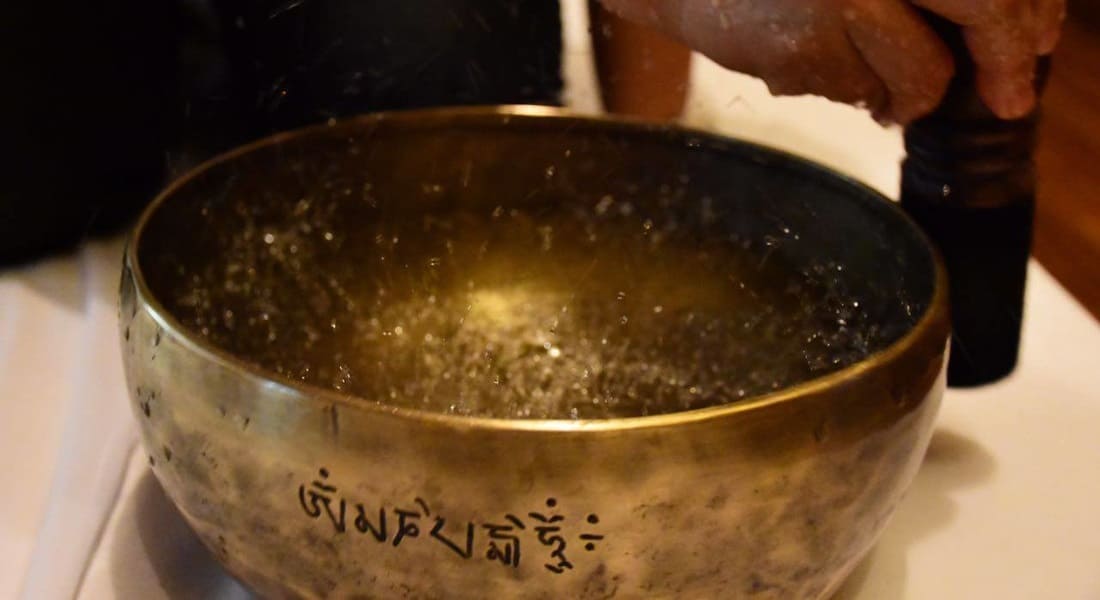
The note produced by the singing bowl matters if you want to balance your chakras. Each of the seven musical notes corresponds to a major chakra in the human body. So by changing the note after adding water, you can shift which chakra you want to work on. You’ll need a way to identify the note the bowl is producing (some smartphone apps do this very well), and you’ll also need to manage the water level carefully to find the note you’re looking for.
Enhanced relaxation by filling the instrument with water
When you vibrate water in your Tibetan bowl and droplets begin to jump out of the instrument, you’ll hear a sound that’s very similar to rainfall. That sound has a calming effect on a huge number of people. So if you’re doing a sound bath or a meditation session, it can be a great idea to use this water technique to enhance the atmosphere. Just be careful not to place the bowl too close to anyone—because while the sound of rain is relaxing, getting splashed definitely isn’t.
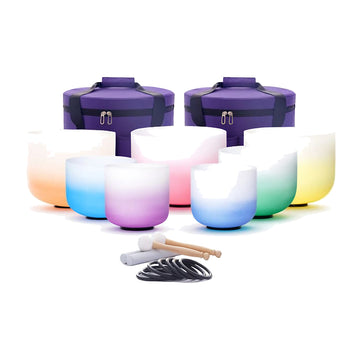 Our pickChoose this set of quartz crystal singing bowls to purify waterView the quartz singing bowls
How do you make the water in the musical instrument vibrate?
There are two techniques you can use to make the water at the bottom of your bowl vibrate. These are the same methods used to play your instrument normally: the rubbing technique and the striking technique. In either case, I recommend filling the Tibetan bowl to about 1–2 cm (0.4–0.8 in) from the rim.
Rub the singing bowl to make the water vibrate
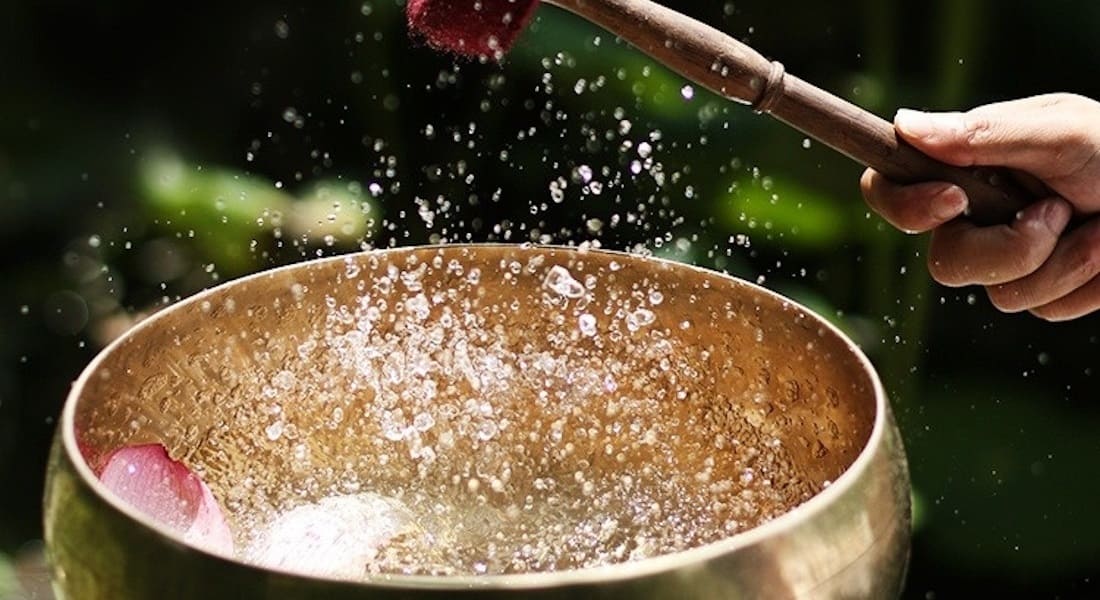
This is the simplest and most visually appealing method. It involves rubbing your Tibetan bowl as if you wanted to make it sing. You can give it a boost, i.e., strike it just before you start rotating it, or not. However, you will definitely need a mallet covered with either felt-like fabric or leather. Mallets made only of wood will not provide enough friction to create sufficient vibrations to vibrate the water. It is not necessary to rotate very quickly; the aim here is to be consistent. Watch the video below for an example:
Strike the musical instrument to give the impression that the water is boiling
Alternatively, you can simply strike the Tibetan bowl to make the water quiver. You’ll just need to gauge your strength to get good results. In this situation, a mallet with a fabric tip will be more effective than a mallet covered with felt. But take a look at the difference below:
An important step to avoid damaging the Tibetan bowl
In any case, after using a singing bowl with water, you must dry the instrument with a soft cloth to prevent rust from spreading on the metal. Take a look at this guide, which explains how to clean and maintain a Tibetan bowl. This will ensure that your precious object lasts for many years to come.
Can any Tibetan bowl be used with water?
Vibrating water in a Tibetan bowl can be done regardless of the size or composition of the instrument. In fact, it is even possible to cause this phenomenon using a wine glass. However, some bowls will be more effective than others for this practice.
Does the size of the singing bowl matter when it comes to making water vibrate?
Whether your singing bowl is relatively small (less than 15 cm (6 in) in diameter) or rather large (more than 25 cm (10 in) in diameter), you can always vibrate water inside it. That said, the smaller the bowl, the less dramatic the effect. With small Tibetan bowls, only a few ripples can be obtained using the rubbing technique, which may disappoint you. So, if you want to see droplets fly off, you should opt for a medium to large singing bowl, at least 15 cm (6 in) in diameter.
To help you determine the right size for your future Tibetan bowl, check out this article.
Does this technique with water also work with quartz crystal bowls?
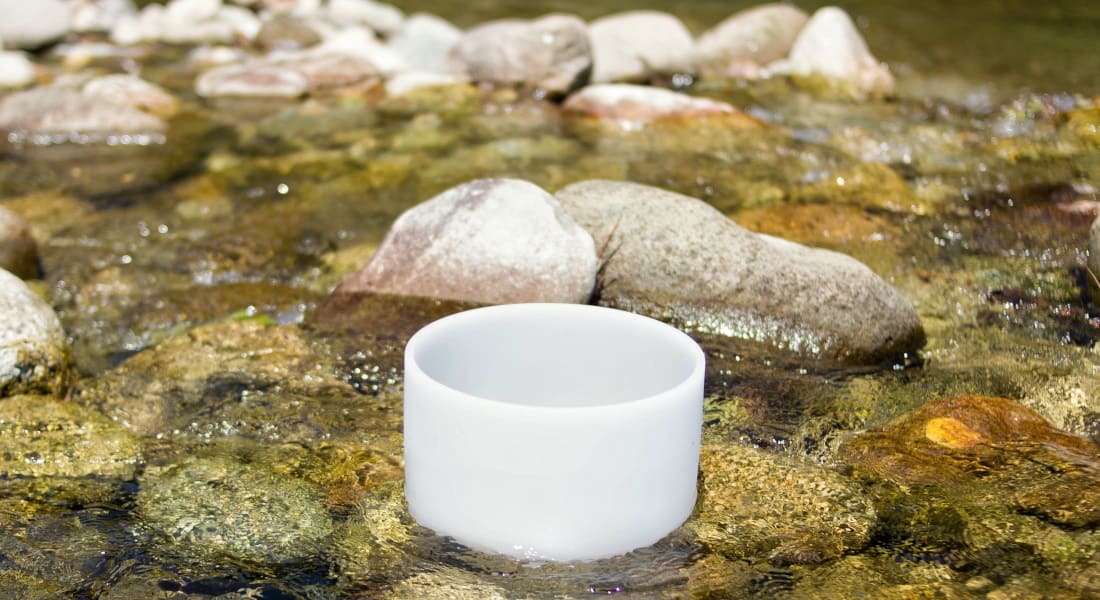
You may already know that there is a second type of singing bowl made almost exclusively from quartz or rock crystal. These instruments are generally transparent or white and much more fragile than their metal counterparts. Once again, it is possible to vibrate water with a crystal Tibetan bowl, as you can see in the video below:
However, bowls made from this material do not really have a parabolic shape like metal bowls, but rather resemble a water glass. This sometimes makes it more difficult to observe the crackling of the water horizontally. But this is only an aesthetic detail.
Use a Tibetan bowl designed specifically for water vibration
An astonishing and fascinating phenomenon, the rippling of water inside a Tibetan bowl is an experience that can be enjoyed by all owners of this instrument, whether it is made of metal or crystal. Now that you have read this entire article, you know how and why to vibrate the water inside your singing bowl.
While the technique works with any bowl, certain models excel at generating strong, intense vibrations that travel beautifully through the liquid. For this reason, Instruments du Monde recommends the specialised singing bowl designed specifically to make the water inside it vibrate.
Discover this singing bowl now by clicking on the image below:
Did you know the instrument can lose some of its energetic effectiveness over time? If you’ve noticed this, it’s a good idea to recharge your Tibetan bowl to make sure it still has the same qualities it did when you first bought it. Also, learn all the different ways you can use this unique instrument, including other energy-related practices.


