



Written by Ambre Montespan on Aug 11, 2025 · Updated on Oct 15, 2026

Table of contents:
Have you recently discovered the music and melodies of Davide Swarup, an Italian percussionist specializing in the handpan? Want to learn more about him? How did he discover this instrument? What’s his story, and what projects has he been working on?
I first heard about Davide Swarup in 2013, when he produced the tracks for the Arambolla project while living deep in the jungle. Since then, I’ve been regularly keeping up with this talented artist’s new releases, and I’m excited to share every key chapter of Davide Swarup’s musical journey with you.
By reading this article, you will discover:
- How Davide Swarup discovered the handpan
- His musical journey
- And his discography
By the end, you’ll know the most fascinating things about Davide Swarup, bringing you closer to this percussionist who helped pioneer this metallic musical instrument.
Now, let’s take a look at how Davide Swarup discovered the handpan.
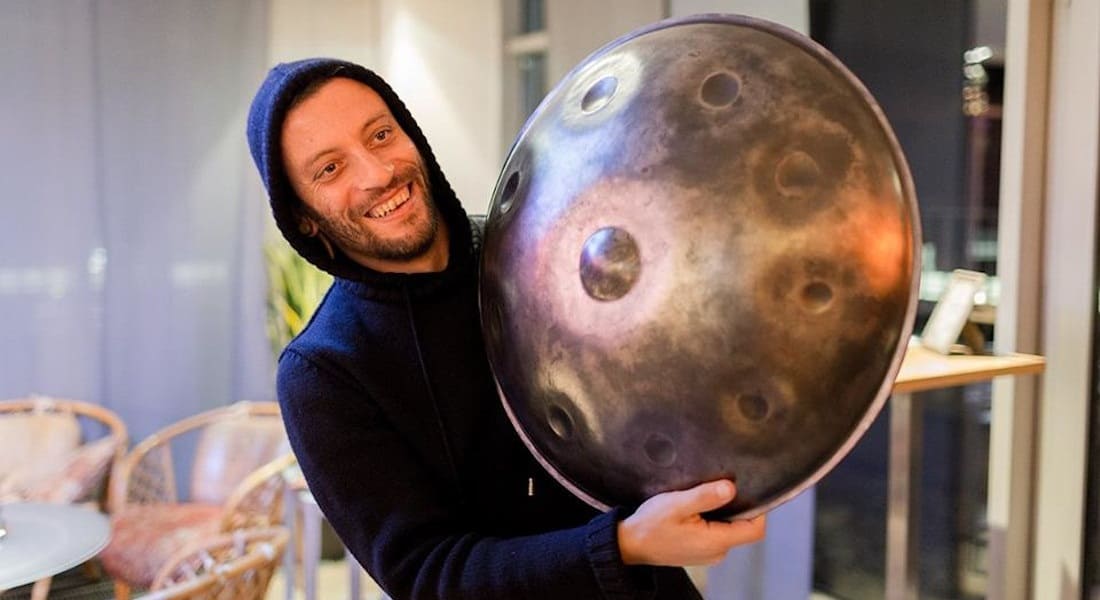
How did Davide Swarup encounter the handpan?
Davide Swarup, whose real name is Davide Bianchi, was born on September 23, 1974, in Como, Italy. He grew up in the small town of Capena, where, by his own account, music played a big role throughout his childhood. At 15, already drawn to percussion, he started out as a bassist in an Iron Maiden cover band called Nefastum, playing with them until he was about 20. Toward the end of his teen years, Davide Swarup broadened his musical horizons and developed a passion for many genres, including rock, blues, jazz, psychedelic, folk, and a wide range of other world traditions.
In the early 2000s, this percussionist felt the urge to travel and find fresh inspiration. He left for India, which he affectionately nicknamed "Mamma India," and returned multiple times. These formative trips allowed him to meet musicians from all over the world, discover traditional instruments (such as the Indian santur), and dive into Eastern percussion. Davide Swarup learned music “on the job,” listening and improvising in jam sessions alongside new musical friends. Without a formal academic background in reading music, he developed an intuitive approach to sound: “I don’t know music theory, but I can feel it,” he says, summing up his self-taught path.
Guided by music and the twists and turns of life, Davide Swarup decided in October 2004 to move to Amsterdam in the Netherlands. It was there that he made a discovery that would change the course of his musical life: the Hang. This metal, saucer-shaped acoustic instrument, developed in Switzerland in 2000, is the ancestor of what we now call the handpan. In Amsterdam, “the Hang was waiting for him,” he says, as he got his hands on his first one almost as soon as he arrived. He was immediately captivated by the airy, soothing sound of this new melodic percussion instrument. In 2005, Davide Swarup devoted himself entirely to this art and became one of the very first musicians in the world to play the Hang drum.
Davide Swarup began playing the Hang as a street musician (busker) on the streets of Amsterdam. His captivating, unconventional style quickly drew the attention of passersby and music lovers alike. He also performed in cafés, coffee shops, parties, and clubs across the Dutch capital, spreading the Hang’s new vibrations wherever he went. You can see one of his performances from 2006 in the video below:
His musical approach, blending meditation and improvisation, gives rise to melodies created in the moment—music that seems to speak straight to the heart. Davide Swarup says he plays in an almost meditative state, letting the music come to him without the ego getting in the way: the energy simply seems to flow through his hands, resulting in spontaneous compositions of remarkable purity. One of his favorite phrases before playing is "Let’s see what happens," reflecting his philosophy of total surrender during performance. That connection to the present moment and the unknown makes each performance unique and gives his music a spiritual, hypnotic dimension often noted by listeners.
What has been the musical journey of this Hang drum professional?
After several years with the handpan, Davide Swarup entered the studio in spring 2007 to record his first solo album, "Music for Hang," released on the now-defunct Samekh Records label. Historically, it’s considered one of the earliest albums devoted exclusively to the Hang, cementing Davide Swarup’s status as a pioneer of this percussion instrument. The album features about a dozen tracks, including (Moods) Bottom and Intermezzo 1, which went on to gain real traction. Davide Swarup also promoted the album himself through videos on his YouTube channel, which he had launched just a few months earlier. Those videos went viral, reaching hundreds of thousands of views—and you can watch one of them right below:
The album’s release pushed the artist onto the international scene at a time when the Hang was still virtually unknown to the general public. For example, American percussionist and handpan player Dan Mulqueen recalls: "I discovered the handpan on YouTube in 2007 while watching Davide Swarup’s Music for Hang video. I was completely blown away by the sound of the instrument." Davide Swarup then began traveling with his Hang to perform across Europe and beyond. He played in the street, but also at intimate concerts, yoga events, festivals (such as Ozora in Hungary), and handpan gatherings.
In 2008, he began experimenting with studio fusions, for example with Israeli flutist Avi Adir and Dutch singer Dewi Pechler, expanding his sonic universe. In 2012, he took part in a TEDx conference in Salford (UK), where he introduced his favorite musical instrument to a broader audience. Organizers described him as "a leading Italian percussionist and one of the world’s pioneers of the Hang." Widely shared online, his TEDx performance helped convince many new listeners of this instrument’s magic.
In 2013, Davide began a particularly fruitful collaboration with the group Anna RF, an Israeli duo blending electronic music with traditional instruments. The meeting took place in Arambol, a village in Goa, India, where Davide often stays. With Ofir J. Rock and Roy Smila (the members of Anna RF), they launched the Arambolla project. Together, they decided to venture deep into the jungle to record a series of original live performances. From that session came the album Dreamland (Live in the Jungle), captured in the magical atmosphere of the rainforest. Released in April 2013, Dreamland features five long improvised tracks: "Dreamland," "The Banyan Tree," "Rostov Lullaby," "Magik Tikka," and "Nameco"—all recorded in a single take out in nature. These became some of his most popular pieces, with this one in particular surpassing 400,000 views on YouTube:
Beyond Anna RF, Davide Swarup has inspired and collaborated with many other handpan players around the world. For example, he has shared stages or projects with artists such as Daniel Waples, Hang Massive, Ravid Goldschmidt, and the duo Hang Playing Hedge Monkeys, all part of the same generation of early pioneers of the instrument. Always on the move, Davide Swarup continues to travel to take part in festivals and events dedicated to handpans and world music. In 2025, for example, he will be the guest of honor at the very first handpan festival organized in the Himalayas, a testament to his international reputation two decades after his debut.
What is the discography of this percussion specialist?
In addition to the 2007 release "Music for Hang" and the Arambolla project (discussed earlier in this article), Davide Swarup put out "Live in Moscow – Love for Improvisation" in 2014, recorded during a concert in Russia. Later, in 2021, he released the album "The Fruit of Life," showcasing his artistic evolution after 15 years of handpan experience. Finally, in 2023, he released a live album titled "Being Human (Live)", which distills his humanist message into music. You can find all his compositions on his Bandcamp or Facebook page.
Compose melodies with your own handpan, just like Davide Swarup
Davide Swarup holds a truly special place in the handpan community because he was one of the first players in the world to bring this instrument to a broad audience. In fact, some of today’s greatest handpan composers discovered the instrument thanks to Davide Swarup. After reading this article, you now have a clear picture of his musical journey.
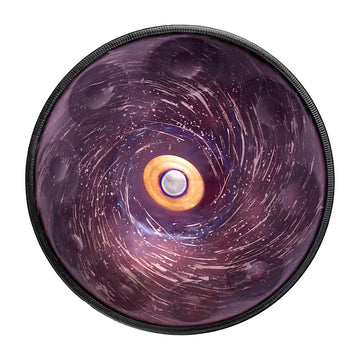
However, beyond his talent, Davide Swarup also became a handpan icon thanks to the quality of the instruments he played. If you want to perform beautiful pieces yourself, choosing an excellent instrument matters. That’s why I recommend the Instruments du Monde store, which offers more than 50 different handpans in a wide variety of tunings to suit every musician. For example, a 10-note D Kurd model is ideal for most players.
Discover this gorgeous purple model now by clicking the image below:
A few years after Davide Swarup published his compositions online, a whole new generation of handpan musicians emerged. This is particularly true of Marcel Hutter, who discovered this percussion instrument in 2012. It’s therefore very likely that Davide Swarup’s influence now extends to the most famous Hang drum players of today.


