



Written by Ambre Montespan on Jun 16, 2025 · Updated on Oct 15, 2026

Table of contents:
Have you recently been captivated by one of Nadishana’s stunning compositions—the Siberian musician now based in Berlin, a master of the handpan and an inventor of experimental instruments? Are you wondering how this singular artist earned his place on the global handpan scene and which pieces are truly unmissable?
Having discovered Nadishana more than 10 years ago thanks to a video shared on social media pages dedicated to ethnic music, I was immediately fascinated by his unique way of making the handpan “speak” with instruments from all over the world. Ever since, I’ve followed his work closely, and in this article, I’m excited to walk you through the key stages of his musical journey.
In this quick overview, you’ll learn:
- The details of Nadishana's musical life, from his origins in southern Siberia to his move to Berlin
- The most famous compositions of this outstanding multi-instrumentalist, reflecting his diverse sonic world
You’ll also discover the deeper motivations that drive this artist, as well as his latest projects, rich in collaborations with other internationally renowned musicians. By the end, you’ll have a clearer sense of the many sides of his talent and, perhaps, feel a little closer to the soul of his creations.
So without further ado, let’s dive into the spellbinding vibrations and subtle harmonies Nadishana has to offer.
What is the biography of handpan player Nadishana?
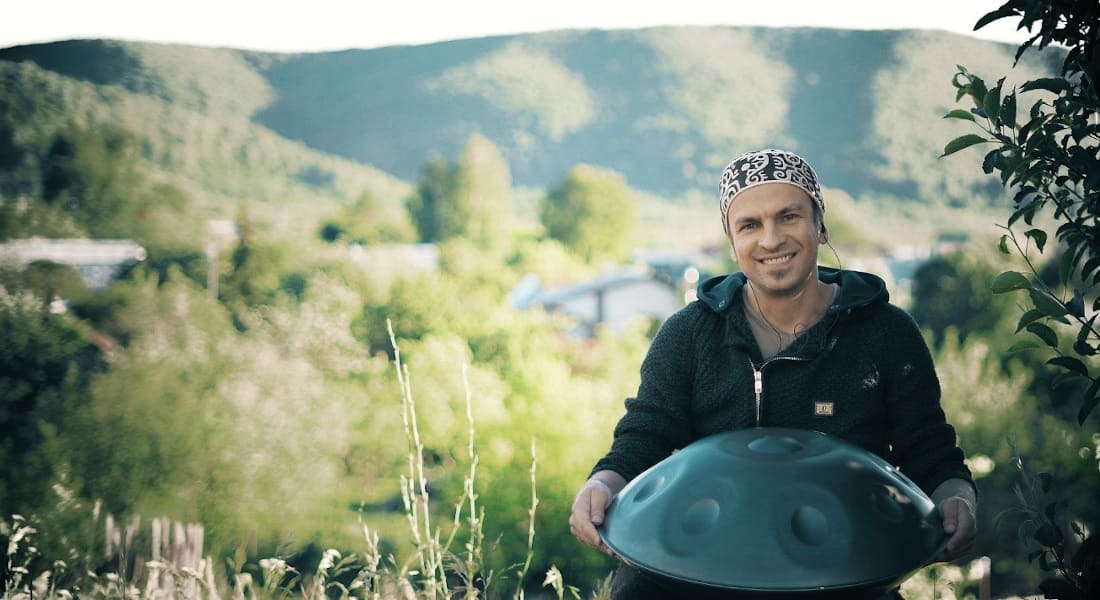
Vladiswar "Nadishana" was born in a small town in southern Siberia, where he spent his childhood before pursuing university studies in St. Petersburg. Coming from a rural environment far from major cultural centers, he explains that, "knowing nothing about music markets, exotic instruments, or the Internet, I had to learn to build and play many instruments on my own."
In the 1990s, while still a student in St. Petersburg, Vladiswar started out as a self-taught guitarist, already inspired by albums from Shakti, Allan Holdsworth, and Gentle Giant—artists he listened to on cassette tapes, the main format of the time. That passion for far-flung instruments quickly led him to study a multitude of ethnic instruments: stringed instruments such as the sitar, oud, mandola, chanzy (three-stringed Mongolian mandolin), and bouzouki; percussion instruments such as the jaw harp (vargan/khomus), morsing, djembe, udu, and darbouka; wind instruments such as the bansuri, quena, kalyuka, zhaleyka, gaida, hulusi, bawu, and tsaaj nplaim (Laotian flute).
Since he couldn’t always find the instruments he wanted in Russia, he began building and prototyping around thirty experimental instruments—dzuddahord, darbudu, pruzhingum, plastrimbaphon, rablorrum, ghostcatcher, pin-sansa, rod-spring gamelan, banbang, and more. This hands-on path led him to develop a very advanced command of acoustics and the design of unconventional instruments.
After graduating in St. Petersburg, Nadishana became interested in the handpan only after discovering a Spacedrum through his friend, the French-American percussionist Steve Shehan, during a stay in Perm, Russia. He explains: "At first, I thought the Hang (invented in 2000 by PANArt) was just a pentatonic steelpan, but while playing the Spacedrum, I realized the unique potential of this instrument." From there, he spent several years developing new handpan techniques, borrowing approaches from the duduk, kalyuka, bansuri, and darbouka to shape his own instrumental language.
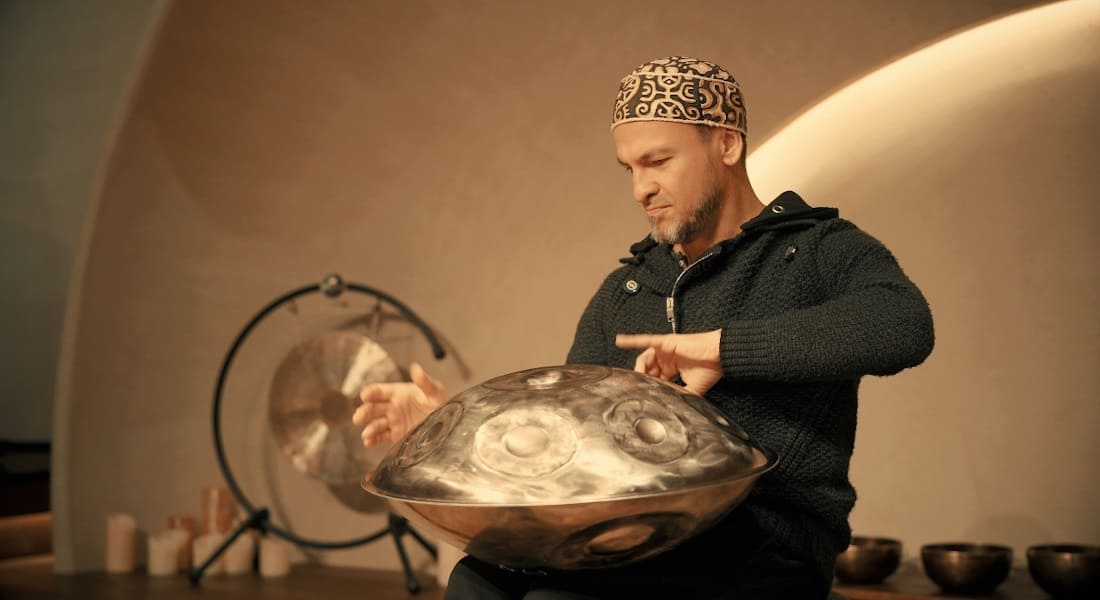
In 2010, Nadishana left Russia to settle in Berlin, drawn by the city’s cosmopolitan music scene and the artistic freedom the German capital offers. He quickly formed his own quartet (Nadishana 4tet), collaborated with artists such as David Kuckhermann, Steve Shehan, and Peter Somos, and performed at major festivals: Ancient Trance (Germany), HUG Festivals (Switzerland), and SunSet (Russia), among others. His Berlin concerts have been praised for the organic blend of handpan, ethnic winds, and original percussion.
Nadishana's style is characterized by:
- The use of odd time signatures, progressive harmonies, and polyphony derived from Balkan, Indian, Caucasian, and Siberian traditions.
- A technique known as "split-hand," in which he divides the hemisphere of the handpan into distinct zones to create an almost orchestral polyphonic effect.
- A process of "sound microsuture," shaped during mixing, which consists of assembling fragments and overdubs to create organic textures while maintaining a very "live" sound.
He describes his approach as follows: "I’m not just a jaw harp or handpan player; I’m a musician who imagines an invisible symphony while playing. I borrow my techniques from tribal percussion and ancient wind instruments to bring out the harmony hidden within these instruments." Eager to share his methods, he teaches on the Master The Handpan platform, where he offers advanced courses in handpan, RAV Vast, djembe, and jaw harp, and develops tutorials on building musical vocabulary for handpan. You can access his highly regarded training by simply clicking on this link.
Notable collaborations and projects
- Duo with David Kuckhermann (Hang & percussion): a project designed to counter the "mystical-meditative" image of the Hang in Russia by showcasing a style more focused on advanced improvisation and polyphonic interaction. You can see this duo in the video below:
- Duo with Steve Shehan (global percussionist): shared touring and exchange of ideas—Steve was one of the first musicians to write and compose for the Hang drum, notably with the Hadouk Trio.
- Duo with Peter Somos (handpan & percussion/bass), recorded live on "Live @ HUG'20 Festival" (album available via Folk.World); this recording highlights artistic resilience during the pandemic, showcases double-sided handpans, and spotlights Somos’ ability to play drums and bass keyboard simultaneously.
For Nadishana, the handpan is not just a trendy instrument; it is a "sound adventure" to be explored in full: "The handpan alone represents a new group of instruments that I call 'melodic finger percussion'. It is a huge creative field: I estimate that barely 3% of its possibilities have been discovered." He also criticizes the "sectarian" dimension that PANArt has established around the Hang: "I don’t want to get involved in the race to buy from PANArt, nor do I want to adhere to their esoteric dogma. It’s better to make the instrument accessible to everyone, as a major brand would do, to allow musicians to develop a true art of playing and not just a status symbol." He therefore prefers to buy from other handpan makers, such as Yishama.
Based in Berlin for over fourteen years, Nadishana continues to seek new sonic horizons, both in the design of innovative instruments and in the creation of new playing methods for handpans, RAV Vast, jaw harps, and ethnic percussion instruments. He also plans to develop a virtual school (Handpanistan), a community space where "handpan musicians from around the world will share and live their passion as if in an imaginary country." Through his multidisciplinary approach, Nadishana embodies a form of avant-garde ethno-fusion: rooted in Siberian traditions, he constantly pushes their boundaries to create a global music rich in textures, progressive harmonies, and innovative techniques.
What are the best songs composed by this musician?
To date, Nadishana has released fourteen albums:
- Move Your Chakra!
- Far & Near (Nadishana Trio)
- Penetration Into Substance
- Asymmetric Beauty
- Tr. Music of Ancient Kuzhebar
- Zero Density (web compilation)
- Live in Izhevsk
- Infinite Approximation
- Kuckhermann × Nadishana (duo)
- Takku Tatei
- Russ-Tuvan KarmaKnot
- Phonic Duet
- Move Your Chakra! (reissue)
- Relict (double handpan album, 2024)
The album Relict, entirely dedicated to the handpan and available for download on Bandcamp, is the result of a crowdfunding campaign launched in March 2023 (€12,000 raised in three months); it consists of a solo handpan CD and a duo/trio CD, exploring new techniques and harmonic textures for this instrument. Tracks like Particles and Shu Khur, as well as his collaborations with Sylvain Barou and Manu Delago, have also been especially popular on YouTube, totaling hundreds of thousands of views. You can enjoy Shu Khur in the video below:
Imitate Nadishana with a handpan with intoxicating sounds
With his unique style, combining percussive virtuosity and melodic sensitivity, Nadishana relentlessly pursues his artistic exploration of the mysterious instrument that is the handpan. Thanks to his exceptionally rich sonic world, this musician weaves together Siberian, Balkan, Indian, and modern influences to create compositions that are both organic and innovative. After reading what you’ve discovered in this article, you now know far more about Nadishana’s career, inspirations, and projects.
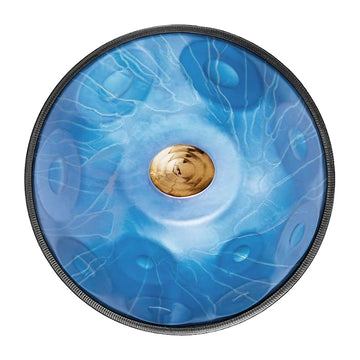
However, to truly immerse yourself in the spirit of his work and reproduce, even partially, the wonderful melodies he develops, it’s essential to choose a handpan of excellent craftsmanship. That’s exactly what the Instruments du Monde store offers, with several models known for their beautiful resonance, such as this excellent 11-note handpan in a bluish finish with iridescent reflections.
Treat yourself to a high-quality handpan and explore this instrument by clicking on the image below:
It turns out that Nadishana is far from the only internationally known figure in the world of this percussion instrument. In fact, there are dozens of other well-known handpan players around the world, including the duo Hang Massive, Malte Marten, and Sam Maher. Learn more about them through all the articles I’ve written about them.


