



Written by Ambre Montespan on Mar 14, 2023 · Updated on Oct 15, 2026

Table of contents:
You’ve seen a unique musical instrument called a kalimba that vaguely resembles a piano, only smaller, and that musicians play with their thumbs to create beautiful sounds. You might be wondering how such a small object can produce tones like that. What mechanical and acoustic principles make it possible? So how does a kalimba work, anyway?
As a kalimba player for over 10 years, I’ve spent plenty of time wondering the same thing. I’ve now explored the topic in depth, and I can clearly explain how this small African instrument, also known as the mbira, sanza, or thumb piano, works.
The kalimba works through the vibrations produced by its steel tines when the player presses them down, bends them slightly, and then releases. Differences in tine length, as well as the presence or absence of a sound box, affect the tone that’s produced.
Once you’ve read this article in its entirety, you’ll easily understand:
- How a kalimba produces sound
- How the presence or absence of a sound box changes the way the thumb piano works
- What any holes on the instrument are for
After that, the way a kalimba works won’t be a mystery anymore. Your curiosity will be satisfied, and you’ll be able to explain it clearly to anyone who asks the same question.
Now let’s take a look at how a kalimba works.

How does a kalimba produce sound?
To fully understand how the kalimba produces sound, you first need to know the parts that make it up, and then learn how this percussion instrument works.
What are the parts of a kalimba?
The kalimba is a simple musical instrument made up of just a few parts. Below is a diagram showing the different parts:
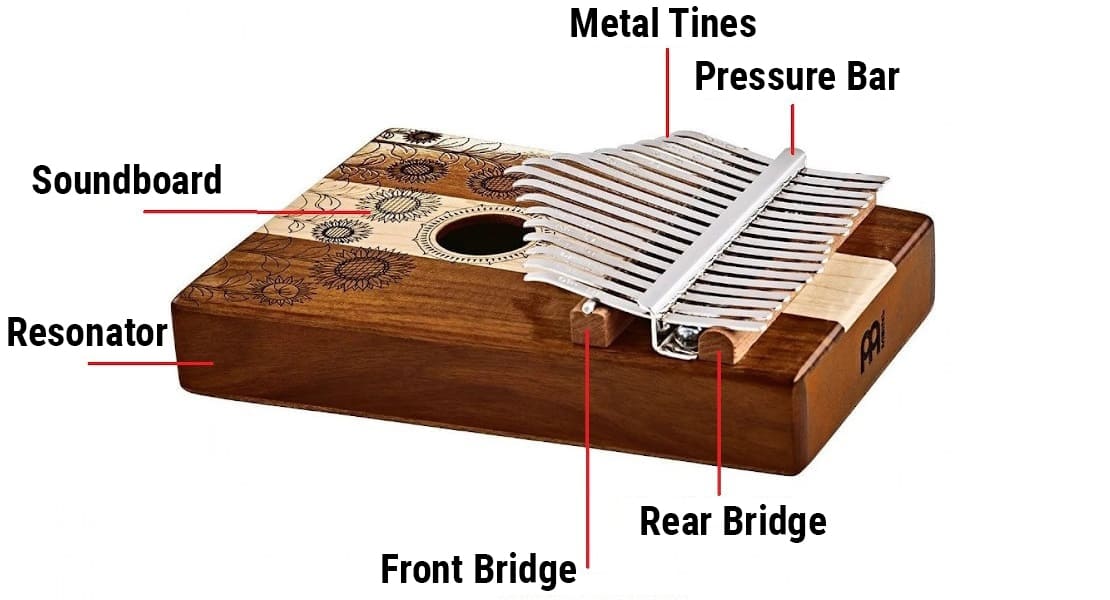
As you can see, a kalimba consists of a soundboard, usually made of wood, on which two bridges are mounted. A cylindrical metal bar is installed on the front bridge to improve vibration transfer. Metal tines of different lengths rest on the bridges, while a pressure bar holds them firmly in place, which is why they look slightly bent in the photograph above. It’s worth noting that around 3,000 years ago, traditional handcrafted kalimbas were made with bamboo tines instead of steel keys.
The number of tines on a thumb piano can vary greatly. Small pentatonic models have 7 or 8. Larger chromatic models often have two rows with several dozen keys fixed to the bridges, while the most classic kalimbas, such as the one shown in the illustration above, are 17-note diatonic models, which are the most interesting for beginners. The number of tines determines how many notes the instrument can play and therefore its range, meaning the span of pitches it can produce.
How does the kalimba work?
The thumb piano, or kalimba, is a percussion instrument belonging to the idiophone family, which means its melodious sounds come directly from the materials it’s made of.
The kalimba works through the vibration of its steel tines. The musician cups the soundboard with both hands, then presses down on a metal tine with their thumbs. It bends slightly under pressure because it’s held in place by the two bridges and the horizontal bar. When the tine is released, it snaps back up and oscillates rapidly up and down. These oscillations create vibrations in the surrounding air, producing sound. Watch the video below for a good overview of this mechanical and acoustic phenomenon:
It’s important to understand that each metal tine produces only one pitch. That pitch is directly related to the tine’s length: the shorter the tine, the higher the note, and the longer the tine, the lower the note. That’s why all the tines are different lengths. In that sense, the kalimba’s tines work much like the keys on a piano.
You can fine-tune the length of each tine by sliding it about an inch or two (a few centimeters) between the two bridges to assign a specific musical note, such as C or D. To do this, the musician uses a small tool called a tuning hammer and taps the end of the tines to shorten or lengthen them relative to the front bridge. Once all the tines are properly positioned, the kalimba is said to be tuned. Check out this guide to learn more about tuning thumb pianos. You can then be sure that your iconic African instrument will always play in tune for beautiful songs and compositions.
As you can see, the kalimba is a very simple, easy-to-play instrument, which is why it’s especially well suited for beginners and children as an introduction to music. That’s very different from certain wind instruments or bowed and plucked string instruments like the violin, harp, or double bass, which can be extremely difficult to master.

How do microphones work with kalimbas?
Some kalimbas are equipped with microphones that sit on the soundboard or are built directly into it. In most cases, they’re actually piezoelectric microphones (often called piezo pickups). Without getting too technical, they create an electrical charge in response to mechanical stress, such as sound vibrations.
They convert those vibrations into electrical signals and send them to an amplifier, speaker, or audio recorder. In most cases, the kalimba’s microphone connects via a 1/4 in (6.35 mm) jack. To help you choose the right one, I compare kalimba microphones in another article.
Does the thumb piano behave differently depending on whether or not it has a sound box?
While the basic playing feel of the thumb piano remains largely the same, there are several differences depending on whether the instrument has a resonator, also known as a sound box.
Kalimbas without a sound box
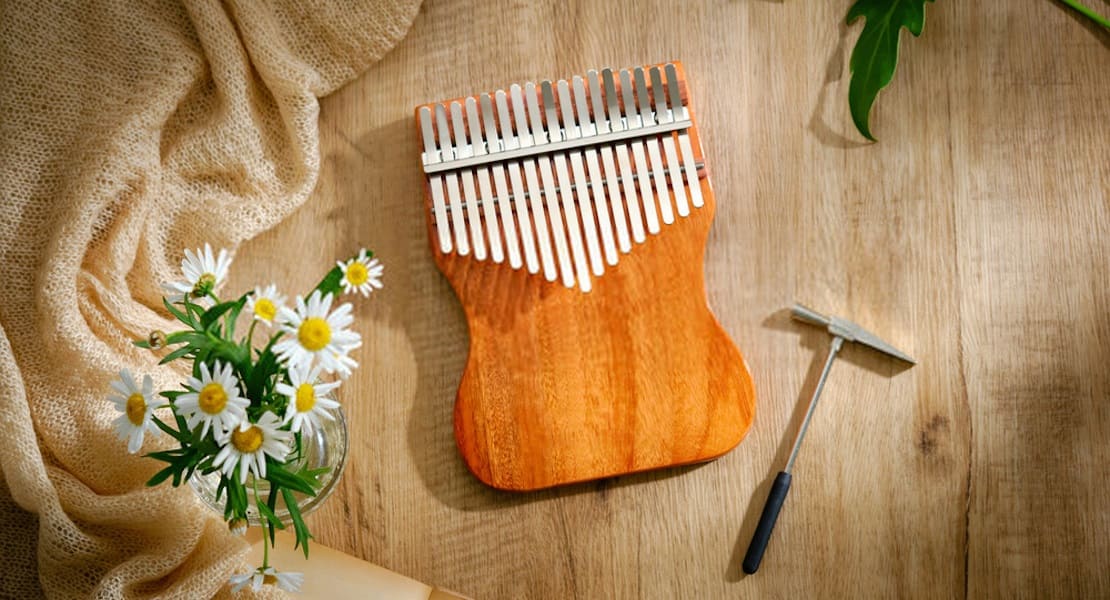
Kalimbas without a sound box are the simplest. The body is a solid piece of wood, with no hollow cavity inside. When the musician makes the tines vibrate, the musical sound waves propagate and bounce off the soundboard as usual. There’s no special resonance effect.
Sanzas with a sound box
Recognizable because they have at least one hole in the soundboard, sanzas, or kalimbas with a sound box, are hollow inside. This time, when the player makes the tines vibrate, the sound waves propagate, but some remain trapped in the instrument’s cavity. Those waves then bounce off the inner walls and end up amplifying the original vibrations. That’s why kalimba models with a sound box, or more simply, with a hole, tend to be louder than those without.

If you’re unsure whether to buy a kalimba with or without a resonator, take a look at our comparison of thumb pianos with and without holes. It’ll help you understand whether you’ll benefit from a sound box, especially if you’re a beginner.
What are the holes in this African musical instrument for?
Specific to kalimbas with a sound box, the holes are usually located either on the front or back of this percussion instrument. However, they can also be located on the underside of the thumb piano. Let’s take a look at what they’re used for.
What is the purpose of the hole on the front of the thumb piano?
The front hole is the main opening of the sound box, so its primary job is to boost the instrument’s volume. However, by partially covering this hole with one of your thumbs right after playing one or more notes, you can create a distinctive wah-wah effect. This lets you add rhythmic movement and expressive phrasing to your playing. In fact, ancient mbiras were sometimes placed in a calabash to expand what traditional percussionists could do. Watch the video below to understand how this works:
What are the two holes on the back of the mbira for?
Some kalimbas also have two holes on the back of the instrument. Similar to the front hole, covering these openings with your fingers while you play creates another sound-modulation effect called vibrato. You can produce this effect with either hand. Listen to what it sounds like by watching the video below:
Treat yourself to a high-quality kalimba.
It’s true that your first encounter with a kalimba can be a little surprising. How can such a small instrument produce such a distinctive sound? When you get interested in the topic, it’s only natural to want to understand how thumb pianos work. At this point, you’re able to describe the full mechanics behind this African instrument, from its parts to the physical principles that create those soft, soothing tones.
That said, what you’ve read here describes how a well-made kalimba works. Some low-quality instruments use wood that doesn’t resonate well, or they have tines that aren’t properly aligned. To help you avoid an instrument that will inevitably disappoint you, Instruments du Monde has selected the best kalimbas to offer for sale. By choosing one of these thumb pianos, you’re getting an instrument with excellent acoustic performance and quality steel tines that deliver a truly beautiful tone.
Buy a kalimba that will work perfectly by clicking on the image below:

Now that you know exactly how a kalimba works, did you know it’s also one of the easiest instruments to learn? There are many reasons for that. Check them out in our article: Is playing the kalimba easy or not? You’ll quickly see that this small African instrument is within everyone’s reach, even for the youngest players. And to wrap things up, read this complete guide to the kalimba.


