



Written by Ambre Montespan on Mar 14, 2023 · Updated on Oct 15, 2026

Table of contents:
Do you own a kalimba and want to record the songs or compositions you play on this instrument with a microphone? Don’t have a thumb piano yet and you’re considering a model with a built-in mic? What kind of microphone will work best?
Since I regularly share some of the melodies I play on my kalimba online, I’ve had the chance to test several microphones and compare their performance. So I can give you clear guidance to help you make the right choice.
There are two main types of microphones for the kalimba: traditional mics that capture sound vibrations and pickups that record mechanical vibrations. Each has its advantages and disadvantages.
Once you’ve read this short article, you’ll know everything there is to know about:
- Microphones added to the instrument
- Kalimbas with built-in microphones
As a result, you’ll be able to choose the right accessory and let your listeners enjoy your playing at its best.
Now let’s dive into this interesting topic.
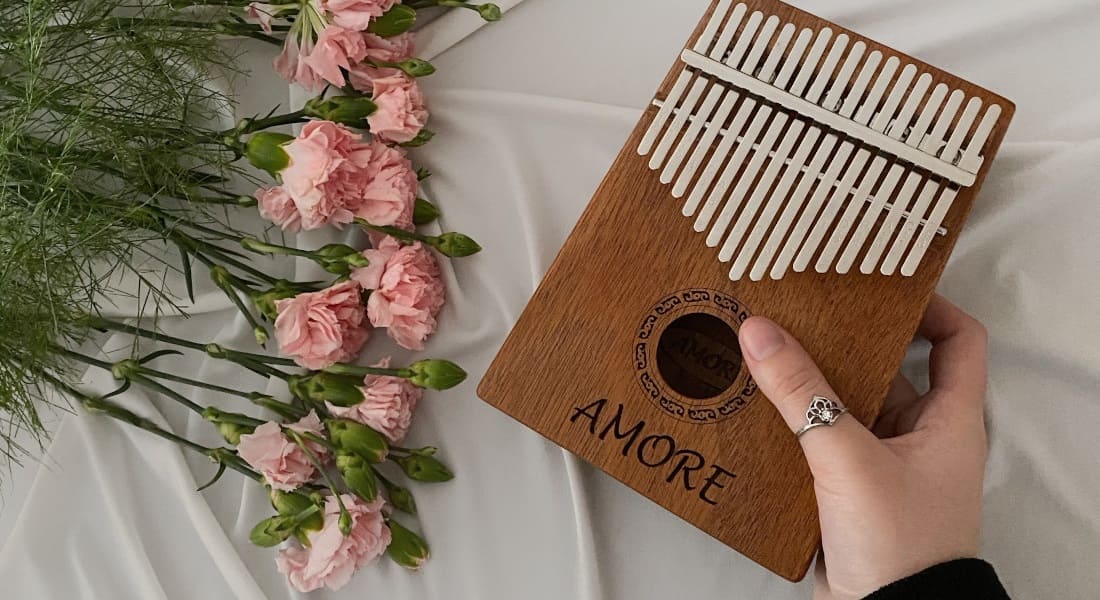
Microphones that can be added to the kalimba
If you already own a kalimba, it probably didn’t come with a built-in way to capture its sound. That means you’ll need to add an external mic to your instrument. This microphone can be one of two types: a pickup or a traditional mic.
Pickup microphones attach directly to the instrument
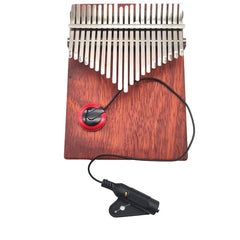
Pickup mics attach directly to the soundboard of the kalimba because they capture mechanical vibrations from the instrument’s body rather than airborne sound waves. They’re usually round and can be attached almost anywhere with double-sided tape—no stand or other support needed.
From an acoustic point of view, the pickup microphone produces a rather dry and muffled sound. Some musicians choose to shape the signal (for example, with EQ) to make it more pleasant. Pickups are also generally very affordable.
Classic stand microphones
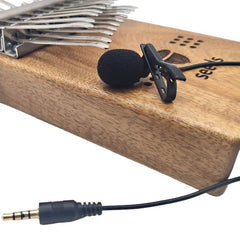
Classic microphones are the familiar workhorses you see on stage, capturing sound waves and converting them into an electrical signal that can be recorded or amplified as needed. You’ll need a stand to position the mic properly, though some models include a clip that lets you attach them to nearby objects—these are often called lavalier (lapel) microphones because they can clip right to your clothing.
Sonically, the recorded sounds come through much more natural and pure. That’s because our ears naturally convert sound waves into signals that the brain decodes—exactly how this type of mic works. As a result, the sounds it captures feel more natural and pleasant than those from a pickup mic.
However, traditional mics do have one major drawback: feedback. You’ve probably heard this unpleasant squeal before—when a mic picks up sound, sends it to a speaker, and then the speaker’s amplified signal is picked up again by the mic, creating an endless loop of shrill noise. Since pickup microphones only record mechanical vibrations, they are never subject to the Larsen effect (feedback).
You’ll find conventional mics at almost any price point, from a few dozen dollars to several thousand for professional models. If you’re playing just for fun, a small, budget lavalier mic will capture your kalimba’s sound beautifully—especially if you’re not ready to invest at least $170 in a higher-end microphone.

Thumb pianos with built-in microphones
Some kalimba models come with a built-in microphone. In these cases, the internal mic has to be a pickup, since it needs to sense vibrations directly from the instrument rather than ambient air movement. In a kalimba with a resonator, the sensor sits inside the resonator box; otherwise, a small hole is drilled directly into the wood to install the device. Some models even include a battery-powered system, so you can plug the instrument into a speaker—always a nice bonus.
The main advantage of kalimbas with built-in microphones is their aesthetic appeal. Visually, a round sensor stuck on an instrument isn’t very attractive. In addition, there’s less risk of damaging the microphone since it’s protected by the kalimba’s wood.
Capture every nuanced sound your instrument produces
The microphone you choose will affect the sounds it captures, so decide between a traditional mic and a pickup based on your needs, as well as each option’s pros and cons. Now that you’ve read this guide, you’re ready to make the right choice.
However, it’s not easy to find a store specializing in kalimbas that offers all types of microphones to satisfy most musicians. That’s why we recommend checking out Instruments du Monde, which sells both types of microphones so you can choose the one you want.
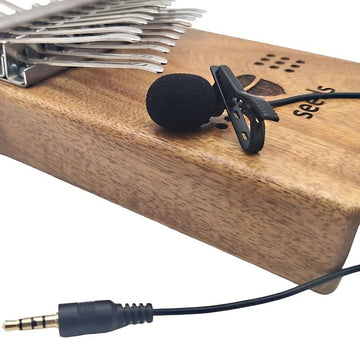
Treat yourself to a microphone for your kalimba now by clicking on the image below:
When it’s time to clean your African instrument, you may need to remove the steel tines so every bit of dust and dirt comes off. Taking the keys out is easy enough, but putting them back in can be trickier. Learn how with our article on installing tines on a kalimba. You can also find all our tutorials in our comprehensive guide to the thumb piano.


