



Written by Ambre Montespan on May 15, 2023 · Updated on Oct 15, 2026

Table of contents:
Have you recently become interested in the ocarina? Are you wondering how such a small instrument can produce that beautiful, unmistakable tone? How does an ocarina really work?
As an ocarina enthusiast for over 10 years, I’ve always been captivated by what’s happening inside it, so I decided to dig deeper. Here’s everything I’ve learned about how this wind instrument actually works.
The ocarina works on the principle of a Helmholtz resonator. When the player blows into the instrument, the airstream hits a beveled edge, creating vibration and sound. By covering or uncovering the holes on the ocarina, you change the pitch.
By the end of this article, you’ll know:
- How the ocarina creates sound
- The function of the holes on this musical instrument
As a result, the way the ocarina works will no longer be a mystery to you, and you’ll be able to explain it to friends and family with confidence.
Now, let's take a look at the acoustic behavior of an ocarina.
How does an ocarina produce sound?
To create sound, the ocarina relies on Helmholtz resonance—a principle first described by Prussian scientist Hermann von Helmholtz around 1850—which determines the pitch created when air is blown into a cavity. A very simple example of this is the sound you get when you blow across the neck of a bottle (or into your cupped hands). In that case, the musical note played depends on the size of the cavity, in other words, the bottle’s internal volume. Using identical bottles and filling them to different levels lets you produce a wide range of notes, as shown by a group playing Luis Fonsi's hit Despacito using only glass bottles.
As you can see in the video above, to get a better sound, you need to blow across the bottle’s opening at a very specific angle. The ocarina isn’t played quite the same way, because the musician blows directly into the mouthpiece, which rests against their lips. To really understand how an ocarina works, you need to look at what happens inside the instrument itself, as shown in the illustration below.
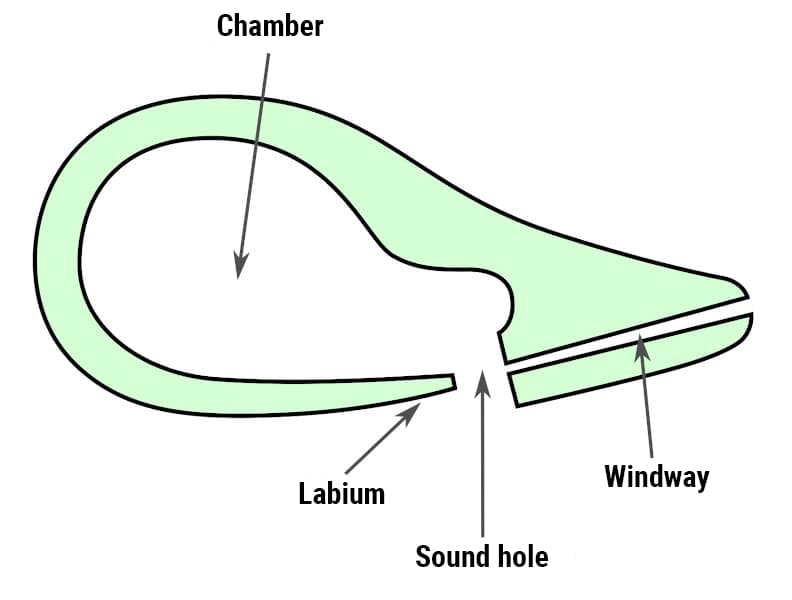
When the musician blows into the mouthpiece of the ocarina, the airflow travels through an internal windway and reaches a sharp, beveled edge. This causes the airstream to split, creating areas of high and low pressure that make it vibrate and produce sound. The system works exactly the same as a recorder, except that on a recorder the edge is clearly visible, while on an ocarina it’s tucked inside the body. In fact, if the ocarina didn’t have holes to play multiple notes, it would essentially be a whistle. You can see the path of the air in the image below.
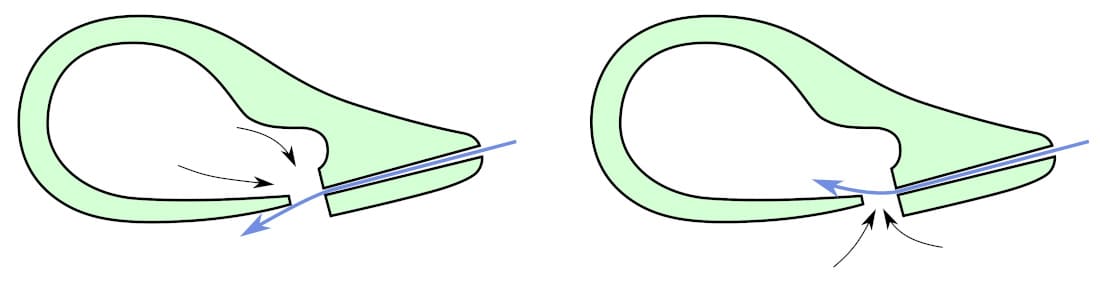
It’s worth noting that the final sounds the ocarina produces depend on several factors, such as the overall volume of the chamber, the angle at which the bevel is cut, the force with which the musician blows into the mouthpiece, and, to a lesser extent, the ambient temperature. Remember: a larger chamber yields lower notes, while blowing harder produces higher ones.
What are the different holes on this musical instrument for?
For an ocarina to be a true musical instrument, it needs to play more than one note—and that’s made possible by the holes placed around the body. Each hole adds another note. The pitch rises as the musician leaves more holes open. With every hole covered (except, of course, the air outlet, sometimes called the bell), the note will be the lowest the ocarina can produce. Conversely, if none of the holes are covered, air escapes the chamber more easily, and the note played will be the highest this wind instrument can produce. Tuning an ocarina is therefore a delicate process, because the holes must be made at the correct diameters to produce accurate notes.
Musicians know that by gradually covering the holes with their fingers, they will obtain increasingly lower notes, as in the example below, which details the finger placement for a 12-hole ocarina in C major.
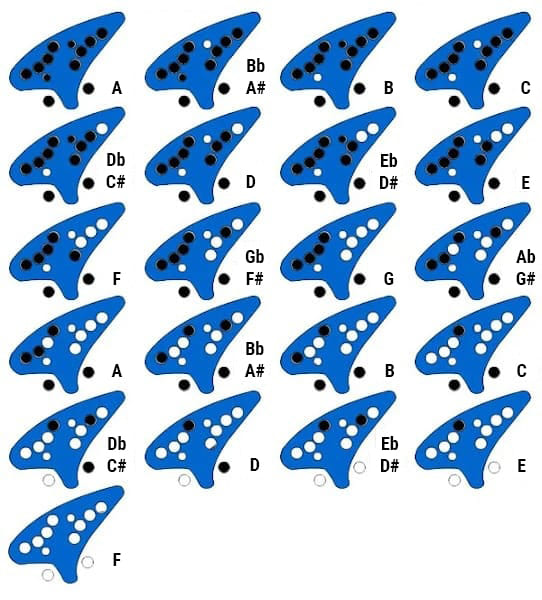
This means the ocarina has a limited range of sounds, also known as its tessitura. To work around this limitation, ocarinas are crafted with chambers of different sizes. For higher notes, choose a soprano or alto ocarina, while a tenor or bass model will deliver deeper, lower tones.
Compared to a concert flute, the exact placement of the holes matters less. They are therefore positioned to be as comfortable and ergonomic as possible when the musician holds the ocarina, as shown in the following diagram:
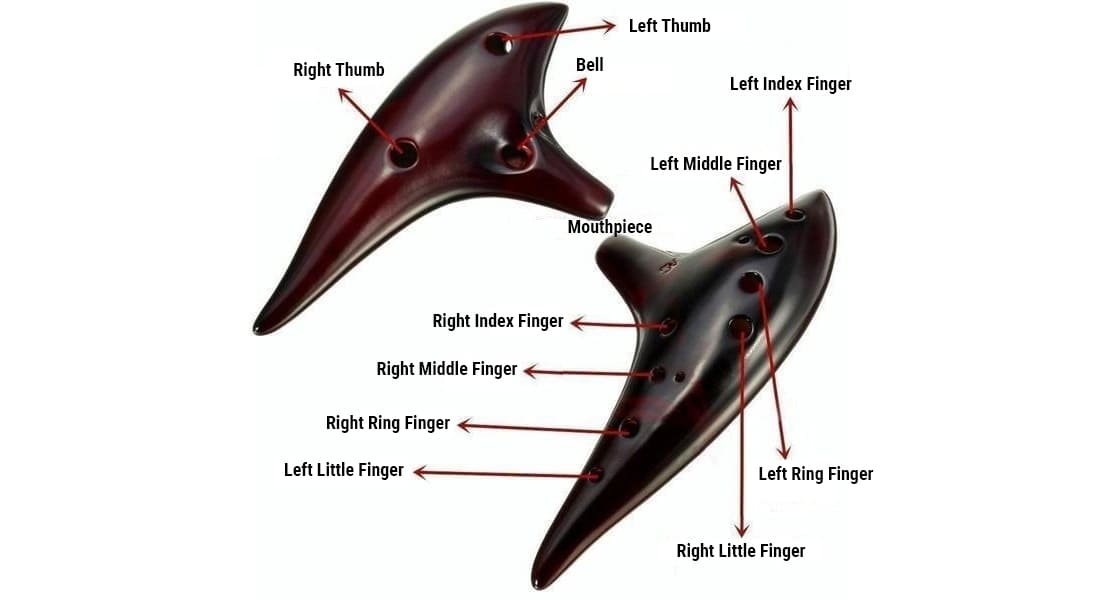
Finally, to be completely thorough, it should be noted that other factors have a very slight influence on the sounds produced by an ocarina. The shape of the chamber, and therefore of the ocarina, will have a small impact, as will the shape of the bevel, the mouthpiece channel, and the air outlet, which can be round, square, or oval. However, these elements have such a minor effect that it’s not really worth focusing on them.
Treat yourself to an ocarina that works perfectly
While an ocarina’s mechanics are fairly straightforward, they’re not always obvious at first because the key technical parts are hidden inside the instrument. But thanks to the information you have just discovered, you now know exactly how any ocarina works.
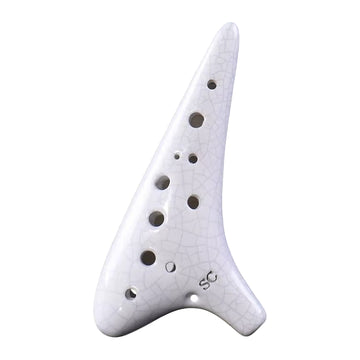
And once you understand how this wind instrument works, it’s clear why the build must be precise and meticulous for the notes to play perfectly in tune. Poor-quality ocarinas, or those made by people who don’t truly master the craft, rarely produce harmonious sound. That’s why Instruments du Monde only works with skilled artisans who create ocarinas with exceptional craftsmanship, such as this 12-hole model with its wonderfully pure tone.
Treat yourself and get this ocarina now by clicking on the image below:
Did you know that some of the best ocarinas are actually made from plastic? Ocarinas made from this material can be surprisingly effective acoustically.


