



Written by Ambre Montespan on Jul 17, 2023 · Updated on Oct 15, 2026

Table of contents:
Have you noticed that you can produce a kind of whistling sound by cupping your hands, as if they were an ocarina? Would you like to learn how to play music using your hands and fingers? Are you looking for a quick, simple tutorial that helps you make sound in just a few minutes?
Having played the ocarina for over 10 years, I was quickly drawn to this hand-whistling technique, which sounds a lot like an ocarina. Every now and then, I’ll play a few melodies using just my palms, and I can teach you my method so you can do the exact same thing.
To play an “ocarina” with your hands, shape them into an airtight cone while leaving a small gap between your thumbs. Then blow across your thumb knuckles to produce sound.
After reading this short tutorial, you will know:
- That playing music with your hands is entirely possible
- The method for turning your hands into an ocarina
- How to play several notes this way
Soon you’ll be able to play a few tunes using just your hands—for your own enjoyment and to impress your audience.
Let’s take a closer look at this hand-whistling technique.
Is it possible to turn your hands into a kind of flute?
It’s absolutely possible to position your hands in a way that creates a real musical instrument. This technique is called hand ocarina, hand flute, or hand whistle because the sound is very close to those three instruments. To produce a note, the player forms a chamber with their hands and blows air through an opening near the thumbs. There are two main approaches to hand placement: the “cupped-hand” technique and the “interlocking” technique.
The pitch of the sound depends on how the hands are held. If the space between your hands is smaller, or if the opening is wider, the pitch goes higher. The acoustic principles are the same as with an ocarina or a Helmholtz resonator. The world’s best hand flute players have a range of up to 2.5 octaves, which allows them to perform in concerts. Watch below for an example of what an amateur can play as a tune using only their hands:
How can you whistle with your hands?
As mentioned above, there are two techniques for whistling with your hands. Here, we’ll focus on the cupped-hand technique, which is the easiest to learn. First, choose one of your hands and place it flat, with your fingers spread wide. You can choose whichever hand you want, but you may naturally prefer one over the other (even if it isn’t your dominant hand). So it’s worth trying the same technique with both hand positions to see which feels best.
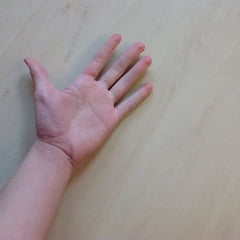
Next, with your other hand, place the edge of your hand at the level of the first knuckles of your flat hand, as shown in the photo below. That’s why this technique is called “cupped hand.”
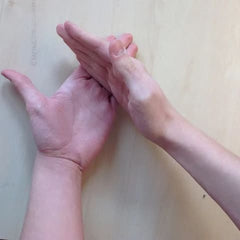
Then slide your top hand so that the tip of your pinky (little finger) is right where the index finger meets the palm of your flat hand. Next, form a cone with both hands by folding your fingers as shown in the illustration below.
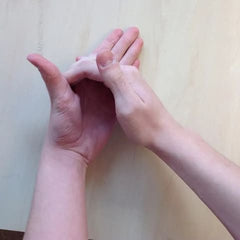
Once you’ve folded all your fingers, you’ve created the chamber where the sound will resonate. For now, it’s important that this chamber stays as airtight as possible. The idea is to create a “container” you’ll blow into, just like when you blow across the top of a glass bottle at a certain angle to make a sound. There’s no need to squeeze your hands too tightly—you’ll need to hold this position for a while, so it should stay comfortable. Next, bring your two thumbs side by side. You’ll notice a small gap between them.

Your ocarina is almost finished. Now lift your thumbs as high as possible without moving your other fingers or deforming the chamber. Your thumbs will rest on one of your index fingers and form an angle close to 90°, depending on your anatomy. It’s important not to keep your thumbs straight. Instead, let them follow the slight curve of the index finger they’re resting on.
Finally, form a small “o” with your lips and place them at the junction of the two thumb joints—right where the red oval appears in the image below:
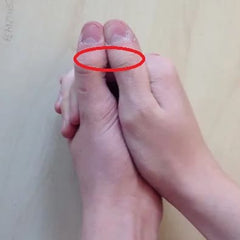
All you have to do is blow at that spot. Make sure the lower part of the opening created by your thumbs stays completely free. Air needs to escape—just like in the mouthpiece of an ocarina or flute—and you should even feel it on your chin when you blow a bit harder.
If no sound comes out when you blow, there may be several reasons:
- The gap between your thumbs isn’t right. Keep blowing steadily and, at the same time, move your thumbs very slightly closer together or farther apart until you find the sweet spot that produces a whistle.
- You’re not blowing hard enough. Try exhaling more air into your hands.
- Your lips aren’t placed correctly. Move them slightly, staying around the thumb joint area, to find the right spot.
- Your hands aren’t forming the right chamber. Make sure you follow the instructions at the beginning of this tutorial so you create a truly airtight chamber.
If you apply these points, you’ll be sure to produce sound.
Note that you can also try the interlocking technique, which involves hooking your fingers together to create the chamber. The rest of the technique stays the same.
How can you produce multiple notes like a musical instrument?
Once you’ve managed to get a sound from your hands, it helps to know how to change the pitch. Otherwise, your hands are just a simple whistle rather than a real musical instrument like a flute or an ocarina.

There are several ways to do it. The first is to lift one or more fingers to change the volume of the chamber or make it less airtight. That will change the tone you produce. You can also move your lips or thumbs slightly, changing the angle of your breath. Finally, you can shift your palms to change the chamber’s shape, making it more or less round. There’s no universal “recipe” for playing a C, D, or E because the notes will depend on the shape of the player’s hands. So it’s up to you to experiment and find what you need to do to reach the note you want.
To make this easier, I recommend using an electronic tuner, a small device that listens and displays the note you’re playing. Leave it in listening mode while you play with your hands, and you’ll be able to hit specific notes just like on a real instrument. Then, memorize the positions of your hands, fingers, and mouth for each note you can play so you can eventually perform songs.
Pick up a real ocarina for an incredible sound experience
At first, it may seem surprising that our own hands can make music like an ocarina or a flute. But with a bit of practice, anyone can play simple songs. With the help of this tutorial, you now know the technique that turns your hands into an instrument, so you can create melodies just about anywhere.
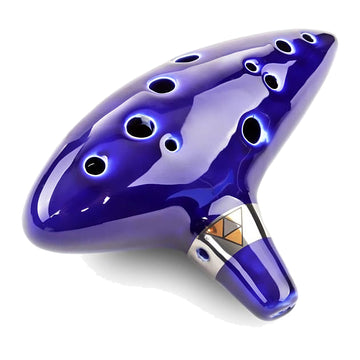
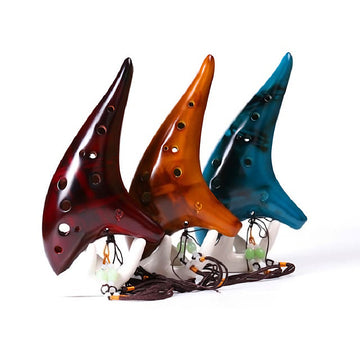
That said, playing with your hands is much harder than playing a real ocarina. Plus, some notes that are too low or too high are simply impossible to reach with your hands alone. The ocarina is also a very small instrument, so it’s easy to carry with you wherever you go. Keep exploring new sounds by treating yourself to a quality ocarina from the Instruments du Monde online store. There are very affordable options, such as this excellent-sounding 12-hole ceramic ocarina.
Discover this ocarina now by clicking on the image below:
Want to take it to the next level with a real musical instrument? Then read our guide to finding the best places to buy an ocarina. You’ll be sure to discover where the highest-quality instruments are hiding.


