



Written by Ambre Montespan - Updated on Aug 11, 2026
Table of contents:
Are you thinking of buying a handpan in the near future? Have you noticed that this percussion instrument has a scale? What is a scale? What is it actually used for? Is it an important factor when buying a hang drum? Which scale should you choose for your future handpan?
I’ve been playing handpan myself for over 10 years, and I currently own several models with very different scales. After testing quite a few, I can help point you in the right direction and explain why it’s so important to pay attention to your choice of scale.
A handpan’s scale is essential because it determines which notes the instrument can play. Choosing one is completely personal and comes down to your preferences, although the D Kurd scale is especially recommended for beginners.
Once you’ve read this article in its entirety, you’ll know everything you need to know about:
- The scale of a musical instrument
- The importance of this choice for the handpan
- The best scale or key to choose for your Hang
After that, you’ll have all the key information you need to choose your handpan. And since this decision can’t be reversed, it’s the best way to make sure you end up with an instrument you truly love, for hours of enjoyment.
Now, let’s take a closer look at what a scale means for a musical instrument.

What is a scale for a musical instrument?
In music, the scale of an instrument, whatever it may be, is an ordered sequence of notes arranged according to a specific pattern of intervals—whole steps and half steps. Put simply, a scale is the set of notes the instrument will have. With a handpan, it’s important to understand that shaping notes into the metal shell takes up a lot of space—so you can’t make a handpan with 88 notes like a standard piano. Most handpans have around ten notes. That means you have to choose which notes will be on the instrument, and that’s exactly what the scale defines.
A scale is the foundation for composition, improvisation, and learning the instrument technically. Scales establish the key of a piece of music and define which notes naturally sound good together. That’s why the notes on a handpan aren’t chosen at random by makers—they’re selected to give the percussionist the best possible acoustic experience.
Why is it important to choose the right scale for your handpan?
A handpan’s scale is an important criterion you shouldn’t overlook for several reasons. The first is that, unlike some instruments like guitar, you can’t change the scale of your Hang once you’ve bought it. Doing so would mean retuning it by altering which notes it has, which simply isn’t realistic. When a musician wants a different scale on handpan, they have to get another instrument tuned to the desired key. In other words, your choice is final—making it a crucial part of choosing your handpan.

The second reason is that a handpan’s scale largely determines the instrument’s overall vibe. There are several broad families of scales, with the most common being major, minor, Eastern, pentatonic, and chromatic. Major scales have seven distinct notes and are known for a bright, uplifting character. Minor scales also have seven notes, but tend to sound more melancholic, mysterious, and introspective. Eastern scales step outside typical Western harmony to explore sound worlds inspired by regions such as Asia and the Middle East. Pentatonic scales use only five notes spread across multiple octaves, while chromatic scales include every half step within an octave—12 notes total.
When it comes to handpans, most models are tuned to a minor scale. But if you’re looking for warmer, more cheerful sounds, you’ll want to choose a handpan in a major scale. The emotions you feel when playing melodies are directly tied to the scale. What’s more, some scales are simply harder to grasp and play than others. A scale that’s too difficult—or not a good fit for your style—can hold back your creativity, while the right one will help you get the most out of your handpan. That’s why it’s worth being careful when choosing the scale for your future instrument.
How many keys are there for the Hang drum?
Handpan makers choose scales based on the notes they build into the instrument. That means there’s virtually an endless number of possible scales and keys, even though, in practice, around ten scales are especially popular among handpan lovers. They sometimes go by names coined by makers themselves, such as Kurd, Hijaz, Akebono, and Amara. These labels are mostly commercial rather than traditional music-theory names. Still, they’ve become widely understood among players—so much so that an experienced handpan player will immediately know what you mean if you say your handpan is a Hijaz.

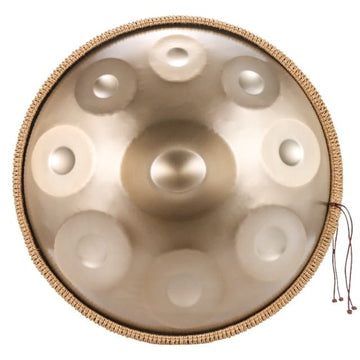
What is the best scale for the handpan?
You’ll often hear that no handpan scale is truly better than another. I don’t completely agree, because some are definitely harder to get comfortable with than others. So if you already have a solid level on the instrument, you can absolutely go with any scale you like. However, if this is your first experience with the handpan, I always recommend that beginners choose a handpan in D Kurd. In my experience, that’s the scale where I’ve seen the fastest progress—and the one new players seem to enjoy the most.
Let’s take a look at the most popular scales you’ll commonly come across when buying a handpan.
D Kurd handpan
Handpans in D Kurd, also known as Annaziska, are the most common. This minor scale is perfectly suited to beginners in terms of difficulty. It’s also one of the most “neutral” minor scales, in the sense that it doesn’t lean too heavily into melancholy compared to other minor tunings. It also offers very smooth transitions between notes, making it easy to create captivating pieces surprisingly quickly. That’s why the D Kurd scale is great for meditation sessions, musical performances, or simply relaxing. A 9-note instrument will generally have the notes D3, A3, Bb3, C4, D4, E4, F4, G4, A4.
Handpan Amara or Celtic minor
The Amara scale is also known as Celtic minor. As its name suggests, it’s a minor scale, and overall it’s quite close to D Kurd. The main difference is that while D Kurd follows a standard minor layout, Amara skips Bb3 and replaces it with a higher note: C5. So the notes you’ll typically find on a 9-note Amara handpan in D are: D3, A3, C4, D4, E4, F4, G4, A4, C5. Most Amara handpans are tuned to D, but you can also (more rarely) find them in C or C#. In those cases, the note layout will be different. This is an easy scale to get into, and the notes connect smoothly from one to the next. Emotionally, Amara can work for introspective pieces as well as lighter compositions, depending on how you play it, which makes it a versatile choice for styles ranging from folk to jazz.
Hijaz handpan
The Hijaz scale is an Eastern scale with a strong Middle Eastern flavor. The sound is often described as deep, mysterious, and adventurous. There are many variations of Hijaz, but it remains a fairly challenging scale to master. For a handpan tuned to D Hijaz, the notes are typically: D3, C4, D4, Eb4, F4, Gb4, A4, Bb4, C5. Whether you’re improvising or writing more structured pieces, Hijaz is a great option for experienced players looking for an exotic soundscape and lots of creative possibilities.
Akebono handpan
Like Hijaz, the Akebono scale is an Eastern scale. This time, the sound suggests Asian rhythms—especially traditional Japanese music. Most Akebono handpans are tuned to F or C minor, although several variations exist. Overall, it’s a scale that feels fairly easy to approach, with a gentle, relaxing atmosphere. However, this tuning is rarer among makers, and prices are often higher than for other keys.
Pygmy handpan
Like the Amara scale, Pygmy is based on a minor scale, omitting certain notes to achieve a wider range. This gives the instrument a distinctive character inspired by African sounds. Pygmy feels more adventurous—and less “standard”—than many other minor scales, which is what sets it apart. Many players describe it as having a tribal, earthy vibe. Several variations exist, but two stand out in the handpan world: classic Pygmy and Low Pygmy. Low Pygmy simply starts on lower, deeper notes than classic Pygmy.
Choose the handpan scale that suits you
If you don’t have a strong foundation in music theory, choosing a handpan based on its scale can feel complicated. It’s a bit ironic, because one of the biggest appeals of the handpan is that you can enjoy playing without knowing how to read music. Still, with what you’ve learned in this article, you’ll be able to choose your future hang drum with confidence.
That said, with so many scales out there, it’s easy to feel overwhelmed. If you don’t have a clear preference, or if all of this feels too complex, the classic “can’t go wrong” choice is a D Kurd handpan. You’ll get a handpan with beautiful, gentle tones that’s easy to learn, so you can really enjoy your playing sessions. Personally, I recommend this model from Instruments du Monde, which offers excellent acoustics.
Start your journey with this handpan by clicking on the image below:

One of the biggest factors with handpans is still the price. It’s a major purchase that can easily reach several thousand dollars. Read my article about the price of handpans to get a clear idea of what you should expect to spend for a quality instrument.


