



Written by Ambre Montespan - Updated on Jan 27, 2026
Table of contents:
You know it’s essential to tune your thumb piano regularly, but you’re wondering which tuner to use for your kalimba? What are all the ways you can tune it accurately? Are free smartphone apps reliable, and can they replace a real electronic device designed for this purpose?
Having been part of the thumb piano world for over 10 years, I’ve had plenty of opportunities to tune multiple kalimbas and test every method out there. I’ve also watched the rise of smartphone apps that offer an alternative to the classic tuner. So yes, I can absolutely help you choose the best tuner for your kalimba.
There are three ways to tune your kalimba: using a small electronic device called a tuner, a tuning fork, or a smartphone app. Depending on your needs, any of these options may be the best fit for you.
Once you’ve read through these few lines, you’ll finally know:
- What a tuner is for
- The different ways to tune your kalimba, with their advantages and disadvantages
You’ll then have all the information you need to decide what makes the most sense for you, depending on your situation, for tuning your thumb piano. This way, your African instrument will always play in tune!
Now, let’s dive into this fascinating topic together.

What is a kalimba tuner used for?
Tuning is an essential step for all kalimba owners. Most of the time, when a beginner buys a thumb piano, it arrives already tuned. In other words, each tine is set so it produces the intended note when you pluck it and it vibrates over the bridge.
However, it’s not uncommon to receive a brand-new kalimba that’s completely out of tune. This can happen because the manufacturer didn’t take the time to tune it, or because the steel tines shifted during shipping. And over time, with regular playing and handling, a thumb piano will inevitably drift out of tune.
So what actually happens? Let’s take the example of a standard 17-tine kalimba that should be tuned to C major. The center tine, which is the longest, normally corresponds to middle C (C4), with a frequency of 261.626 Hz. But if that tine shifts, it might produce a frequency of 270 or 250 Hz. In practice, that doesn’t match any note: the next semitone up, C♯, is 277.183 Hz, and the semitone below, B, is 246.942 Hz. So if your center tine produces 270 Hz, it’s simply out of tune.

Without getting too technical, out-of-tune notes should be avoided, because they sound unpleasant and unharmonious. A tuner is therefore essential for checking pitch accuracy across several octaves on every tine of your kalimba. Also, some pieces of sheet music ask you to retune a few tines or use a different key/scale to play them—for example, turning an F into an F♯ or a B into a B♭. In that case, you’ll also want a tuner that supports the chromatic scale.
Now you understand why a tuner is essential for any kalimba player. Once you’ve chosen your tuner, we invite you to read our other article: how to best tune a kalimba. You’ll then see, step by step, the method to ensure you achieve excellent results.
Tuning your thumb piano with a dedicated tool
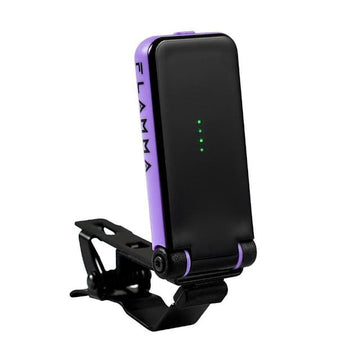
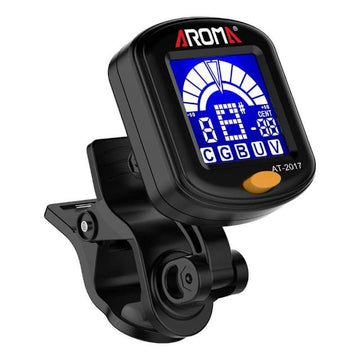
The most reliable way to tune your kalimba is still to use a dedicated tool called a tuner. This small device, usually just a few inches wide (a few centimeters), runs on batteries and analyzes the vibrations in the surrounding air to show you the note it hears on its LCD screen.

Because it’s designed specifically for tuning, its sensor is highly reliable and factory-tested for that exact purpose. The tuner is fully standalone, compact, lightweight, and very easy to use. It uses very little power, and the battery can last for hundreds of hours. Sometimes, a clip is included so you can attach the tuner close to the kalimba for better detection. It’s the go-to solution for music professionals.
As for disadvantages, there’s really only one: the price. Even then, it’s worth putting into perspective, because you can now find very accurate, highly effective tuners for under $30. A tuner is what I use most often with my kalimba because I’m confident in its reliability. If you want maximum precision and it fits your budget, go with an electronic tuner.
I personally recommend the one shown in the photo below. It’s accurate, reliable, and works extremely well for kalimba.

Tuning the mbira with a tuning fork
The second method for tuning your mbira (or kalimba) is to use a tuning fork. A tuning fork is a metal tool that vaguely resembles a fork (though there are several shapes) that, when struck, produces a consistent reference pitch. Most often, this is A (A4) at 440 Hz.
Then, using that reference pitch, you need to tune your entire kalimba by ear. Unlike acoustic and electric guitars, and other plucked or bowed string instruments such as violin or ukulele—where tuning with a tuning fork can be done fairly easily by adjusting the strings one by one—this isn’t practical with a kalimba. You’ll have to tune all the notes (except the A from the tuning fork) by ear. That’s why I personally don’t recommend this acoustic method for thumb piano.
While a tuning fork is inexpensive and requires no electricity, its downsides outweigh its benefits unless you have perfect pitch and solid experience identifying notes.

Smartphone apps for tuning finger pianos
Now let’s look at smartphone apps that specialize in tuning musical instruments. We’ll see how they work before listing the most well-known and widely used ones.
What is a musical instrument tuning app?
These apps work just like the electronic tuners we looked at earlier, except they use the microphone built into your phone to listen to the notes you play.
You’ll find free apps supported by ads, as well as premium apps priced under $5, available to download from the App Store (iOS) or Google Play (Android). Your phone can essentially turn into a tuner.
What are the disadvantages of a tuning app?
That said, there’s still a major drawback. The microphone inside a smartphone isn’t really designed to be used as a tuner. And depending on the quality of your phone, the built-in mic may not be very accurate. When you’re on a call, a little distortion isn’t a big deal. But for tuning a kalimba, it can be.

What’s more, it’s surprising how, with the same phone but two different apps, you can get different results. That means the same note may be interpreted differently depending on how the app is programmed. You’ll find YouTube comparisons where apps are tested against electronic tuners with mixed results. The biggest issue is that you probably don’t have the exact same phone used in the test, so you can’t count on getting identical performance.
All of this reinforces the fact that a smartphone isn’t a long-term solution for tuning your kalimba. You can absolutely use it as a temporary option, but if you have the budget, it’s worth considering buying an electronic tuner.
What apps are available for tuning your kalimba?
It’s important to distinguish between apps that work on Android and those that work on iOS. Most of these apps offer roughly the same features; the main difference is the interface.
Tuning apps for Android
Below are the most popular apps for tuning your kalimba.
1 – Da Tuner

The Da Tuner app claims to be the most accurate tuner in the world—nothing less. It will let you tune your kalimba without too much difficulty. The interface is English-only. The app is free to download, but a recent update added lots of ads, which can seriously slow down load times. To remove ads, it costs $30 per year. If the ads drive you crazy, don’t overthink it—an electronic tuner is around $30 as a one-time purchase.
You can find the Da Tuner app in the Play Store.
2 – Tuner – gStrings Free

This second free app is primarily designed for stringed instruments, but it works well for kalimba, too. It includes a few nice customization options. Like Da Tuner, it will regularly display ads so you can keep using it. Otherwise, you’ll have to pay $3.99 to remove them permanently. The Tuner – gStrings Free app is a solid alternative if you’re on a tight budget.
3 – Pano Tuner – Chromatic Tuner

This time, it’s a paid app that costs $3.99. It’s popular with many musicians thanks to its impressive number of options, allowing you to tune almost any instrument, including kalimba. However, it seems that since an update a few months ago, some smartphones are no longer compatible. That’s another downside of apps: you can’t always count on long-term support. Download Pano Tuner – Chromatic Tuner directly from Google Play.
What apps can I use to tune my kalimba with my iOS smartphone?
If you have an iPhone, I’ve got you covered. Here is a list of apps you can use to tune your kalimba.
1 – BOSS Tuner

The BOSS Tuner app is 100% free. It includes a few ads without feeling overly cluttered. It allows hands-free tuning for a wide variety of instruments, including kalimba. You can choose between a horizontal or vertical view depending on your preferences. The advertised accuracy is about ±1%, making it a good compromise if you can’t budget for an electronic tuner.
2 – InsTuner Free – Chromatic Tuner

As its name suggests, this tuner is free in exchange for displaying a few ads on your screen. According to the developers, it uses DSP (Digital Signal Processing), which reportedly enables improved accuracy of ±0.1%. The app can also simulate a traditional tuning fork so you can tune by ear. A plethora of other settings are available in insTuner Free – Chromatic Tuner, but they won’t be especially useful for tuning a kalimba. The ad-free version costs $3.99.
3 – Tuner Lite by Piascore

Tuner Lite by Piascore is a tuner that lets you quickly and accurately tune your instrument using the built-in microphone on your iPhone or iPad. The app is free, but some useful features are reserved for the paid version, called Tuner by Piascore, priced at $4.99. The note detected by the app is shown with a needle that moves across the screen. Updates are frequent, and user reviews are generally very positive.
Achieve perfect tuning with your sanza
As we’ve just seen, finding the right tuner for your kalimba is an essential step for any player. Your thumb piano should be tuned regularly. Choose a tool that’s simple, intuitive, effective, and that you actually enjoy using so tuning stays a quick routine instead of becoming a chore that you avoid. Now you have all the options you need to tune your kalimba. You also know the pros and cons of each method, which will help you pick the one that suits you best.
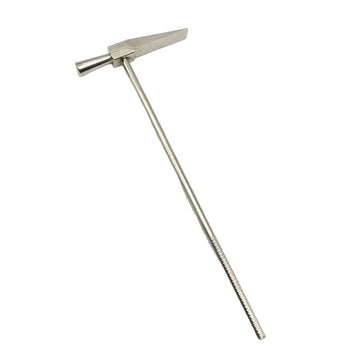
However, no matter which method you choose, you’ll need a tuning hammer to get your kalimba perfectly in tune. This small tool is used to slide the metal tines up or down on the bridges to change their pitch. Using other tools isn’t recommended: some aren’t precise enough, while others can damage the steel keys. That’s why Instruments du Monde offers a tuning hammer specifically designed for thumb pianos. With this tool, you’re guaranteed an effective tuning session!
Get this kalimba tuning hammer now by clicking on the image below.
Did you know the kalimba is a very accessible instrument, whether the person who wants to play is very young or much older? Come discover what age is best to start playing the kalimba. You can then feel confident you’re choosing a great gift for the person you’re buying a thumb piano for. And to complement this article, read our detailed guide to the kalimba.


