



Written by Ambre Montespan - Updated on Sep 25, 2026

Table of contents:
Have you noticed your kalimba doesn’t sound as good as it used to, and you’re wondering why? You may have seen or heard that it’s essential to tune your thumb piano, but you’re not sure how. Why tune your instrument at all? Is it possible to change a few notes on the tines to play a specific piece of sheet music or tablature?
I’ve been playing the kalimba—also known as the mbira, sanza, or thumb piano—for over 10 years now, and I’ve tuned my African instrument well over 100 times. And honestly, I’m probably still undercounting! So yes, I’m more than able to teach you how to tune your own kalimba.
To tune your kalimba correctly, slide the steel tines up or down, then check with a tuner to see if you’ve reached the desired note. Once all the tines are in the right position, your kalimba is tuned and ready to play.
After reading this entire article, you will finally learn:
- Why it is essential to learn how to tune your kalimba
- How to tune a thumb piano
- Why tuning should be done regularly
Tuning your kalimba will then be a simple formality for you. Your musical instrument will always produce beautiful sounds, and you will be able to play all the sheet music and tablatures that require retuning your thumb piano.
Now, let’s dive into this fascinating topic together.
Why tune your thumb piano?
It is very important to tune your thumb piano regularly. First, it is important to understand why this is necessary and, second, to know when it needs to be done.
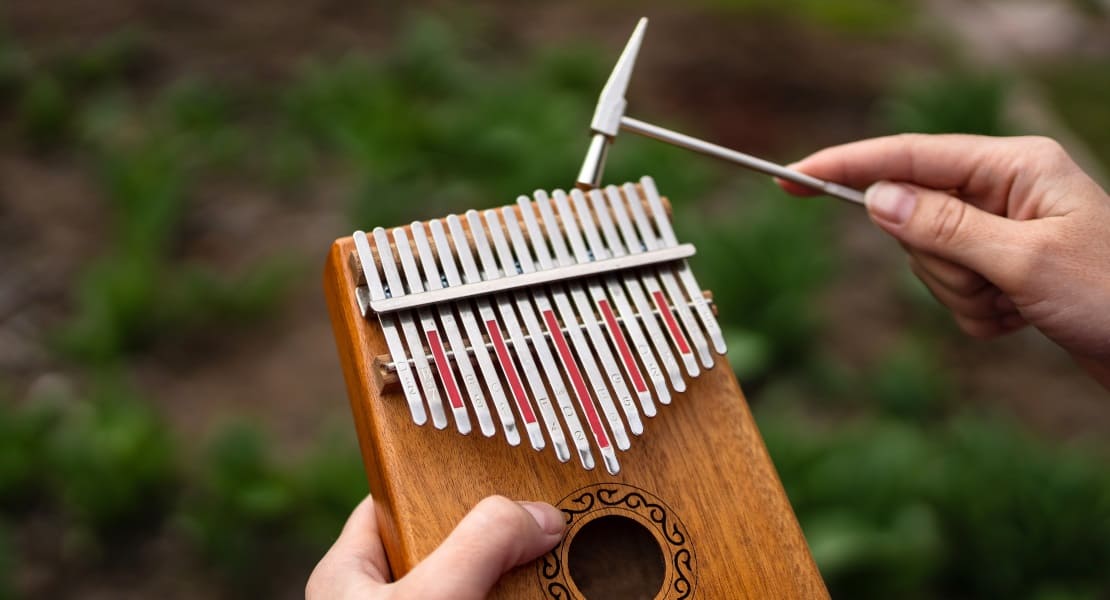
What is tuning a musical instrument, and what is it for?
Tuning a musical instrument means adjusting it so it produces the intended notes. The kalimba is far from the only instrument that needs tuning. In fact, guitars, violins, ukuleles, and most plucked or struck string instruments also need to be tuned.
When a sound is produced, it’s actually vibrations that travel as waves. These sound waves are generated at a specific frequency. All this leads to the conclusion that each musical note corresponds to a specific frequency. For example, for a C3, C of the third octave, the frequency is 261.626 hertz. For the musical note just above it, D3, the frequency is 293.665 Hz. You’ll notice there is a difference of a little over 30 hertz between C and D in the same octave. Notes can be in tune or out of tune. If, for example, the tine on your kalimba that is supposed to be C3 registers at 270 hertz, then your instrument is out of tune and that note is inaccurate.
Therefore, the goal of tuning a kalimba is to change the position of the metal tines to reach the desired note as accurately as possible. If you leave a thumb piano out of tune, the final result of a melody will be very unpleasant compared to an instrument that’s properly tuned. Its acoustic performance won’t be optimal.
When should you tune your kalimba?
Now that you have a good understanding of what tuning a kalimba entails, it’s important to look at when you need to do it.

1 – Regularly
Beginners often make the mistake of thinking that once a mbira is tuned, it stays that way forever. This is obviously incorrect. Wood, which is often chosen for the body of the instrument, is a living material that tends to shift over time or with humidity. This is particularly true for mahogany and spruce. In other words, even if it’s imperceptible to the naked eye, wood moves. As a result, the tines also tend to shift, which slightly changes the frequency of the musical notes.
The same holds true for acrylic kalimbas. Simply playing your instrument causes the tines to vibrate to produce sound, and over time this vibration can shift their position. Finally, kalimbas with a soundboard and resonating box tend to go out of tune more quickly.
That’s why it’s smart to check your kalimba regularly to make sure it stays in tune. How often you need to do this depends on your instrument and how much time you spend playing it. Some players will check tuning every month, while others only need to do so every three months. In any case, it’s important to do it consistently.
2 – After an impact
If you drop your kalimba on the floor or it takes a hard hit, you should check whether it has gone out of tune. A strong impact can cause the metal tines to move. Even if they only shift by a few millimeters, your thumb piano can end up out of tune.
3 – To play tablature or sheet music
Some tablature, sheet music, or compositions may ask you to change a few notes that are normally part of a C major tuning. If you don’t know how to tune your sanza, you won’t be able to play the melodies and songs in these scores properly. For example, you may need a C#4 (C sharp in the 4th octave), which is a semitone above C4. That C sharp isn’t present on a thumb piano tuned to C major. So you’ll slightly adjust the position of the corresponding tine to turn a C4 into a C#4.
4 – Changing the frequency of your kalimba
In 1975, international standard ISO No. 16.1975 established that the reference frequency for music was 440 hertz. This means that the reference musical note, A3, must be tuned to 440 Hz. All other notes are then derived from this base. But music has not always been calibrated to this frequency. Previously in France and Italy, thanks in particular to the influence of Italian composer Giuseppe Verdi, the reference A3 was tuned to 432 hertz. This means that all other musical notes are completely different from those tuned to 440 Hz.
So nothing stops you from tuning your kalimba to 432 hertz instead of the usual 440. Why might you choose to do that? Without getting too deep into the debate, some musicians and enthusiasts believe music tuned to 432 hertz feels more beneficial than music tuned to 440 hertz. If you want to explore this alternative tuning—or any custom reference frequency—you’ll need to know how to make the adjustment.

What equipment is needed to tune this musical instrument?
In addition to your kalimba, of course, you’ll want to gather all the essential accessories to tune your instrument to perfection.
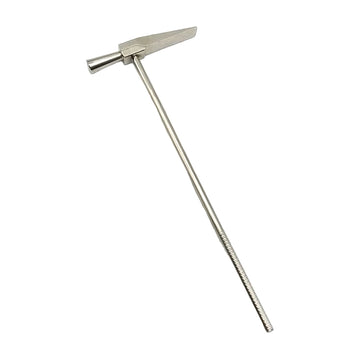
A tuning hammer or pliers
A tuning hammer looks like a regular hammer, except it’s much smaller. Most of the time, it’s included (or offered as a gift) with the kalimba. It’s used to tap the metal tines so they slide up or down. Using a tuning hammer is essential, and using a full-size hammer is strongly discouraged. It’s far less precise and, if you miss the tine, you could damage your instrument. A tuning hammer also has a flat side and a pointed side. The flat side is used for stronger taps to move a tine more, while the pointed side is more precise for fine adjustments to finalize the tuning.
Note that some kalimbas come with pliers instead of a hammer, which can also be used to tune the instrument.

A tuner for kalimbas
To tune your kalimba, you’ll need a tuner—or at least something that can serve as one. Below, we’ll explore what this tool does and the options that are available to you.
1 – What is a tuner used for?
If you don’t have perfect pitch, you’ll definitely need a tuner. This handy electronic or acoustic device tells you whether the note you just played is in tune or not. Several types are available, so let’s take a quick look at them now.
2 – Which tuner should you choose for your kalimba?
To tune your kalimba correctly, you will need either an electronic tuner, a tuning fork, or a smartphone app.
A – An electronic tuner
The most effective solution is still an electronic tuner. This small device listens to the note you play nearby and instantly tells you whether it’s in tune. The display also shows whether you’re slightly sharp or slightly flat.
Electronic tuners are often battery-powered, so you can take them anywhere. They’re portable, stand-alone, and very accurate, yet still affordable—a reliable choice for beginners and seasoned players alike.

B – The tuning fork
A tuning fork generally resembles a metal fork with two prongs, a bit like a Y with a more elongated shape. When struck with another metal object, the tuning fork always emits the same note, called the reference note. The goal here is to tune your mbira according to the note emitted by the tuning fork.
So, as you can see, you need to have a good ear to use a tuning fork. But it is a very durable, simple tool that works without batteries. It can therefore be a good compromise, even if it remains very difficult to get truly accurate results on a kalimba.
C – Smartphone apps
Finally, there are smartphone apps that work like electronic tuners using the microphone. There are free apps with ads and paid apps. However, we caution you about the accuracy of these apps, as the results can sometimes be unreliable depending on the quality of the smartphone’s microphone.
That’s why, to be sure of the quality of your tuning, we recommend using an electronic tuner designed specifically for this purpose. You can also check out our guide to the best tuners for kalimbas. You’ll learn about the advantages and disadvantages of this device in detail.

How to tune a kalimba?
Now that we’ve covered the equipment, let’s get down to business and learn how to tune your mbira.
How to tune a 17-tine kalimba?
Tuning a 17-tine kalimba involves several steps that must be followed in sequence.
1 – Prepare your tuner and your acoustic environment
First, you need a tuner. Choose from the three options described above. Read the instructions carefully to understand how it works. Next, find a quiet place where there will be no background noise. Turn off the air conditioning, fans, television, and anything else that could interfere with the sounds produced by your kalimba. The goal is to create a completely silent environment.
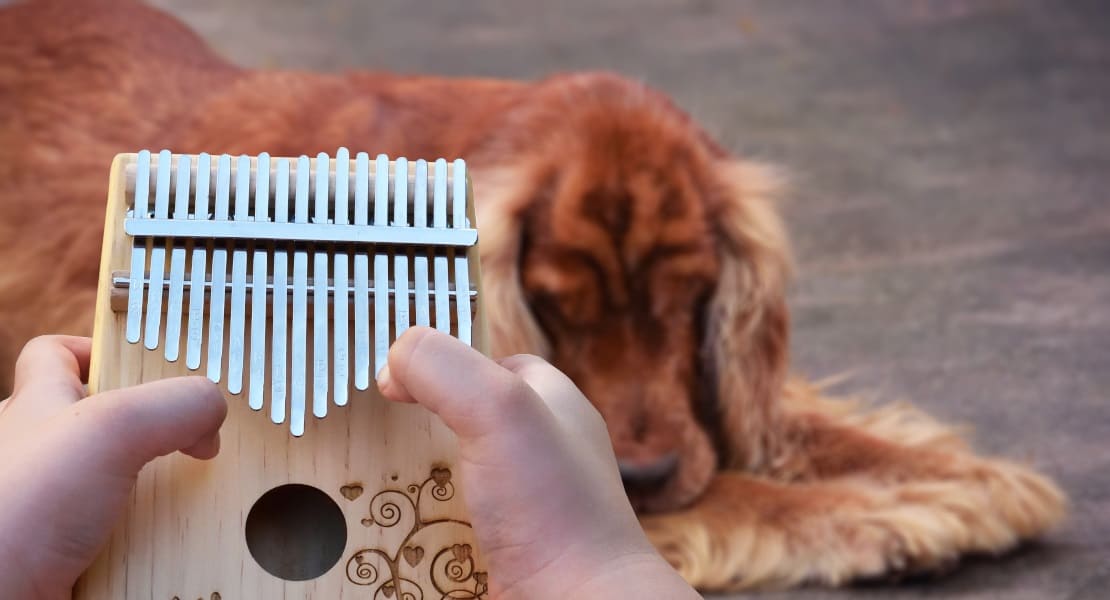
2 – Learn the correspondence between the kalimba keys and musical notes
Next, you’ll need to know the correspondence between the keys on your kalimba and the musical notes. When you purchased your musical instrument, this correspondence is often provided in an instruction booklet. If your kalimba has engraved keys, you can use these engravings as a reference. If you don’t have any information about the note/key correspondence, most 17-key thumb pianos today are tuned to C major. Here is a diagram of a kalimba tuned to C major:

Each column corresponds to a tine on the kalimba. The blue columns are simply the ones where there should be a sticker. These are visual cues to help you keep track of your layout. Learn how to place all your kalimba stickers correctly by reading this other article.
The numbers or letters on each column indicate the musical note that should be tuned on the corresponding tine. The letters and numbers in the top row come from Batavian note notation, while the numbers with dots in the bottom row come from the Arabic numeral musical notation known as NMCA. Here is a table of correspondences:
| solfège | do | re | mi | fa | sol | la | si |
| batave | C | D | E | F | G | A | B |
| NMCA | 1 | 2 | 3 | 4 | 5 | 6 | 7 |
The dot(s) above the numbers indicate that it’s the same note, but one or two octaves higher than the one without a dot. You’ll also notice that next to each letter in the top row, there is also a number. That number indicates the octave. For example, A4 is one octave lower than A5. However, even though the letter A corresponds to la in solfège, A4 does not correspond to la4. In solfège, notes are typically written one octave lower than in letter-name notation. So A4 actually corresponds to la3. Consult this standard piano key frequency chart if you would like to learn more.

3 – Change the position of the finger piano keys
Once you know which note to assign to each key, turn on your tuner and set it to listen mode. To tune your sanza, you can use the empirical method, or more simply, by trial and error.
Choose any key—just make sure you don’t forget any by the end of the tuning process. Pluck the selected key to make the tine vibrate and look at the result on the tuner. You then have three possibilities:
A – The note displayed on the tuner matches the desired note exactly
Perfect—you don’t need to adjust this tine. Move on to the next one using the same procedure.
B – The note displayed on the tuner is lower than the desired note (the frequency is lower)
This means that the portion of the tine below the bridge bar (the horizontal bar that holds all the kalimba keys in place) is too long. You’ll therefore need to use the hammer to slide this tine upward. In practical terms, you need to strike the tine in question with the hammer as shown in the photograph below:
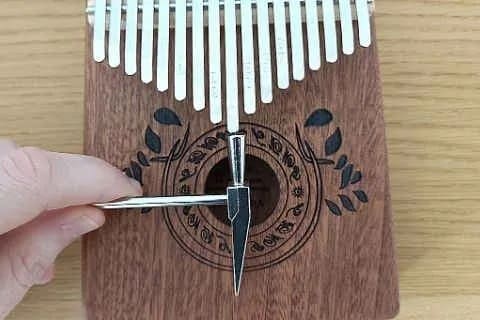
Once the key has been moved slightly upward, repeat this step from the beginning by playing the same key again and checking the tuner to see whether the change you just made shifted the note the way you wanted. If so, you can move on to the next key. If not, slide the metal tine again based on the new reading from the tuner.
C – The note displayed on the tuner is higher than the desired note (the frequency is higher)
This means that the portion of the tine below the retaining bar is too short. Gently tap the tine downward with the hammer, as shown in the image below:
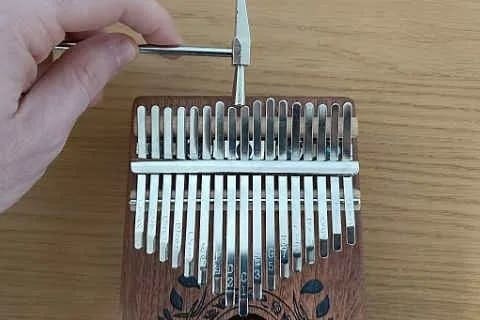
Just as when the note is flat, double-check with your tuner to confirm that the new tine position has done the trick, as explained above.
Once you’ve repeated this process for every key, your kalimba is in tune!
How do you tune an 8-tine kalimba? And what about a 21-key sanza?
Whether you have an 8-tine, 21-tine, or any other number of tines, the procedure is exactly the same. You will still need the same accessories (tuner and hammer/pliers). You will simply have more or less work to do depending on the number of keys on your thumb piano.
However, the correspondence between the keys and the musical notes will inevitably change. As a result, you should refer to the booklet provided when you purchased the kalimba. Otherwise, here are the most common diagrams.
21-key kalimba:

8-key kalimba with diatonic scale:

Some of the keys or blades on my thumb piano are dead, buzzing, or no longer resonate. What should I do?
After tuning your instrument, some tines—often the smallest ones on the outside—may stop resonating or resonate very faintly. This happens when the tine doesn’t vibrate enough to produce a sound. To fix it, gently nudge the key a few millimeters until you find the sweet spot while keeping the note in tune.
Some keys may also buzz. First, make sure the tine in question is perfectly perpendicular to the horizontal support bar. If that doesn’t work, there may be debris stuck between the tine and the support bar. Therefore, it is advisable to clean your kalimba thoroughly with maintenance oil to remove any dust that could interfere with the sound of your mbira. Read these tips on how to maintain your thumb piano and learn how to take it apart for proper cleaning.

Can I tune my sanza differently from the manufacturer's instructions?
While you can certainly tune your kalimba to a different key than the one intended by the manufacturer, there are limitations. Several different tunings will be presented after discussing the difference between minor and major scales.
The possibility of tuning your kalimba differently
The diagram of the 17-key kalimba shown above shows the C major tuning. But there are many others, and some musicians like to change them regularly to add variety to their playing. In reality, there are almost infinite different tunings, since the only limitation is the combination of notes you want to incorporate into your tine layout. In addition, thumb pianos can also be tuned to a chromatic or pentatonic scale, which adds even more variety.
The physical limitations of different tunings with your thumb piano
However, while it is theoretically possible to change the tuning of the mbira, you will be faced with a physical limitation: tine length. In order to change the tuning, and therefore the different musical notes, of the kalimba, you will need to slide the tines up or down. The problem is that if the portion of the tine above the support bar is too short, you won’t be able to slide the tine down far enough to obtain the desired note. On the other hand, if the tine is too short between your thumb and the support bar, it simply won’t vibrate and won’t produce any sound.

So, it is possible to tune your kalimba differently, provided that the manufacturer has left enough room to do so and that the notes you want to set are consistent with the physical limitations of your thumb piano. For example, with a classic kalimba, you’ll never be able to play notes in the 6th octave, which would be too high, or those in the 1st octave, which would be too low. A full-size piano, on the other hand, can do this very well. It’s said to have a wider range, unlike the kalimba, which has a more moderate one.
What is the difference between a minor and a major chord on a musical instrument?
When it comes to naming the chord on the kalimba, you may have heard it referred to as "C major" or "F major." However, it is also possible to have a chord in "F minor" or "C minor." Without getting too technical, the difference between a minor and a major chord boils down to the frequency gap between the notes on the kalimba keys. As a rule of thumb, major chords are often used for upbeat pieces, while minor chords are generally used for sadder melodies.
To help you hear the difference, let’s take the theme from the video game Super Mario Bros, which is a happy song in a major scale. Listen to the difference in these two audio clips.
You can hear that it’s the same melody, but the one played on the kalimba in C major sounds much more cheerful than the one in C minor. If you’re interested in this topic, and since nothing beats practice, we invite you to explore several minor and major chords to form your own opinion—and to experience the full expressive potential of your kalimba.
Classic chords for mbira
In addition to the C major chord you saw earlier, here is a list of all the most common chords you can find for the 17-key kalimba.
G major

D major

A major

E major

F major

B-flat major

E flat major

A flat major

A minor

E minor

B minor

F-sharp minor

C sharp minor

D minor

G minor

C minor

F minor

Record your performances after tuning your mbira
Knowing how to tune your kalimba is an important step for any instrumentalist who wants to improve their mastery of the instrument. Playing wrong notes even though you’re using the right technique can be discouraging. But now you have this knowledge, and you can tune any thumb piano, regardless of the number of keys. You’ll produce only accurate notes for the pleasure of your ears and those of your audience. In addition, you’ll be able to explore different tunings to vary the sound and feel.
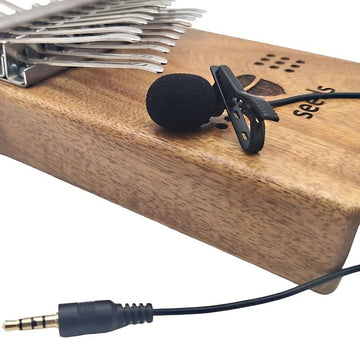
However, kalimbas are rarely supplied with a microphone for recording your own performances. Yet this is a great way to track your progress over time while sharing your musical talents with the whole world, via YouTube for example. That’s why the Instruments du Monde store offers a versatile, high-quality microphone that will allow you to capture all your kalimba prowess.
Get this kalimba microphone now by clicking on the image below:
Even if tuning your African instrument holds no secrets for you now, have you ever wondered whether kalimba is treated as masculine or feminine in French? Don’t hesitate any longer—come find out whether the word kalimba is masculine or feminine! You can then confidently correct anyone who gets it wrong. If this topic doesn’t interest you, learn everything there is to know about the kalimba.


