



Written by Ambre Montespan - Updated on Jan 28, 2026
Table of contents:
Would you like to discover or deepen your knowledge of the tongue drum, a soothing-sounding instrument that (kind of) looks like a flying saucer? How and where was this curious object created? What kinds of sounds can you play on a tongue drum? Can you buy one, and how do you choose the right model? How do you play it for fun—or specifically for relaxation?
I’ve been passionate about this musical instrument for over 10 years, and I’ve spent a lot of time researching it while practicing regularly. In this guide, I’m sharing everything I’ve learned so you can discover the tongue drum for yourself.
After reading this informative article, you’ll finally understand:
- What a tongue drum really is
- How to choose your own
- The different ways to use this musical instrument
By the end, you’ll know what matters most about the tongue drum’s origins, and you’ll be able to pick the right instrument based on your expectations and how you plan to use it. Perfect if you’re just getting started.
What is a tongue drum?
The tongue drum is a percussion instrument belonging to the idiophones family—meaning instruments that produce sound through the material they’re made from, typically when struck. The xylophone, cymbals, glockenspiel, balafon, and gong are good examples of idiophones. First, let’s look at the tongue drum’s origins, and then we’ll explain how it works.

Where does the tongue drum come from?
The tongue drum is far from being a traditional instrument. Although its invention is generally attributed to American Dennis Havlena in 2007, this instrument actually has much older roots. It can be traced back to the slit drum, a wooden instrument shaped like a log with one or more slits cut into it so the percussionist can produce several tones by striking it with a mallet, beater, or drumstick. The body of the instrument acts as a resonator, much like the tongue drum. Slit drums are at least 500 years old, and quite different versions have been found on several continents. In South America, for example, you can find teponaztlis, an instrument used by the Aztec and Mayan civilizations. Watch an example of the sounds a musician can produce with it in the video below:
In 1990, an American named Jim Doble had the idea of creating an instrument from large used gas cylinders. By cutting shapes into the bottom of the cylinder, he was able to produce different sounds without necessarily tuning each shape to a specific musical note. He called this instrument the Whale Drum, because the sounds it produced reminded him of whale song.
Then, in 2001, a Swiss couple created the Hang Drum, also known as the handpan, which greatly inspired Dennis Havlena in terms of its shape and the arrangement of the notes. The difference is that no cuts are made in the material of the handpan. The turning point came when professional musician Fellé Vega presented a new instrument in 2005 that he called the Tambiro, but which was never marketed. Watch the artist demonstrating this instrument in this archive video:
Skillfully combining the strengths of the handpan and the Tambiro, while also drawing inspiration from the Whale Drum concept, Dennis Havlena cut shapes into a 29 lb (13 kg) propane tank to create tongue-shaped cutouts on the underside. Each tongue corresponds to a musical note that he tuned precisely, sometimes with the help of neodymium magnets. You can hear the result of his prototype in the following video, where he produces surprisingly melodic sounds for a handmade instrument:
Since then, manufacturing techniques have become industrialized, and professionals no longer use recycled tanks to make this instrument—although some DIY enthusiasts still try to reproduce Dennis Havlena’s tongue drum. For a deep dive into the origins of this mysterious musical instrument, check out our article dedicated to the origins of the tongue drum. There are plenty of fascinating historical details to uncover.
Are the tongue drum, tank drum, hank drum, and Hang Drum the same instrument?
This instrument goes by several names. In addition to tongue drum, steel tongue drum, and steel drum, its inventor initially called it a hank drum. Others call it a tank drum or vibe drum. In France, musicians sometimes refer to it as a tambour à langues, tambour à languettes, tambour zen, or even zen drum.
However, it’s important to differentiate between the tongue drum and the Hang Drum (also called the handpan). Even though they look similar, they’re two different percussion instruments. Besides the Hang drum usually having a larger diameter than a tongue drum, the main difference lies in how they’re made. A tongue drum is cut into the metal, while a handpan is hammered into shape. In practice, it’s easy to spot: if you see tongue-shaped grooves, it’s a tongue drum; if you only see smooth indentations, it’s a Hang drum/handpan.
If you want to learn more about all the names given to this instrument, read this article. You’ll also better understand the big differences between the tongue drum and the Hang drum, a close cousin in the same sonic family.


How does this musical instrument work?
The way a tongue drum works is, all in all, relatively simple. First, it helps to watch a short video showing a modern tongue drum in action.
As you can see, every time the player strikes one of the tongue-shaped cutouts with a mallet, a sound is produced. In fact, when the mallet hits a tongue, that tongue starts to vibrate. The vibrations travel through the instrument’s hollow body, which acts as a resonator, boosting the volume to around 70 to 80 decibels and creating its signature tone. The sound hole is often located on the underside of the instrument, although some models place it on the top shell. This lets the musician create effects by covering and uncovering the hole with their hand while playing.
The size of each tongue directly affects the sound it produces: larger tongues create lower notes, while smaller tongues produce higher ones. The overall diameter of the instrument also makes a difference—larger tongue drums tend to sound louder and more resonant than smaller ones. The notes are determined during manufacturing, and makers must measure each tongue very precisely to tune the instrument accurately. To learn more about how the tongue drum works, read this other article.
Are there any benefits to playing the tongue drum?
In general, regular practice on any musical instrument offers many benefits for the player, and numerous studies from around the world have shown it. Playing an instrument can help lower blood pressure, reduce stress and anxiety, and improve sleep quality. It also improves coordination and can support brain connectivity. Plus, exploring an instrument naturally boosts creativity—most musicians eventually feel the urge to create their own pieces. It’s a wonderful skill to develop for kids, adults, and seniors alike.
Where the tongue drum really stands out is in the soft, pleasant, soothing tones it produces, which can enhance that calming effect even more. And there’s another major advantage: it’s a percussion instrument that’s genuinely easy to pick up. Unlike the violin or piano, which can take hundreds of hours to feel comfortable, almost anyone—even with no music theory background—can enjoy what the tongue drum has to offer. In just a few minutes, you can start benefiting from its relaxing soundscape.
Check out this short article that lists all the benefits of the steel tongue drum. You’ll see why so many people fall in love with this instrument for everyday relaxation and calm.
What is the best tongue drum?
As with the vast majority of musical instruments, there’s no single best tongue drum. The “right” model depends on what you want to do with it. Let’s break it down together.

How do I choose the right tongue drum for me?
There are roughly ten key criteria that can influence your choice. One of the first is undoubtedly the number of tongues (notes) the instrument has. This directly impacts the instrument’s range. If you want to play recognizable melodies from sheet music, aim for a tongue drum with a larger number of notes—around 15—because songs you can play with fewer notes tend to be rare and quite simple. On the other hand, if you’re using the tank drum for musical meditation, rhythmic relaxation, or “zen” improvisation, a more limited range can be perfect, and 6, 8, or 11 notes may be plenty.
As we mentioned earlier, the total diameter of the hank drum also affects the sound. A small tongue drum, around 8 or 10 in (20 or 25 cm) in diameter, has a smaller resonating chamber, which supports faster playing because the notes don’t ring as long. By contrast, a large tongue drum, 16 in (40 cm) in diameter or more, produces deeper vibrations with notes that sustain for a long time. That type of instrument is generally better suited to slow playing, traditionally linked to meditation, yoga, and introspection.
It’s also worth noting that tongue drums aren’t all tuned to the same reference frequency. While most instruments today are tuned to 440 hertz (the standard in Western music), some are tuned to 432, 528, or other frequencies. Some players believe specific frequencies can influence the body and mind, such as 432 Hz, which is often associated with a more “natural” feel. So while a zen drum tuned to 440 Hz is ideal if you want to play with other musicians, alternative tunings can be an interesting option if you’re using it for sound therapy.

We’ve only covered a few important criteria without going into every detail. If you want to choose your instrument based on brand, material, accessories, or even its minor or major scale, check out our guide to choosing a tongue drum. You’ll be sure to select a tank drum that truly matches your intended use—which is ultimately what makes it the best choice for you.
What is the ideal tongue drum model for beginners?
There’s no single tongue drum that’s perfect for every beginner. First, ask yourself how you plan to use this percussion instrument. If you mainly want to play from sheet music, you’ll need a model with as many tongues as possible to expand your options. In that case, a tongue drum with 15 notes will let you play almost all the sheet music you’ll find online.
If, on the other hand, you want to focus on intuitive playing, then an instrument with fewer notes—and a tuning that naturally supports meditation and a more contemplative vibe—may be the better fit. In that case, a 9-note tongue drum tuned in D minor or in the Amara scale can be very satisfying. This tuning is popular with beginners because it’s simple and forgiving. Plus, 9 notes are a great middle ground between ease of learning and musical possibilities.
Of course, beginners should also consider their budget. If you have less than $100 to spend, the two options mentioned above may be hard to pull off. In that situation, a smaller model with fewer notes will significantly lower the cost. To get a clearer idea, check out our guide to the best tongue drums for beginners. You’ll quickly figure out which model matches your needs.

Are there specific instruments for children in elementary and preschool?
Teachers are often interested in offering creative musical activities, especially to younger children in elementary or preschool. These activities have real benefits: early musical exposure supports brain development, particularly in young kids, and multiple serious studies have shown this. And instead of using the traditional recorder or other conventional classroom instruments, the tongue drum naturally sparks curiosity while offering a soothing palette of sounds that many children respond to very well.
If that sounds like your situation, it’s smart to choose a tongue drum with a smaller diameter—around 6–8 in (15–20 cm)—so even the youngest children can handle it easily. An instrument tuned to C major or F major with 8 to 11 notes is also a good choice, since those keys are commonly recommended for beginners across many instruments. Having fewer notes also helps prevent children from feeling overwhelmed.
With this type of tank drum, you can support children’s creativity through guided exercises, or help them reproduce familiar tunes and nursery rhymes using the included pair of mallets. We highly recommend reading our article specifically dedicated to using the tongue drum in schools—it includes everything you need to make the most of this instrument in a classroom setting.

Which range or key should you choose for your tongue drum?
The scale or key of the tongue drum is an important factor that should not be overlooked, because it’s very difficult—often impossible—to change once you own the instrument. A tongue drum doesn’t have many notes and, unlike a piano, you must choose which notes will be present (and which won’t). That specific combination of notes is the tongue drum’s scale.
No one key is inherently “better” than another; they simply create different musical experiences. For example, tongue drums in major scales tend to sound bright and uplifting, while minor scales often feel more introspective or melancholic. There are also scales with specific names such as Akebono, Hijaz, Pygmy, and Amara. However, some scales are much harder to master than others, and a tongue drum in C major will generally be more beginner-friendly than one tuned to a Hijaz scale.
As a result, the tongue drum’s tuning truly becomes its sonic signature—and it will most likely keep it for its entire lifetime. While it’s still possible to slightly adjust notes by changing the tongue surface area with tools or by altering weight with neodymium magnets, it’s not an easy process. So if you’re unsure about this crucial feature, read this article to help you determine the perfect scale for your needs.
Where can you find tongue drums?
The tongue drum isn’t a mainstream instrument like the guitar, piano, or drum kit. As a result, it can be harder to find one—and harder still to find a store that offers enough options to help you pick the perfect model.
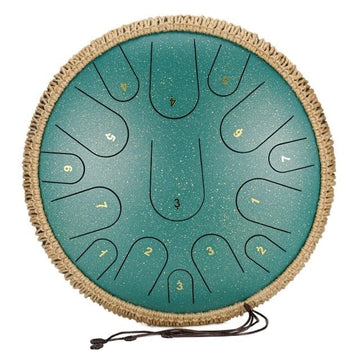
Today, your best bet is still online stores. You’ll mainly find two types: general music retailers that sell far more than tongue drums, and more specialized shops.
Specialized shops are usually run by passionate people, which means you’re more likely to get useful guidance. They also tend to offer a wider catalog, including, for example, models tuned to different frequencies to match different player profiles. That’s why you can find more than 50 tongue drum models in the Instruments du Monde store—ideal for finding the right fit.
Generalist stores, on the other hand, often have a more limited selection and rarely provide specialized advice. Many of them buy instruments in bulk and focus on lowering prices, without necessarily understanding what they’re selling. The priority is volume, not matching each musician with the right tongue drum.
Finally, you could visit brick-and-mortar shops or browse the second-hand market. In both cases, the tank drums you find will be rare, since this musical instrument is still quite exotic. Be mindful of pricing, which can be high simply because the instrument is hard to find. The upside is that you may get to test one and see if you like the sound. That said, today you can also buy online and use a 14-day return right (under French consumer law) if the tongue drum isn’t for you—no justification required.
For more details, we invite you to read this article that details all the places where you can buy a tongue drum. It lays out the pros and cons of each option so you can choose with confidence.

How much should you invest in a Zen drum?
The price of a tongue drum varies greatly. It can range from around $50 for the smallest models to several hundred—or even several thousand—for professional-grade instruments. The amount you spend mainly depends on size. The number of notes has very little impact on price. And logically, the larger the tongue drum’s diameter, the higher the cost.
A tongue drum with a diameter of around 6 in (15 cm) can often be found for about $50 or $60. At that size, you’ll usually get between 6 and 11 notes, which can make it a great pick for kids or adults who want something very easy to play, but with limited musical range. However, you’ll generally need to spend over $100, or even $200, to buy a steel tongue drum with a diameter of 8, 12, or 14 in (20, 30, or 35 cm). These models offer an excellent balance: the price stays reasonable, and the instrument’s musical potential is much higher. This is often the sweet spot for beginners.
Finally, professional-quality tank drums, or models with special tunings, usually cost well over $500. They’re better suited to experienced musicians who already know they’re committed to the instrument. Read our specialized article on tongue drum prices to get a clearer idea of the right budget for your situation.

What are the differences between a handpan and a steel tongue drum?
Beginners often confuse the steel tongue drum with its distant cousin, the handpan. Some retailers, who aren’t particularly knowledgeable, can make the same mistake. Fortunately, it’s very easy to tell these two instruments apart.
The most obvious difference is how they’re made. As we saw earlier, tongue-shaped cutouts are made directly in the shell of a tongue drum. A handpan, by contrast, is carefully hammered into shape using specialized tools. So while a tongue drum is cut, a handpan is formed. That’s why you can usually identify them at a glance: grooves mean tongue drum; smooth dimples/indentations mean handpan.
This manufacturing difference also leads to other differences unique to each instrument, starting with the sound. Rather than describing it, the best way is to listen. First, here’s a video of a tongue drum, and then a similar video featuring a handpan.
A trained ear can easily distinguish a handpan from a tongue drum. But the differences don’t stop there. Hammering steel into shape is far more time-consuming and difficult than cutting it, so handpans tend to cost much more—often 2 to 10 times the price of a tongue drum. Also, handpan shells are thinner so the maker can shape the metal, which makes them more fragile. Dropping a handpan can dent it and throw it out of tune. Tongue drums, with their thicker build, are among the most durable instruments you can buy.

There are other differences too, like size and weight, as well as how challenging each instrument is to learn. To explore all that and more, read our guide on choosing between a tongue drum and a handpan. It will help you pick the instrument that’s truly right for you.
How do you make a tongue drum?
Historically, the tongue drum was created as an affordable alternative to the handpan, which was far too expensive for most people at the time. It was invented by cutting a used gas cylinder with a grinder in a small garage. So it started as a DIY instrument before being adopted and produced by professional brands. That said, it’s absolutely possible to make your own tongue drum using Dennis Havlena’s original method.
First, you’ll need a wide range of tools. At minimum: a vise, an angle grinder, a drill with metal bits, a hacksaw, and an electronic tuner. Next, you’ll need a butane or propane tank to use as the base—ideally one with a diameter of about 12 in (30 cm) and a low profile. Finally, you’ll want a diagram or template showing exactly where to cut, so your finished tongue drum plays in tune.

Once you’ve gathered everything, you must first make sure the used tank is completely empty. To do this, fill it with water several times after removing the valve by unscrewing it. Then comes cutting with the grinder and drilling according to your plan. Finally, you’ll refine the tongues with a hacksaw and use the electronic tuner to ensure each note is correct. For a much more detailed walkthrough, we strongly recommend following this tutorial on how to make a tongue drum. It takes you step by step so you can craft your own fully handmade tongue drum.
Are some tongue drums better than others?
After considering all the information above about choosing a tongue drum, it’s natural to wonder if there’s a model that clearly outperforms the rest. In reality, it’s more nuanced than that, because there’s no single tongue drum that’s truly “the best”. It all depends on what you want from the instrument and how you plan to use it—although you should avoid poor-quality brands like Panda Drum, Exodrum, or Karma Drum, which are known for disappointing quality.
If you want to play a wide selection of sheet music, you’ll want a model with more notes and a broader range. If you’re into music therapy or energy work, a model tuned to 432 Hz can be a great option. For children, it makes sense to choose a tongue drum that fits their size. Because needs vary so much, I selected the strongest instruments and compiled them into a top 10 list to help you choose. Check out our comparison of high-quality tongue drums by clicking here.
How to use a hank drum properly?
Because the tongue drum is still a relatively exotic instrument, it’s not always easy to find a teacher to help you learn how to use it properly. But don’t worry—we’ll cover what you can do with it and share practical tips so you can enjoy its captivating sound to the fullest.
What notes are on a tongue drum?
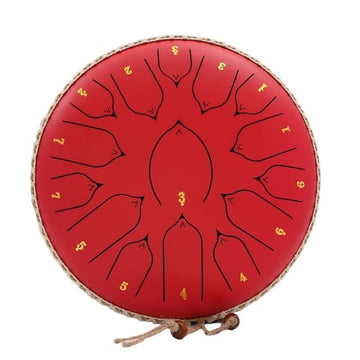
Choosing the right tongue drum can be tricky because of the variety of notes and scales available. Each tongue drum is tuned to a specific key that can’t be easily changed, unlike stringed instruments like the guitar. The range of the instrument, which is often limited by its size, varies from model to model, offering between five and twenty notes. The scales can be pentatonic, diatonic, or chromatic, directly affecting the number and type of notes you can play.
That’s why choosing the right tongue drum depends heavily on your musical goals. If you’re aiming for variety in your compositions, an instrument with a wider range or several octaves can be a smart choice. On the other hand, fewer notes can be more than enough for simple pieces or meditation exercises. Identifying the exact notes on a tongue drum is also important. You can do this with an electronic tuner or by using the markings often printed on the instrument. Notes are typically laid out to match the instrument’s key and spread across octaves to enrich the harmony.
The tuning frequency, typically around 440 Hz, also influences the tone and how easily your tongue drum blends with other instruments. Some variations, like 432 Hz tuning, can create a slightly different listening experience, which many players enjoy for solo playing or relaxation sessions. Ultimately, the right tongue drum is the one that matches your needs and your understanding of the instrument’s scale and layout. If you’d like to learn more about the notes you can find on a tongue drum, follow the link to read the dedicated article.
What are the stickers on the tongue drum for?
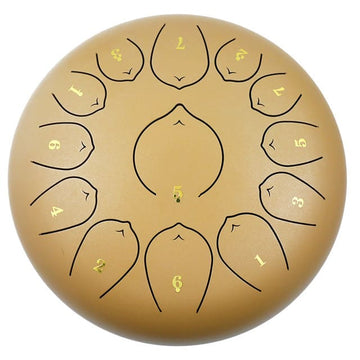
Some beginners are surprised to find numbered stickers included with the tongue drum—or already applied to each tongue. These stickers are actually very useful because they tell you which note corresponds to each tongue.
First, the numbers range from 1 to 7, and each number corresponds to a musical note in numbered musical notation, where 1–7 represent the notes of the scale. For a model tuned to C major, the correspondence is shown below:
| notes | C | D | E | F | G | A | B |
| NMCA | 1 | 2 | 3 | 4 | 5 | 6 | 7 |
On vibe drums with many notes, you may also see stickers with dots above or below the numbers. This means the note is one octave higher or lower than the same number without a dot.

If the stickers aren’t already on your tongue drum, refer to the included booklet to find out where to place them. You can also do it by ear, or by comparing tongue sizes (larger tongues usually produce lower notes). If you don’t have any guidance at all, use an electronic tuner to identify each tongue’s note, then apply the correct sticker. This whole process is explained in detail in our tutorial for placing stickers on a tongue drum. It’s worth reading—placing these stickers incorrectly will throw off your playing and make it hard to follow sheet music properly.
How do you read steel tongue drum sheet music?
If you want to build a real repertoire and learn lots of melodies, you’ll eventually need to learn how to read tongue drum sheet music. If you already read standard music notation, you can absolutely play from classical sheet music with staves, rhythm values, tempo markings, and more.
However, tongue drum players often prefer simplicity and don’t want a long learning curve just to play a few songs. That’s why simplified sheet music exists—often just a string of numbers, like in the example below:

If you’ve read the previous section about sticker placement, you already know that each number corresponds to a musical note. You simply play the notes in the order they appear to get the melody. Parentheses usually mean you should play the notes at the same time.
That said, this kind of simplified score doesn’t really help you play a song you’ve never heard before because it doesn’t clearly show the tempo, note durations, or rests. That’s why another type of score exists, a bit more complex but still largely based on numbers. This time, note values, rests, tempo, and time signatures are included, so you can play much more accurately when learning a song. It does take a bit more effort to read, though.
That said, we provide a free manual where you’ll find everything you need to read any tongue drum score, so you can confidently play a wide range of beautiful melodies.
Where can you find tongue drum sheet music?
Since the tongue drum is still a relatively unusual musical instrument, finding sheet music for it can be challenging. Most of the time, you’ll only come across strings of letters or numbers shared by hobbyists on social media.
However, to help you out, Instruments du Monde offers some completely free tongue drum sheet music by well-known composers so you can express yourself with this relaxing instrument. You will need a model with enough notes to play all the melodies—around 15 notes is ideal.
How can you learn to play this musical instrument?
To learn how to play the tongue drum well, first make sure the stickers have been correctly placed on the instrument. Once that’s done, position the drum properly to get the best sound. If your tongue drum has rubber pads on the underside, you can place it on a hard surface. Otherwise, hold it between your thighs or use a stand designed to support it. Settle into a comfortable posture where you feel relaxed and free of strain.
When it comes to producing notes, you have a few options. For beginners, it’s strongly recommended to use the pair of mallets usually included with the instrument. The goal is to strike a tongue with a quick, clean hit, and avoid pressing into the metal. If the mallet stays in contact for too long, the vibrations can’t fully develop. You can test this yourself by striking a tongue, then pressing it with your finger—the sound stops quickly. That “muting” effect can be useful sometimes, but most of the time, you’ll want to let the note ring. After that, practice playing notes in sequence, or even two at once.
You can also play the tongue drum with your hands, somewhat like a handpan. But because a tongue drum’s shell is thicker, you’ll generally need to use a bit more force than on a handpan. Use the same principle as with mallets: strike the tongue with a sharp hit and lift right away. This technique is more demanding than using mallets because it takes some practice to “snap” the tongue and get a clear, ringing tone. Many players use the last joint of the thumb because it’s firm and works well. But you can use other fingers too, as long as the stroke is quick and clean. With practice, you can get results like this:
If you’d like to learn how to hold your mallets correctly or improve faster, check out our guide on how to play the tongue drum like a pro. You’ll have everything you need to start playing beautiful melodies quickly.
Is it possible to meditate with a tongue drum?
Yes—meditating with a tongue drum is absolutely possible, and it’s one of the reasons this instrument has become so popular in recent years. Meditation involves training the mind to reach a contemplative state. It can be done with any instrument, but the tongue drum’s soothing tone gives it a real advantage.
For meditation, a tongue drum tuned to a pentatonic scale—a musical scale with five different notes, unlike the more traditional diatonic scale, which has seven—is often the best choice. With a pentatonic instrument, almost any note sequence will sound harmonious, no matter the order. That’s not necessarily true with diatonic scales. This is especially helpful for tongue drum players who improvise instinctively and let emotion guide the performance. If you’re not sure what scale your hank drum is tuned to—or if you have a diatonic model—read this article on tongue drum meditation. It explains how to identify your scale and even how to adapt a diatonic tongue drum into a pentatonic layout for meditation.

Once your tongue drum is ready, prioritize consistency over duration: a daily 10-minute session is often better than one 2-hour session per week. Find a calm, comfortable space. Then, use a mantra-like approach and repeat a simple sequence of notes to ease into a meditative state. Focus on the sound and the vibrations moving through your body. You can also improvise freely without following any written music. You’ll get something like the video below:
Here, the instrument is tuned to the pentatonic scale, and the player is improvising entirely by instinct. Yet everything sounds melodious—that’s the magic of this tuning.
Can I tune a vibe drum differently?
One of the core principles of a tongue drum is that it’s essentially a fixed-tuning instrument. To change the tuning—and therefore the notes—you would need to change the surface area of the tongues. Many beginners appreciate this because you can’t accidentally detune it the way you might with a guitar. However, there are a few tricks that can be used to retune a tongue drum. Let’s go through them.
First, if you drop your tongue drum or it takes a strong hit, it may end up slightly out of tune. To correct that, you can carefully bend the tongues up or down. Bending a tongue changes its pitch.
If you want to seriously change the tuning, you basically have two options. The first is irreversible: make the tongues longer by extending the cuts with a hacksaw blade. The second, less extreme method is to use neodymium magnets and place them on the tongues (inside the tongue drum). By increasing tongue length (via cutting) or adding weight (via magnets), you can lower the pitch. These techniques won’t raise the pitch, however. Also, some tongue drums are made of copper, which is non-magnetic, so magnets won’t work. If you don’t want to try either method, you’ll need to buy a new tongue drum with the tuning you want.

It’s also worth mentioning that tunable tongue drums do exist—models designed to be retuned using a set of magnets included by the manufacturer. It’s a tempting concept, but in practice, the system still isn’t fully refined. The tunings offered are often very similar, so the variation is limited. And above all, these models are expensive: expect to pay just under $500 for a version with only 8 notes. For that budget, you could buy several tongue drums and enjoy much more tonal variety.
If you’re especially interested in tuning, we go into much more detail in our article on modifying the tuning of tongue drums.
How can you unblock and harmonize your chakras with the tank drum?
The tongue drum is sometimes nicknamed a chakra drum. In fact, many players use it in energy-focused practices, especially to work on chakra balance. In Hindu tradition, chakras are energy centers distributed throughout the body. The goal is to bring these points into balance to cultivate harmony between body and mind. There are seven major chakras and many others considered less important, but most people focus on balancing the seven main ones.
In this tradition, there is a correlation between these seven major chakras and the seven notes of the major C scale. You can see this correspondence in the diagram below:

So, depending on which chakra you want to work on, you would play a specific note on your tongue drum to “unblock” it or focus on it. It’s worth noting that, according to current scientific research, there’s no proof that chakras or the energy said to move through them can be measured—even if some yoga masters claim they can sense them. Ultimately, it’s up to you, and you have little to lose by trying the experience.
If you’d like to use your tongue drum in this way, check out our specialized article that will guide you in using and purchasing a tongue drum for balancing your chakras. You’ll learn, among other things, that not all tongue drums are suitable for energy wellness.
Treat yourself to a tongue drum for an unforgettable sound experience
Gradually emerging from obscurity, the tongue drum is an instrument that’s becoming more and more popular. With its unique tones that naturally relax and soothe, it’s easy to see why the tongue drum has such a bright future. You now have a complete overview—and everything you need to choose the model that fits your goals.
That said, its rarity is still its main drawback: it can be hard to find a trustworthy store with a wide selection. To solve that problem, the French company Instruments du Monde has curated a collection of dozens of high-quality tongue drums for even the most demanding musicians. You’ll find all sizes, all uses, and all budgets.
Discover this fabulous collection of tongue drums now by clicking on the image below:


