



Written by Ambre Montespan on Feb 3, 2025 · Updated on Oct 15, 2026

Table of contents:
Have you recently purchased a handpan? Want to know how to play this musical instrument? Is it possible to learn the techniques used by famous artists who regularly compose with this unique sound sculpture? What are the best ways to play beautiful songs on your hang drum?
After playing handpan consistently for more than 10 years, I also started from scratch, just like every beginner who decides to learn this percussion instrument. So I can share all my tips to help you progress quickly or, at the very least, build the essential basics and fundamentals.
To play the handpan well, you first need to hold your instrument correctly, then learn several striking techniques that let you produce a wide range of sounds. Finally, regular practice is also important.
By reading this article in its entirety, you will obtain all the useful information you need about:
- How to hold your handpan
- The different ways to strike or tap your instrument
- Interesting exercises to do as often as you like
- The level of difficulty in learning to play the handpan
- How long it takes to play at a decent level
- Whether you can learn this instrument on your own
With all my advice to guide you step by step into a whole new and extraordinary acoustic universe, you can confidently start learning this melodic instrument.
Let's start right away by looking at how to hold your handpan.

How to Hold a Handpan Properly
Before you even start producing sounds with your flying-saucer-shaped instrument, you need to learn how to hold it properly to get the best possible tone. First, I recommend starting your handpan practice while seated, ideally on a low chair (like a camping chair), so your knees are slightly higher than your hips. This lets you rest the instrument on your thighs, tilting it gently toward your chest. The handpan will then naturally press against your body, preventing it from slipping to the ground and giving you better control. On top of that, make sure you’re in a comfortable position you can maintain for a long time without pain.
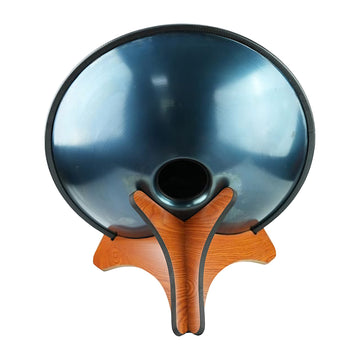
Once you’ve found the right position, orient your handpan correctly. Because the instrument is round, beginners may not immediately know how to position it. Almost all players place the lowest notes as close to their chest as possible. That means the largest tone fields will be just a couple of inches (a few centimetres) from your stomach, while the smaller ones will be farther away. If you’re not sure what a tone field is, read this article, which includes a diagram of the handpan’s structure. You’ll also learn essential vocabulary related to this percussion instrument. Back to positioning: make sure every note is easy to reach so you can play without having to shift your torso.
How Do You Strike or Tap a Hang Drum?
To play clean, beautiful notes on your handpan, the words “strike” or “tap” aren’t really accurate, even if beginners use them a lot. In practice, you want to touch the handpan very gently. More specifically, you should brush it with a quick flick of the wrist and, above all, avoid keeping your finger in contact with the metal for too long, as this will dampen the vibrations of the instrument and its resonance chamber. Typically, your thumbs are used for the two notes closest to you, while your index and middle fingers handle most of the other notes (though some players do things differently). In general, you’ll want to develop a certain level of ambidexterity so you can use your left and right hands equally well.
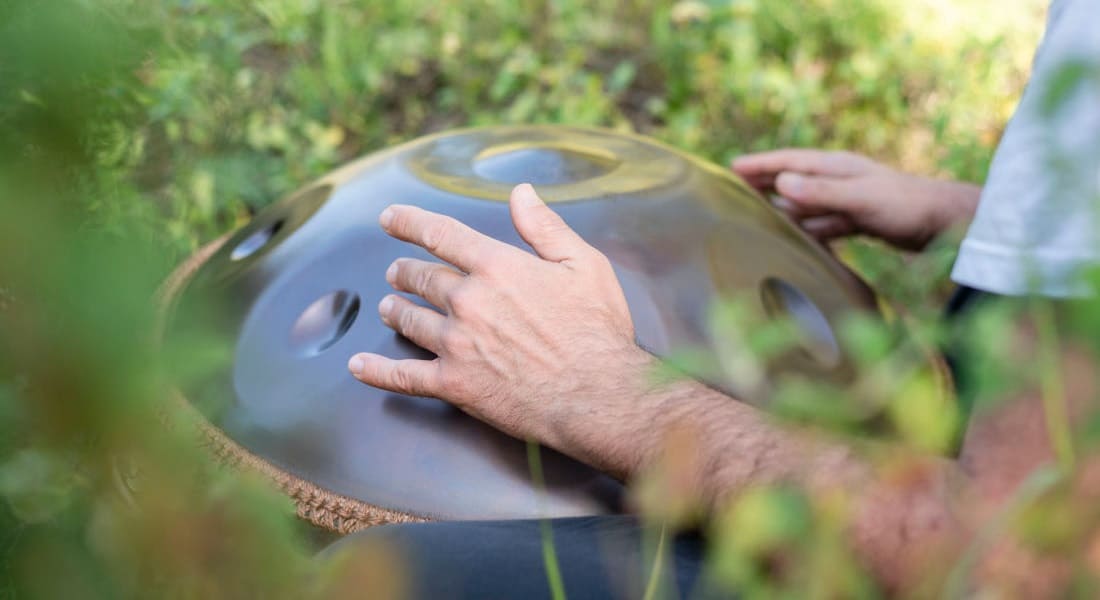
Where you make contact is also crucial. Traditionally, a note is played at the border between the tone field and the dimple—the ridge that runs around one of the handpan’s dimples. The idea is to lightly touch that ridge with the last segment of your finger, whether it’s your thumb, index finger, or middle finger. This is how a note is played. The exception is the ding, which should be played directly. That said, there are many ways to get different sounds from this instrument. For example, you can use the palm of your hand, tap with a closed fist, or bend a finger and hit with the joint between two phalanges. Here are a few, along with their names, which you’ll find in handpan sheet music:
- Ding tonefield : this involves hitting the shoulder, the flat area surrounding the ding.
- Fist : a hit made with the base of a closed fist on the interstitial (untuned) area of the handpan. Use moderate force for this percussive effect so you don’t deform your instrument.
- Knock : a hit made with a knuckle on the interstitial part of the handpan.
- Palm mute : a hit made with the palm of the hand on the ding, producing a very low, muffled sound.
- Slap : a hit with the flat of the fingers on the interstitial part of the handpan.
- Tak : a crisp hit on the edge between the shoulder and the interstitial area of the handpan.
- Finger roll : the finger roll consists of playing the same note or percussive effect very quickly using 2 or 3 fingers, like a drum roll.
What Exercises Are Useful for Practising With Your Handpan?
First, it’s a good idea to practise playing all the notes on your instrument so the motions become as natural as possible. The goal is to repeat those movements hundreds, even thousands, of times until they’re ingrained as an automatic reflex. Your goal should be to play each note with your eyes closed. This way, your brain will naturally connect a certain movement with a certain sound, which is a key first step.
Next, an effective exercise is to play scales up and down. The idea is to play each note from the lowest to the highest for the ascending scale, then from the highest to the lowest for the descending scale. At first, you’ll find this exercise challenging, but the more you practise, the easier this sequence of movements will become, until eventually you won’t even have to think about it. Get a glimpse of the ascending scale in the video below:
Next, start playing chords, meaning lightly brushing multiple notes at the same time to enrich your handpan playing. Depending on your instrument’s tuning, you’ll discover that some combinations sound more pleasing than others. Once you’ve learned a few chords, it’s time to explore some rhythms, either ones you create yourself or ones you borrow from talented players. Focus on learning one rhythm at a time, and only move on to a new one when you feel the first is truly solid.
Finally, consistency is what delivers the best results. Personally, I recommend playing a little every day rather than doing long sessions only once a week or once a month. Even with a busy schedule, try to set aside ten minutes a day rather than two hours once a week. In my experience, this approach yields better results.
Is It Difficult to Play This Percussion Instrument?
The handpan is often described as an instrument designed to be easy to play, even for people with no musical experience and no training in music theory or sight-reading. That’s partly true because each handpan is tuned to a specific scale during manufacturing, so it’s almost impossible to produce a “wrong” or dissonant note. These characteristics make it an excellent first instrument for anyone who wants to discover unique sounds without spending hours deciphering symbols such as quarter notes, half notes, treble clefs, and more.
However, while the first notes may feel easy for a beginner, the reality is a bit more complex. To play the handpan well, you need to invest significant energy and time. For starters, the playing technique isn’t necessarily obvious: you have to use your fingertips for each note, but with a gentle, precise touch. Also, each handpan comes with its own scale, such as D Kurd, Celtic Minor, and Hijaz, to name just a few. That means you need to develop an instinct for which notes “belong together” to get the most musical results. Some experts can do this in seconds, but it takes countless hours of practice to reach that level. So even though the handpan is very accessible, don’t expect to become a master in just a few weeks—it’s simply not realistic.
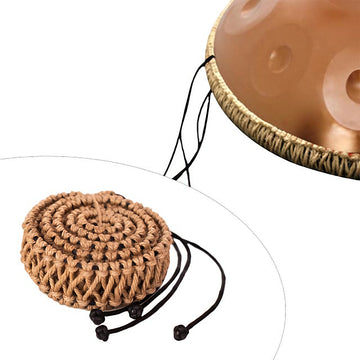 Our pickProtect your handpan from bumps with this beautiful natural-fiber coverSee the handpan cover
How Long Does It Take to Learn to Play the Handpan?
How quickly you learn to play the handpan can vary a lot depending on several factors. It depends on your natural aptitude, as well as any previous experience with other instruments. Also, if you use learning resources like a book or instructional videos, you can speed things up considerably because you’ll be guided step by step in the right direction. You can learn the basics in a few weeks if you practise regularly. On average, about 20 hours of practice is enough to become a decent handpan player. However, to truly master the instrument, you’ll likely need months, or even years, of practice.
Is It Possible to Learn the Hang Drum on Your Own?
Yes, it is entirely possible to learn the handpan on your own. This instrument is known for its intuitive feel, so it doesn’t require a lot of formal theory to get started. Many self-taught players can create melodies simply by exploring the available notes. That’s how most renowned handpan artists began: they discovered the instrument around 2010, when it was still largely unknown and online resources were scarce. So if you don’t have a budget for lessons, this is a perfectly valid option.
However, it’s not the approach I recommend. You can lose precious hours testing combinations and rhythms that don’t sound very harmonious, while hundreds of experienced players have already done that work and can help you progress faster. Having a teacher or joining a workshop will definitely enhance your experience. It will allow you to develop techniques, get personalized feedback, and improve more quickly. Take a look at my article that specifically discusses the different methods for learning the handpan. Whether you're looking for an online video course or an in-person teacher, all of these options are covered. Plus, for around CA$50, you can get genuinely helpful guidance, which is a small price considering the time you’ll save.

Discover Lots of Techniques for Playing Beautiful Melodies on the Handpan
The handpan is an intuitive musical instrument, but that doesn’t mean you can play it well without any technique. You’ll need to develop a clean touch and a solid sense of rhythm to unlock its full artistic potential. Thanks to all the information and advice you’ve discovered throughout this article, you’re now well on your way to becoming a talented handpan player.
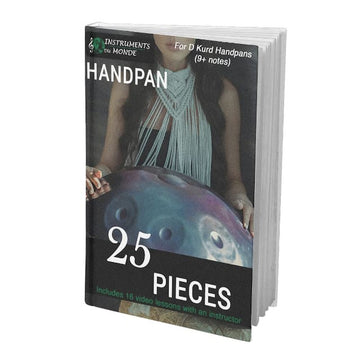
That said, while self-teaching is free, it’s often a long and challenging path, especially if you’ve never seriously learned an instrument before. That’s why I strongly recommend that beginners pick up this handpan book from Instruments du Monde. It includes essential advice, tutorial videos taught by an instructor, and 25 pieces of sheet music so you can start playing beautiful songs on your instrument. In short, you’ll have everything you need to get your handpan journey off to a great start.
Get this book as soon as possible by clicking on the image below:
Once you’re playing comfortably, you may also want to learn how to record and publish your handpan music. There are a few technical and legal rules you need to know—learn them in this comprehensive article.


