



Written by Ambre Montespan on Oct 28, 2024 · Updated on Oct 15, 2026

Table of contents:
Did you just discover a curious musical instrument called the handpan? Want to learn more about it? How does it work? How does the handpan produce such soft, melodic sounds?
I first discovered the handpan more than 10 years ago, and I’ve been digging into how it’s built and how it works ever since. So I’m able to explain, very precisely, what a handpan is and how it works.
The handpan is a metal percussion instrument mainly played with the hands. It relies on Helmholtz resonance and produces rich, harmonious tones when the player strikes specific areas that have been hammered and tuned by the maker.
In this short article, you will learn more about:
- What a handpan really is
- How this percussion instrument works
This will help you recognize this sound object at a glance. Plus, you’ll be able to explain the physical and acoustic principles that give this instrument its unique, mesmerizing tone.
Now, it seems appropriate to define what a handpan, or hang drum, is.

What is a handpan?
A handpan is a percussion instrument with a flying-saucer-like shape. It’s an all-metal instrument in the idiophones family—objects that produce sound through the vibration of the material itself. The origins of the handpan are rich and varied, but it’s often compared to the steelpan, a convex steel drum from Trinidad and Tobago with a very different tone than the handpan.
This instrument first appeared under the name Hang in Switzerland in 2000. It was invented by the company PANArt, founded by Felix Rohner and Sabina Schärer. Since then, hundreds of makers and artisans have started building this type of instrument, now commonly called a handpan, since “Hang” is a protected name owned by PANArt.
The handpan is a relatively intuitive instrument played with the hands, so you don’t need to learn music theory, solfège, or have any formal training to start playing. Many percussionists use it for relaxation and unwinding, while others explore it for meditation or experimental music. You can see how to play the handpan and hear its sound in the video below:
How does this musical instrument work?
To fully grasp how the handpan works, let’s first look at how it’s built and then explore how it produces sound.
What is a Hang drum made of?
The handpan consists of two metal shells, usually made of nitrided steel or stainless steel. The two shells are typically glued or stamped together to create the handpan’s distinctive lenticular shape. Before assembly, a craftsman hammers each shell for dozens—or even hundreds—of hours to create the instrument’s specific form and reliefs. Each relief has a precise name, as shown in the diagram below:
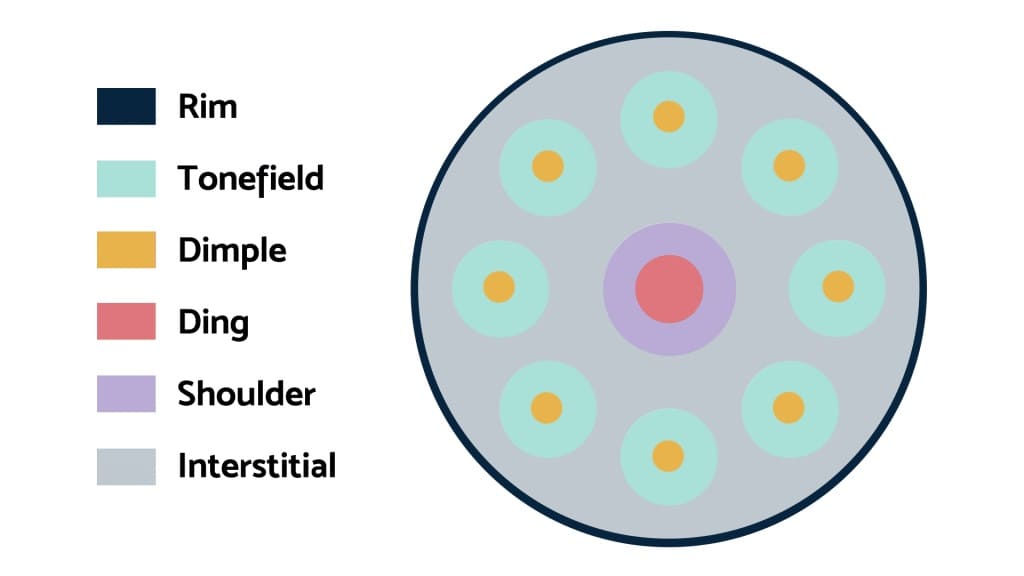
The image above shows the upper shell of a classic handpan. Let’s take a closer look at each part of this musical instrument:
- Ding : the red area represents the ding, which is the central note and usually the lowest note on the handpan. Most of the time, the ding protrudes outward from the instrument, like a dome. This is known as an apex ding. More rarely, it can be oriented inward, a bit like a navel. In this case, it is called an inpex ding. The sound is very similar between an inpex and an apex ding. The main difference is aesthetic, and the choice mostly depends on the maker’s habits.
- Shoulder : the flat area shown in purple around the ding is called the shoulder. This area connects the ding to the interstitial area, which is an untuned part of the handpan.
- Dimple : this is the hollow area, shown in yellow in the image, located at the centre of a note. Dimples are essential because they reduce unwanted frequencies, especially in the high register, when a note is played. This makes the overall tone more harmonious.
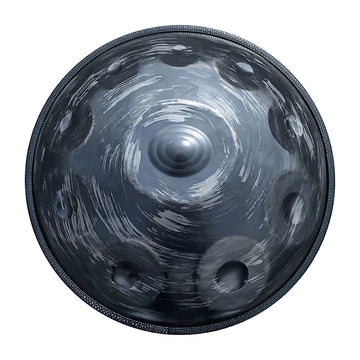
- Tonefield : like the shoulder around the ding, this is the flat area surrounding a dimple. Shown in green in the image, a tonefield can be round or oval. It’s often at the junction of the tonefield and the dimple that the musician strikes with their fingers or hand to play a note, although moving slightly away can create subtle variations in tone.
- Interstitial : this is the grey area that isn’t tuned. Still, players can strike this area to produce a slap or tak to add rhythm. When listening to a handpan piece, if you hear a fairly sharp metallic sound, it’s likely a slap played in this interstitial area, usually between two tonefields.
- Rim : the rim, shown in navy blue, is simply the edge of the instrument where the upper and lower shells meet. It’s sometimes called the flange.
- Note : a note corresponds to the combination of a tonefield and a dimple, or the ding and the shoulder. So, the handpan in the image has 9 different notes.
- Gü : this is the opening on the lower shell (not visible in the image), usually placed symmetrically opposite the ding. The gü has two purposes. First, it allows the sound to escape and develop inside the resonance chamber. Second, it helps the craftsman fine-tune the handpan through this opening, allowing adjustments without separating the two shells.
- Bottom note : this is a note located on the lower shell of the handpan.
How does a handpan produce sound?
The handpan uses the Helmholtz resonator principle, which relies on air resonance in a cavity. A very simple example is blowing across the neck of a partially empty bottle. The sound that’s produced depends on the volume of air in the bottle and its shape. Some musicians can even play full songs this way, like the Bottle Boys with “Despacito”:
With the handpan, there’s no need to blow, although it is possible through the gü. A light strike on the metal is enough to create vibrations. That’s because most handpans have shells between about 1 and 1.2 mm (0.04–0.05 in) thick, which is extremely thin. In other words, even a gentle touch can create the vibrations needed to activate the Helmholtz resonator. Those vibrations then transfer into the surrounding air to create sound, especially inside the handpan itself, which acts as a resonance chamber.
However, you can’t adjust the air volume inside a handpan like you can with a bottle. So, makers instead create notes (tonefield + dimple) in different sizes. The larger the surface area, the lower the sound. Conversely, a smaller note produces a higher-pitched tone. That’s why the notes on any handpan are all different sizes. It’s also why you can’t have dozens of notes on a single handpan—there simply isn’t enough space on the metal shells to fit that many.
Treat yourself to a quality handpan.
When you first discover the handpan, it has a mysterious quality, largely due to its shape and the unusual sounds it produces. While it may raise questions at first, the way this percussion instrument works is actually quite simple. With all the information you’ve found in this article, you now know what a handpan is and how it produces sound.
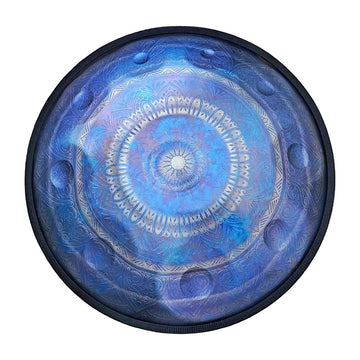
That said, instruments that produce truly beautiful tones are rare. In fact, many handpans on the market are mediocre at best. That’s why I recommend the online store Instruments du Monde, which sells dozens of well-made handpans. You’ll be able to enjoy playing beautiful melodies on a great instrument—like this magnificent 10-note handpan with an Eastern-inspired design.
Discover this beautiful handpan by clicking on the image below:
If you plan to play for an audience or record your performances, you’ll need to amplify your handpan or choose the right microphone. This article covers that topic in depth and offers helpful tips for capturing its acoustic vibrations faithfully, so they come through with clarity for your listeners.


