



Written by Ambre Montespan on Aug 21, 2023 · Updated on Oct 15, 2026

Table of contents:
Have you heard of an unusual musical instrument called a sansula? Want to learn more about this fascinating instrument? Thinking about buying a sansula and wondering whether it’s really worth it?
As a former sansula player for more than 10 years, I’ve done a deep dive on this percussion instrument and can share everything you need to know. I’ll also compare the sansula to its big brother, the kalimba, to help you decide which instrument to choose.
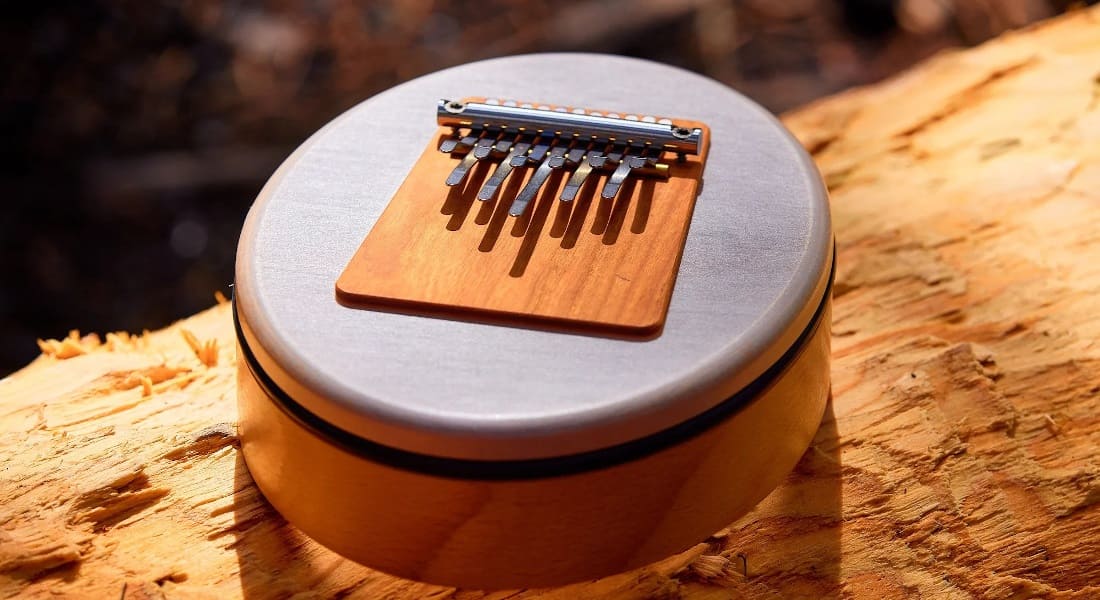
The sansula is a kalimba without a resonator box, combined with a simple oval-shaped frame drum. When you rest the sansula on your lap, you can vary the resonance to create different tones.
In this article, you’ll learn all about:
- The sansula and its origins
- Its advantages and disadvantages compared to a kalimba
You’ll satisfy your curiosity about this lamellophone while figuring out whether a sansula makes sense for your own needs.
Now, let’s dive into the world of the sansula.
What is a sansula?
To understand exactly what a sansula is, we first need to define what a kalimba is, since the sansula is a clever combination of the kalimba and the frame drum.
The kalimba is a percussion instrument belonging to the idiophone family, meaning the sound is produced by the instrument’s own materials. More specifically, it’s usually a solid or hollow block of wood, about 8 × 6 in (20 × 15 cm), fitted with a set of steel tines held in place by a bridge and bar. To play the kalimba, the musician plucks a steel tine and then releases it so it can vibrate freely. As it vibrates, the tine produces a note whose pitch depends mainly on its length: the longer the tine, the lower the note.
Archaeological discoveries suggest that the kalimba originated in Africa. It’s believed to have been invented twice: first in West Africa more than 3,000 years ago, and later in the Zambezi Valley. Today, modern kalimbas have evolved considerably, and you can find them in solid wood, as in the past, as well as acrylic or plastic. Below, you can watch a video presentation of a very classic kalimba:
Back to the sansula: it’s simply a kalimba without a resonator box, with its soundboard surrounded by a skin (membrane), which is then mounted onto a wooden frame. It’s as if a kalimba were embedded right into the center of a frame drum’s head. That’s where the fusion of these two percussion instruments comes from. Compared to a frame drum, which is usually round, the sansula is more oval, so the player can still reach the metal tines with their thumbs. The sansula is played the same way as a kalimba, except the musician can choose whether or not to press the frame against their thighs while seated. This lets the sound open up and gives the player a chance to create a sound effect known as wah-wah.
Who invented this percussion instrument?
It turns out that the sansula was invented fairly recently, in 2001, by Peter Hokema. Hokema is a German musician and musical instrument maker. At the time, his company mainly produced kalimbas. One day, while testing a new kalimba model, he played it after setting it down flat on a drum without really thinking about it. When he heard the resulting tones, he realized pairing these two instruments could create something new. He decided to call the new instrument the Sansula, blending the word “sanza,” a synonym for kalimba, with “ula,” meaning “small.” Since then, the Hokema brand has been selling sansulas, and this musical instrument has enjoyed considerable success. Below is a video of Peter Hokema presenting the acoustic potential of the sansula for the first time:
Is it worth buying a sansula instead of a kalimba?
Since the kalimba and the sansula are very similar in terms of sound, it’s natural for some musicians to hesitate when choosing their next percussion instrument. Personally, I’m convinced there’s no debate because the advantages overwhelmingly favor the kalimba.
First, consider the price. A mid-range 17-key kalimba will cost around $60. On the other hand, a 9-key sansula of similar quality is priced at $120. For the luxury model, you’ll have to pay more than $250. This big price gap comes from the fact that making a sansula is far more complex than making a kalimba, especially because of the work required to mount the kalimba into the drum head.
The number of tines also favors the kalimba because sansulas generally have 9 tines, which is very limiting if you want to play melodies. It’s important to understand that you can only play 9 notes and not a single one more. So most of the time, sansula players rely on instinct rather than arranging more complex pieces. A kalimba usually has 17 tines, and you can easily find models in a chromatic layout with 34 tines. As a result, along with playing freely by ear, you also keep the option of playing well-known sheet music, which is always a pleasure.
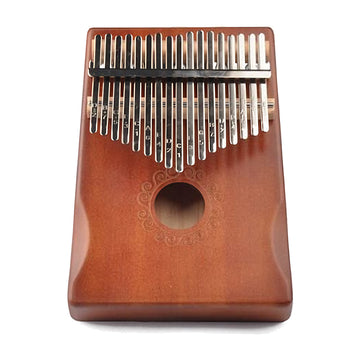
Another point to consider is bulk. The whole point of a kalimba is that it’s compact and portable. Adding a frame drum around the kalimba inevitably increases its overall size. As a result, the sansula is much less portable than its big brother, the kalimba.
Finally, the kalimba also wins points for durability and animal welfare. It’s worth noting that the skin used for the sansula’s frame drum is usually of animal origin—most often goat or sheep, similar to a djembe. If you care about animal welfare, you may prefer a kalimba crafted solely from solid wood and metal. But above all, adding a skin head makes the sansula much more fragile than the kalimba. That’s how I lost my last sansula: the skin cracked during transport, and it’s simply impossible to repair by hand. In addition, the skin requires special care to maintain good elasticity. You won’t have this kind of issue with a kalimba.
Does that mean the sansula has only disadvantages? In reality, the only advantage, in my opinion, is its ability to produce wah-wah effects, as Peter Hokema demonstrates in the video shown a few paragraphs earlier. The problem is that while kalimbas with resonator boxes were quite rare in 2001, when the sansula was invented, that’s no longer true today. So you can also create wah-wah effects on a kalimba without much difficulty. Just play a note and place your thumb in front of the center hole, as shown in the video below:
In fact, some musicians use it beautifully in their songs, like YouTuber April Yang in several of her performances. Watch how, in this one, she uses her thumb to create that wah-wah effect:
So yes, the sansula will create a more pronounced effect than a kalimba, mainly thanks to its larger overall size. But does that make up for all the drawbacks mentioned above? Absolutely not. As a result, the kalimba remains the sensible choice for me.
Relax with music thanks to a thumb piano
Among the many exotic musical instruments out there, the sansula is one of the lesser-known ones. So it’s perfectly normal to want to learn about the origins and benefits of this one-of-a-kind instrument. Now that you’ve read this article, you know everything you need to know about the sansula.
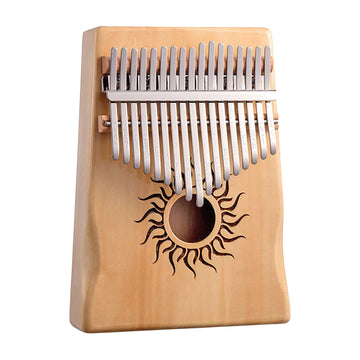
However, as we’ve seen together, the sansula isn’t really the best choice when compared to its big brother, the kalimba with a resonator box. When it comes to portability, upkeep, durability, and what you can actually play, the kalimba comes out on top across the board. So treat yourself to a kalimba from a trusted retailer like Instruments du Monde, which offers more than 250 models in its catalog. For example, this wonderful diatonic model will let you play an endless number of melodies.
Discover this kalimba now by clicking on the image below:
Did you know that a musical instrument looks like a flying saucer or a turtle shell? This fascinating, all-metal instrument produces otherworldly tones. Discover it now to expand your knowledge of exotic instruments.


