



Written by Ambre Montespan on Mar 14, 2023 · Updated on Oct 15, 2026

Table of contents:
Have you discovered a world music instrument that vaguely resembles a small piano, played with the thumbs to produce soft, soothing tones? Have you heard it’s called a kalimba? But what is a kalimba? Where exactly does this unusual percussion instrument come from?
I’ve been playing the kalimba for over 10 years and have taken a deep interest in its origins, so I can answer all your questions on the subject.
The kalimba is a musical instrument invented by Hugh Tracey in the 1950s, based on the mbira, another traditional African instrument dating back 3,000 years. It’s a small piano with steel tines that the player plucks with their thumbs to produce sound.
After reading this article in its entirety, you will know everything about:
- The origin of this musical instrument
- The exact composition of the kalimba and the type of sounds it produces
- What the thumb piano is used for
You’ll know exactly what a kalimba is and will spot one right away if you ever come across one in the future.
Let’s take a look at the answers to all the questions you might have about the kalimba.
Where does this musical instrument come from?
First, we should mention the mbira, a traditional African musical instrument that served as the basis for the creation of the kalimba, before talking about the latter.
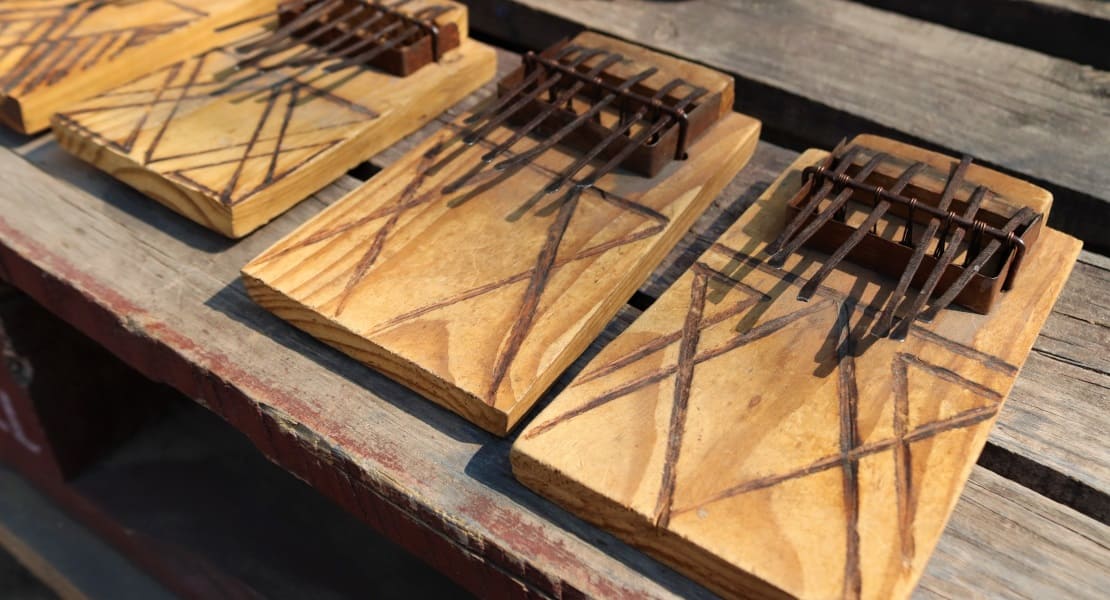
The mbira, the kalimba's distant cousin
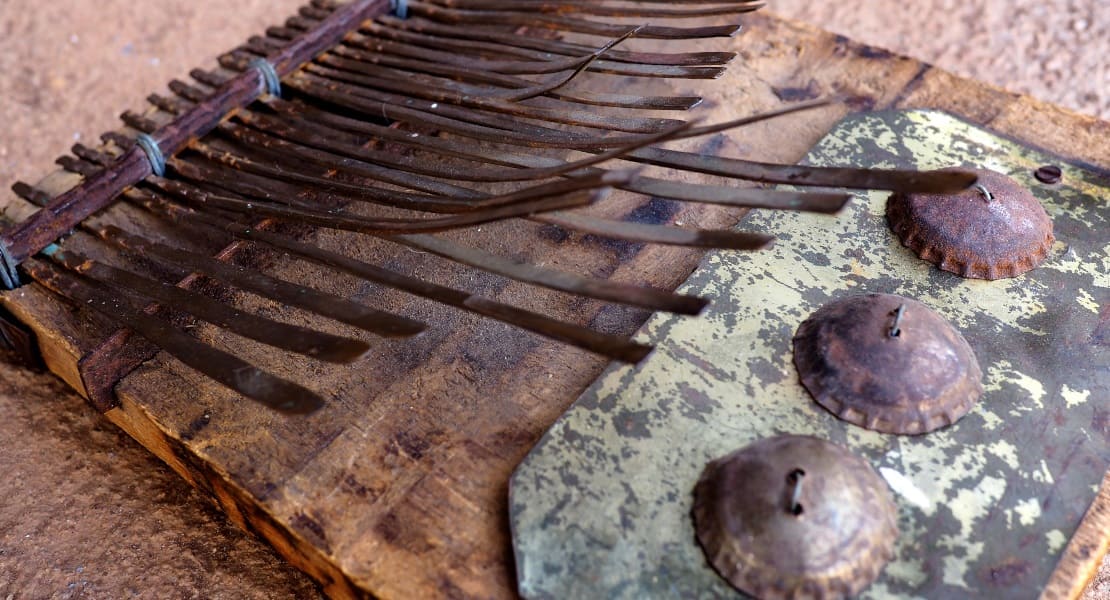
The mbira is a musical instrument that originated in sub-Saharan Africa, more specifically on the west coast, around 3,000 years ago according to the latest archaeological sources. It is a percussion instrument consisting of a rectangular wooden board measuring about 8 × 6 × 0.8 in (20 × 15 × 2 cm), on which steel tines about 4 in (10 cm) long are placed. The number of tines can vary greatly. You can find mbiras with just a few keys, while larger models can easily have around thirty. These tines can be arranged in a single row or in several rows, sometimes overlapping. Finally, metal capsules can be positioned on the mbira's support and serve as a resonator.
To play, the musician presses down on the keys to apply pressure, then releases them, causing the metal tine to vibrate and produce a sound. Each tine corresponds to a single musical note, much like a classical piano—a design that earned the mbira the nickname “thumb piano” or “finger piano” among European colonists.
But let's now explore the link between the mbira and the kalimba.
The birth of the kalimba
In the 1950s, British ethnomusicologist Hugh Tracey proposed a Westernized version of the mbira that he discovered while traveling in what was then Southern Rhodesia, now Zimbabwe. He named this version the kalimba.
The kalimba consists of 15 keys, each corresponding to a note standardized by Western music (the familiar C, D, E, F, G, A, and B). The keys sit in a single row and are secured by a system of two bridges and a pressure bar. The former simple wooden board of the mbira was replaced by a hollow wooden block with a front hole, creating a sound box that lets the player craft effects like wah-wah. Two other holes are sometimes placed on the back of the instrument to allow players to produce a vibrato effect. Finally, Hugh Tracey thought of adding stickers to certain tines to make memorization easier and serve as visual cues for the musician.
Today, the kalimba has evolved considerably, and its manufacture has become much more widespread in the West. Based on Hugh Tracey’s model as a reference, the vast majority of kalimbas now feature 17 keys. However, you can also find kalimbas with far fewer (5, 7, or 10 tines) or far more, such as chromatic models with several dozen metal tines. The tines are no longer necessarily arranged in a single row, with some manufacturers offering two or even three rows of tines.
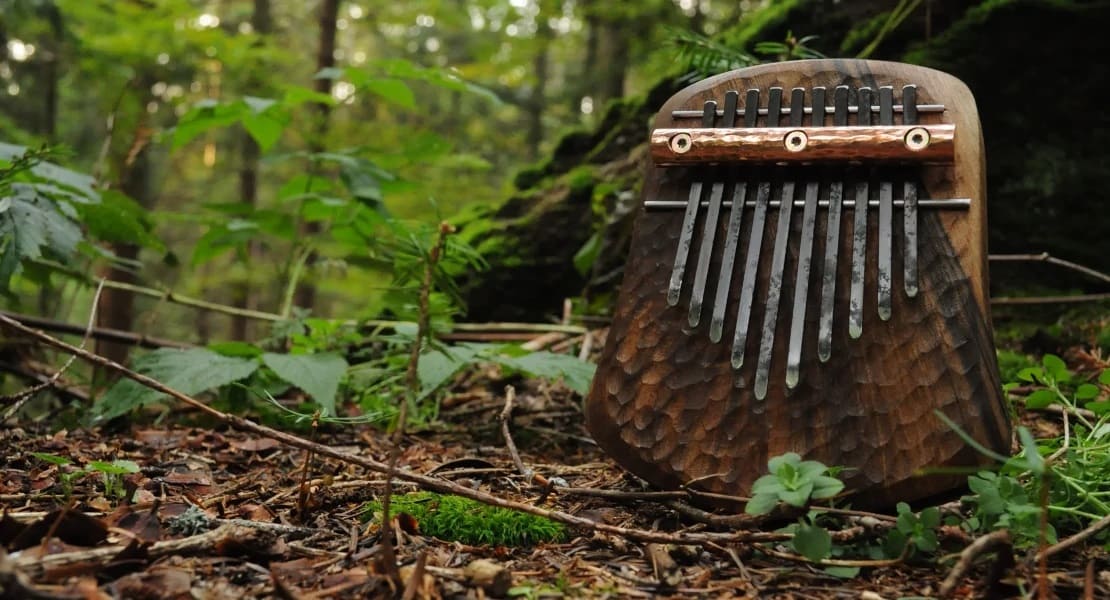
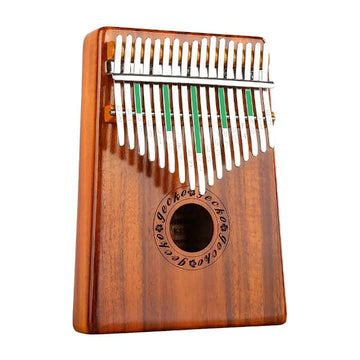
Here you can see the difference between a mbira, on the left, and a kalimba, on the right:
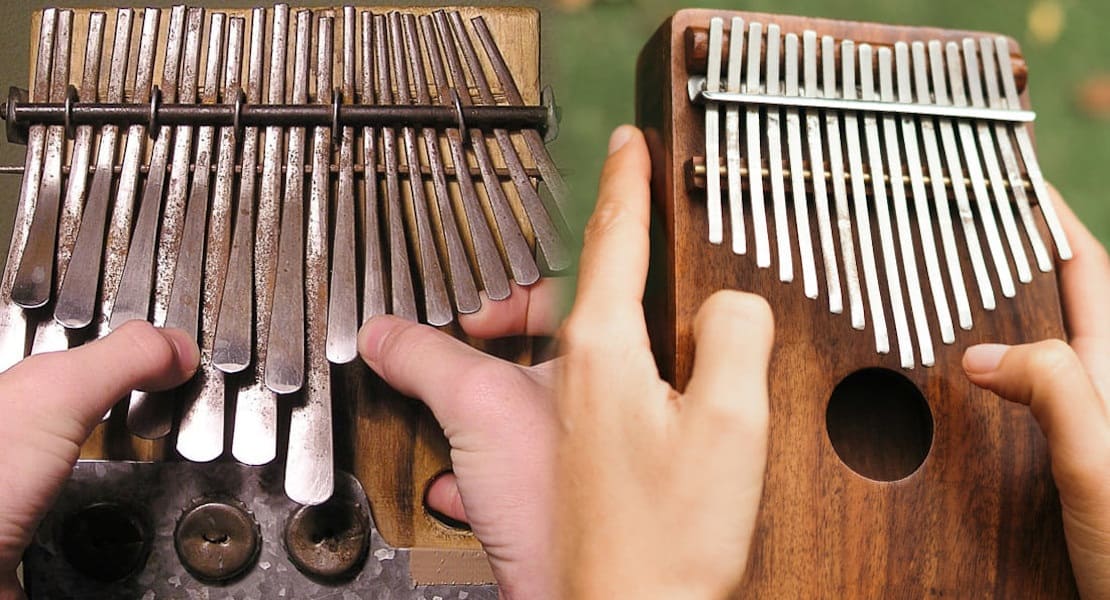
You may also have heard of the sansula or sanza alongside the kalimba and mbira; these are other names often used for thumb pianos. To explore the subtle nuances between these African instruments, be sure to read our other article. Although most people who use these terms do not distinguish between them, there are some slight nuances.
What is a kalimba made of?
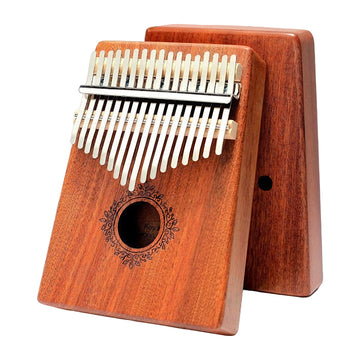
You’ll see that the kalimba is a simple musical instrument. It consists of a soundboard, bridges, a pressure bar, and metal tines. Take a look at the photo below to get a better idea.
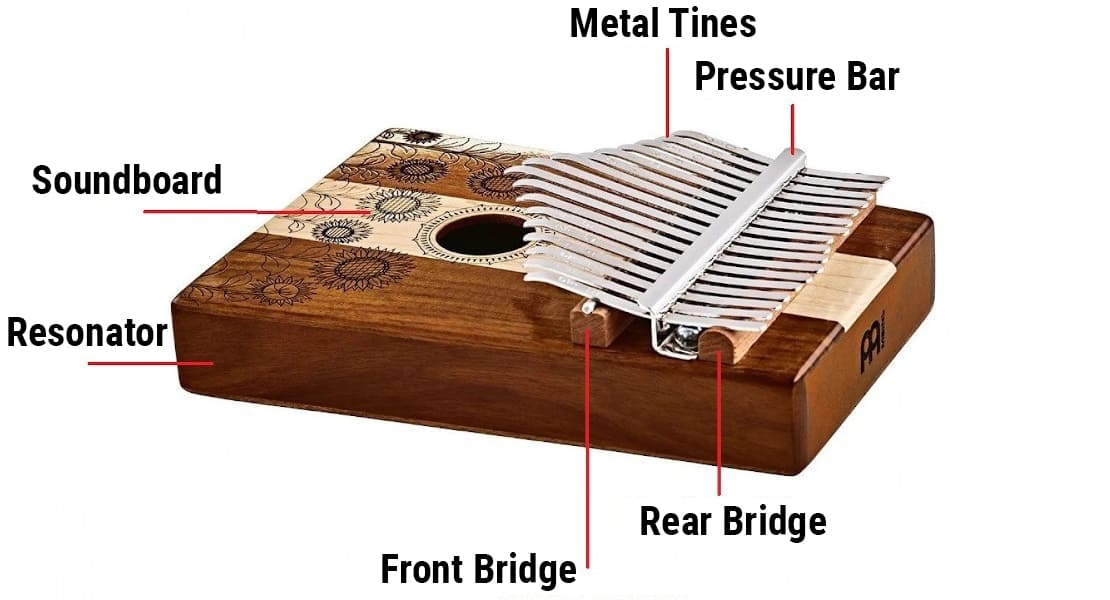
The soundboard of the kalimba
The soundboard, also known as the support or body of the instrument, is mainly used to attach the tines and propagate their vibrations. It is traditionally made of wood, but you can now also find it crafted from acrylic glass, a highly durable, crystal-clear plastic material that adds undeniable charm to the kalimba.
In the model shown in the photograph above, the thumb piano has a resonator. This means that the soundboard is hollow, a bit like a wooden box, and a hole has been drilled in the front. The body thus acts as a sound box, allowing the kalimba to produce louder sounds. This design is often called “hollow.”
Some manufacturers still produce models without a sound box, consisting simply of a solid wooden board. These kalimbas are often referred to as “flat” or block kalimbas. The advantages and disadvantages of kalimbas with and without soundboards are discussed in this guide, helping you choose the right kalimba if you’re ready to buy.
The front and rear bridges of the thumb piano
The bridges are securely attached to the soundboard. Their purpose is to support the steel tines. The tines rest on the bridges, which connect them to the soundboard to transmit vibrations.
You’ll notice a horizontal metal bar between the wood and the tines on the front bridge—another detail engineered to improve sound projection. In most cases, the bridges are crafted from the same wood as the soundboard.
The mbira pressure bar
The pressure bar sits between the two bridges, aptly named because it presses the tines firmly against the soundboard. This downward pressure causes the steel to curve slightly between the bridges.
By applying pressure at this point, the tines are held securely in place and cannot detach from the instrument. In addition, the pressure bar is essential because the tension generated on the tines allows sound to be produced when the musician plucks the keys.

The steel tines of the finger piano
The steel tines are slightly curved at one end so that the player doesn’t hurt their thumbs after long hours of playing. Some kalimba models also feature a unique engraving on each key to indicate the musical note it is supposed to produce.
The tines are a central element of the kalimba because you will need to change their position to tune the instrument. Using a small tool called a tuning hammer, you can slide the tines either down or up to change the sound produced when you pluck the key, so it’s important to find the right position for each tine to produce the intended note.
What family of instruments does the kalimba belong to, and how is it classified?
The kalimba is classified as a percussion instrument, more specifically as an idiophone. This means the sounds are produced solely by the materials of which the instrument is made when it is played. As the kalimba also has steel tines, it also belongs to the subfamily of lamellophones.
How loud is a kalimba?
The volume of a kalimba depends on whether or not it has a sound box, but overall, it is generally accepted that this instrument produces between 75 and 90 decibels—slightly louder than a normal conversation between two people.
Is the kalimba popular today?
Although the kalimba is still a fairly exotic and little-known musical instrument, it is becoming more widespread and increasingly present in the homes of families who appreciate its simplicity.
What kind of sounds does a thumb piano produce?
When people discover the kalimba, they tend to say that the sounds it produces are soft and melodious, sometimes reminiscent of childhood. The best thing is to form your own opinion by listening to a short melody played on this instrument in the video below.
What is a kalimba used for?
In addition to providing enjoyment as a musical instrument, the kalimba is now used professionally by certain artists. This is particularly the case for Maurice White of the group "Earth, Wind and Fire," David Bowie, and the famous April Yang. The kalimba is also used in music therapy, which is the use of instruments and music in a healing process. Being very simple and easy to play, the kalimba fits perfectly into this practice, as it improves coordination and exercises the player's memory when trying to reproduce a melody.
The traditional mbira was used particularly by the Shona people of Africa for festive events such as weddings, but also during official ceremonies or to communicate with spirits or the dead. It is therefore an instrument with a rich cultural heritage, whose manufacturing methods and playing techniques were inscribed by UNESCO in 2020 on its list of Intangible Cultural Heritage.
What do you call a kalimba player?
There’s no official term in French dictionaries for this yet. By analogy with “guitarist” for guitar or “pianist” for piano, a kalimba player is usually called a “kalimbist” until the Académie Française formalizes an entry.
Escape to Africa with the help of a musical instrument!
And there you have it—now you know exactly what a kalimba is. It’s true that this musical instrument is still quite exotic compared to the more traditional violin, piano, or guitar. But thanks to its small size, ease of learning, and soft tones, the kalimba is becoming more popular in Europe. One thing is certain: if you come across one soon, you’ll know exactly what it is and its history.
If you’ve fallen in love with its sound and want to buy one, Instruments du Monde offers over 200 kalimbas—so you’re sure to find the perfect match. Whether you want one with or without a sound box, made of wood or acrylic, with 17 keys or in the shape of a cute animal, choose this specialist company to buy your kalimba!
Explore a wide collection of kalimbas by clicking on the image below:
The kalimba now holds no secrets for you, except perhaps how it works. Learn this right away by watching our guide on how the thumb piano works. Then you'll know how this little instrument produces such enchanting sounds. To understand everything about the kalimba, take a look at this other article.


