



Written by Ambre Montespan on Sep 7, 2026 · Updated on Oct 15, 2026

Table of contents:
Have you come across handpan videos online that mention 369, 396, 417, 444, 528, 639, 777, 888, 999, or even 1111 Hz? Are you wondering whether the instrument itself is tuned that way or whether it’s a playing technique? Do these frequencies truly offer anything to the listener?
I’ve been playing the handpan for over 10 years now and have had the chance to try many different scales. Melodies that claim to be tied to a specific frequency are actually a fairly recent phenomenon. I’ve also done a lot of research on the subject, which I’ll share with you in this article.
Unlike 440 and 432 hertz, which truly correspond to handpan tuning based on a reference pitch, the other frequencies mentioned, such as 528 or 999 Hz, are values drawn from sacred Solfeggio or angel numbers, without the handpan necessarily playing that exact frequency at any single moment.
As you read this article, you’ll quickly learn:
- What theory underlies the frequencies mentioned in the videos you’ve watched
- The benefits attributed to 369, 396, 417, 444, 528, 639, 777, 888, 999, and 1111 Hz
This way, you’ll fully understand handpan frequencies and what they mean. You’ll also know whether it’s possible to buy a handpan like this or perhaps play melodies at these frequencies.
Let’s take a look right now at what these ten numbers are hiding and how they relate to this percussion instrument.
What do hertz numbers mean on a handpan?
A number in hertz, which corresponds to a frequency, can have three meanings on a handpan. It may be a sacred Solfeggio frequency, an angel number, which does not really have anything to do with music, or the instrument’s tuning frequency, which has a perfectly logical and practical explanation. It’s worth looking at these meanings one after the other.
396, 417, 528, and 639 hertz: the sacred Solfeggio frequencies related to the handpan
Sacred Solfeggio is a theory rooted in the Bible. In 1970, a naturopath named Joseph Puleo developed a theory based on the Book of Numbers, the fourth book of the Bible, by applying a numerological reduction, which consists of adding the digits of a number until only one remains. He drew in particular on verses 12 through 83 of chapter 7 of this ancient text. Based on these calculations, Joseph Puleo obtained six numbers that he considered sacred frequencies: 396, 417, 528, 639, 741, and 852.
To understand the numerical mechanism on which Joseph Puleo based his analysis, here it is:
- 396 → 3+9+6 = 18 → 1+8 = 9
- 417 → 12 → 3
- 528 → 15 → 6
- 639 → 18 → 9
- 741 → 12 → 3
- 852 → 15 → 6
It turns out that the numerical reduction always gives 3, 6, or 9, which corresponds to the three digits of the first sacred Solfeggio number, 396 Hz. It’s also worth noting that to move from one number to the next, he always adds 111, which also corresponds to an angel number in numerology. So, to go from 396 to 417, you simply add 111, and so on. Although this theory remained fairly discreet when it first appeared, Leonard Horowitz popularized it in a book published in 1999 called Healing Codes for the Biological Apocalypse.
But what, then, is the connection with the handpan? Almost none. No handpan is tuned to any of these frequencies, and no musical note lands precisely on one of them. Some come relatively close, such as the C in the 4th octave, which has a pitch of 523 hertz, but not 528. So why do some videos mention this kind of frequency in their title or description? This is the case, for example, with Malte Marten, a great handpan player who often uses a frequency to identify one of his performances, as in this one:
The answer is simple and can be found directly on the artist’s official website, where he is completely transparent: it allows him to reach an audience that would never have discovered him without that mention. In fact, Malte Marten specifies that all the handpans he plays are tuned to 440 Hz, and that the “healing frequencies” in his music do not come from the instrument itself: they are added in post-production. And that is entirely true, because out of curiosity I analyzed the audio spectrum of the handpan in the video above, and the C I mentioned earlier, which is normally at a pitch of 523 hertz, is actually at 528 hertz in this video. In reality, all the other notes have also been slightly raised in pitch to keep the music harmonious and coherent.
In addition, Malte Marten fully acknowledges that he does not rely on science and writes that he has never explored the subject in depth. He does not even claim to feel the effect. He says he personally does not experience any marked physical effect from these frequencies, but he observes that they move many people and that the feedback is positive. So you will never find a handpan for sale that is tuned to one of the sacred Solfeggio frequencies. If you do, it is certainly a scam. What you will find are simply videos that have been modified in post-production so that one of the ten or so notes played on the instrument lines up with one of these frequencies.
As for the benefits, each frequency claims a particular virtue. Here they are:
- 396 Hz: releasing fear, guilt, and shame
- 417 Hz: undoing blockages, triggering change
- 528 Hz: “DNA repair,” love, transformation
- 639 Hz: harmonizing relationships and communication
- 741 Hz: detoxifying, freeing self-expression
- 852 Hz: awakening intuition, returning to spiritual order
These attributions do not come from any tradition. They were formulated in a single book, Leonard Horowitz’s 1999 work, and every other source that discusses them has relied on that book ever since. It should also be noted that listening to these frequencies cannot replace medical treatment if you need it. I prefer to make that clear because the phrase “DNA repair” could be misleading. The links between these frequencies and the benefits they are said to provide have never been validated by any scientific study.
369, 444, 777, 888, 999, and 1111 hertz: the angel numbers connected to this percussion instrument
You may sometimes see repeating numbers like 777 Hz or 1111 Hz in the titles of certain videos related to the handpan. The duo Chantress Seba, for example, features such numbers in the names of several tracks. Unlike sacred Solfeggio, which has a relationship with music, these numbers have absolutely none. They come from a belief in numerology, a pseudoscience based on attributing properties to numbers.
The term “angel number” comes from Doreen Virtue, a very famous American New Age author, who discussed it in her books from the early 2000s, Healing with the Angels, and then Angel Numbers in 2005. She recounts sitting in a meditative position with paper and a pen, then going through a list of numbers while asking the angels for the meaning of each one. And that is how the meanings of numbers such as 777 or 1111 were supposedly revealed to her. It should also be noted that today Doreen Virtue refutes her own theory and has publicly asked people to stop reading her books. She changed her mind in 2015 after listening to one of Pastor Alistair Begg’s sermons titled “Itching Ears,” on the passage from 2 Timothy 4 where Paul announces that people will seek out false teachers to have their ears tickled. Doreen Virtue recognized herself completely in this sermon, which led her to ask people to stop reading her works, but it seems her appeal has not been heeded since this theory still circulates widely in numerology.
So, the same question still arises: What is the connection with the handpan? Once again, none. Angel numbers do not land on frequencies that correspond to musical notes, even if some come close, just like sacred Solfeggio. And no manufacturer tunes a handpan to 888 hertz or 1111 hertz. The answer is similar to the one I gave you for sacred Solfeggio: it is mainly about reaching an audience that might not have been interested in the handpan at first glance.
As for the supposed benefits of these numbers or frequencies, here they are. Of course, you are free to believe in them or not:
- 000: reminder of unity with God, feeling the presence of the Creator
- 111: new beginning, thoughts materialize
- 222: balance, partnership, keeping the faith, things falling into place
- 333: creativity, communication, support from the ascended masters
- 444: stability, foundations, protection, the angels surround you
- 555: a major change is coming, transition, freedom
- 666: rebalancing, too much material focus, refocusing on your values
- 777: you are on the right path, expect more miracles
- 888: a phase is ending, the fruit is ripe, do not delay in harvesting it
- 999: completion of a major cycle, get to work without procrastinating
- 1111: manifestation portal, moment of alignment
If you’ve been following along, you’ve noticed that I haven’t yet talked about the number 369, even though it is sometimes associated with angel numbers. In reality, this number was never mentioned by Doreen Virtue. It actually comes from a quote attributed to Nikola Tesla: “If you knew the magnificence of 3, 6, and 9, you would have the key to the universe.” This quote appeared online around 2010, has been repeated ever since, and its exact source remains impossible to find. Nikola Tesla, meanwhile, was a renowned physicist who mainly spoke about electricity and electromagnetic radiation, not sound. So the link between music and Tesla appears very tenuous.
440 and 432 hertz: the two real tuning standards for the Hang drum
Contrary to everything you may have read above, handpans, or Hang drums, tuned to 440 or 432 hertz do indeed exist. To tune a musical instrument, you need to start from a reference pitch, meaning the point from which all the other notes will depend according to mathematical calculations. For the vast majority of today’s musical instruments, that reference is 440 hertz. However, some people believe that tuning to 432 hertz is a more natural frequency and has benefits. That is why handpans tuned to 432 exist and have been created. I explain all of this in more detail in my article comparing 440- and 432-hertz handpans.
And that is exactly why there is so much confusion in the minds of many handpan enthusiasts. On one hand, they see that 440- and 432-hertz handpans exist. On the other, they come across handpan videos labeled 1111 Hz or 528 Hz. As a result, I regularly hear from people who want to buy a 528-hertz handpan, even though such a thing simply does not exist.
Treat yourself to a handpan tuned to 432 hertz
As you’ve seen, the frequency indicated for a handpan can mean many things. Between genuine tuning and supposed benefits linked to sacred Solfeggio or angel numbers, it can sometimes be difficult to see clearly. But thanks to the information in this article, you can truly understand what lies behind the number being shown to you.
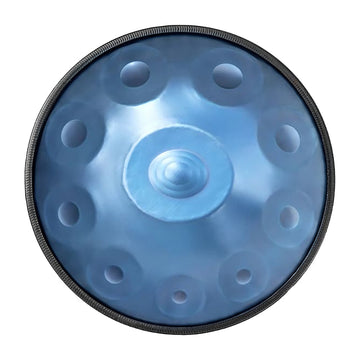
However, as this article clearly explains, aside from models tuned to 440 or 432 hertz, there are no handpans tuned to sacred Solfeggio frequencies or based on angel numbers. But if you are looking for a frequency connected to nature and believed to have benefits, I recommend the 432-hertz handpan from the Instruments du Monde store. This instrument, with its magnificent bluish color, has 10 notes tuned to a D Kurd scale, which is ideal for beginning this wonderful sonic adventure.
Discover this fabulous handpan now by clicking on the image below:
Handpan frequencies now hold no more secrets for you. But have you ever wondered how to carry this percussion instrument on long journeys? I tackle that thorny question in my article focused on what it takes to travel properly with a handpan, whether by plane or in your own vehicle.


