



Written by Ambre Montespan on Aug 19, 2024 · Updated on Oct 15, 2026

Table of contents:
Have you heard of the handpan and the Hang drum? Did you get the impression these two terms refer to the same metal percussion instrument? Are there really any differences between the handpan and the Hang drum?
As someone who’s been passionate about this UFO-shaped instrument for over 10 years, I’ve had both a handpan and a Hang in my hands many times. So I can easily walk you through the history behind these two terms and help you tell them apart.
Both “handpan” and “Hang drum” refer to a round metal instrument played with the hands. “Handpan” is used for generic instruments, while Hang drum—or simply Hang—is a registered trademark owned by the Swiss company PANArt Hangbau AG.
After reading this article in its entirety, you will learn:
- The differences between handpan and Hang drum
- The legal context behind this distinction
- Other names for the handpan
As a result, you’ll always be able to differentiate between a handpan and a Hang drum, allowing you to use the right terminology for the instrument in front of you.
Let’s dive right in and look at what separates these two instruments.
What are the differences between a handpan and a Hang drum?
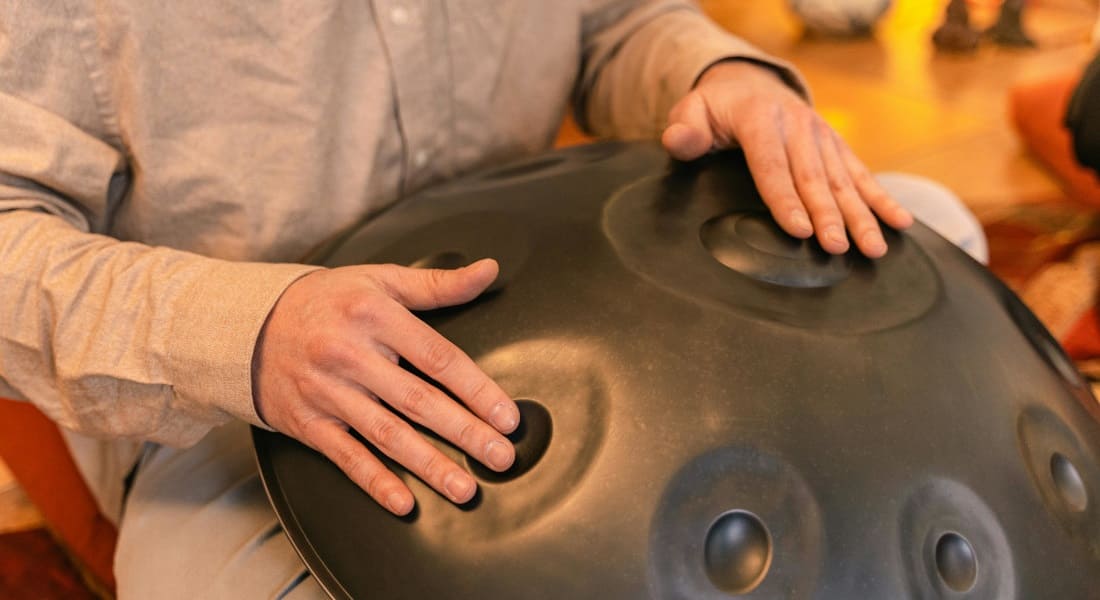
In practice, many musicians who are drawn to the handpan but haven’t really looked into its origins tend to use “handpan” and “Hang drum” interchangeably. That confusion is understandable since “handpan” became the name used by most makers who, more or less, replicated the original Hang. To understand what truly sets them apart, we’ll first cover the legal background and then the physical differences.
What are the legal issues surrounding these two similar instruments?
To understand why the Hang and the handpan can look very similar without necessarily being the exact same instrument, we need to go back a bit. In 2000, Felix Rohner and Sabina Schärer of PANArt Hangbau AG developed a new instrument in Switzerland and simply named it Hang. It became such a success that even its creators were surprised. As demand kept growing, Felix Rohner and Sabina Schärer made buying a Hang conditional on submitting a letter explaining your motivation and traveling to Switzerland. Producing only about 400 Hang instruments per year on average, and with purchasing conditions that were fairly restrictive, various luthiers and musical instrument manufacturers ended up copying the Hang concept to sell it to a wider audience, since no patent had been filed at the time.
Faced with many copies being made in Switzerland and abroad, PANArt Hangbau AG registered the trademark “Hang” internationally in 2008, protecting the name of its instrument. Other manufacturers then had to use a different term to sell their instruments, and “handpan” emerged, eventually becoming even more popular than “Hang drum.” The situation stayed more or less the same until early 2020, when PANArt Hangbau AG decided to take legal action against all manufacturers and sellers of handpans for copying and counterfeiting its Hang. According to PANArt Hangbau AG, the lens shape, the central dome (ding), and the hole underneath (gu) are all integral parts of its intellectual property.
As a Swiss company operating primarily in German, PANArt first focused on the German-speaking market for sending cease-and-desist letters. As a result, two German handpan sellers and makers had to shut down, and several other professionals in Switzerland also received similar notices. PANArt’s broader goal is to obtain a court decision that sets a global precedent and, in turn, forces all handpan makers and sellers to close. Faced with this threat to the instrument’s future, the nonprofit organization Handpan Community United (HCU) formed spontaneously in September 2020. Its goal is to raise funds through crowdfunding to hire intellectual property attorneys and fight PANArt Hangbau AG in court.

At the time of writing, more than €200,000 has been raised. As things stand, a July 2024 ruling by the Bern court established that copyright does indeed exist for the Hang. The question was worth raising because musical instruments are usually not protected by copyright. However, PANArt Hangbau AG argued that the Hang is not an instrument but a sound sculpture, which is also why Felix Rohner and Sabina Schärer don’t call it a “Hang drum,” but simply Hang. The Hang was therefore treated as a work of art and granted corresponding copyright protection. The key question now before the Swiss courts is how far that copyright extends and how it applies in practice. Members of Handpan Community United hope that handpans that don’t closely resemble the Hang’s shape will be allowed to remain, which would preserve both makers and sellers. For now, that question is still unresolved.
As a result, while the Hang and the handpan used to be relatively similar, it appears the handpan will be compelled to differentiate itself as much as possible from the Hang to respect PANArt Hangbau AG’s intellectual property. That shift is increasingly visible in the instruments manufacturers have been releasing in recent years. Within the percussion community, the question of whether the handpan and the Hang are truly the same instrument still isn’t fully settled. Some consider them one and the same, while others believe they’ve diverged into two distinct instruments.
What are the physical differences between the Hang and the handpan?
As we’ve just discussed, the handpan is legally pressured to move away from the Hang in order to keep existing. So while the Hang has its famous lens shape, some handpans feature a flatter profile or a more rounded body. Other manufacturers make the tone fields (the oval playing surfaces) much more pronounced. Take a look at what an original Hang looks like:
And compare it to a handpan from another manufacturer:
While still fairly subtle, these differences are visible to the naked eye. It’s a safe bet they’ll become even more pronounced once the legal battle between PANArt Hangbau AG and Handpan Community United is resolved. One last difference worth noting: the Hang is made from Pang, a special steel whose name has been trademarked by PANArt Hangbau AG. Other makers build their instruments from nitrided steel (a treatment that’s fairly close to Pang), stainless steel, and more recently, Ember Steel.
Does the handpan go by other names such as pantam or Spacedrum?
Many manufacturers give their handpan lines a specific name to stand out from the competition. So a Spacedrum is still a handpan, just made by Metal Sounds. The Yataopan is also a handpan, but from the Yatao brand. There are plenty of these names, and in my opinion, it’s mostly a marketing angle with limited real importance. On the other hand, the term pantam is said to have been coined in Israel in 2004 by Ziv Yehezkel, one of the first distributors of PANArt Hangbau AG. It combines Pan (steelpan) and Tam (ghatam), the two main instruments that inspired Felix Rohner and Sabina Schärer when they created the Hang. More rarely, you may also hear “hangpan,” a blend of handpan and Hang, but in my view, it no longer really has a place today for the legal reasons mentioned above.
Enjoy the rich, resonant tones of this superb musical instrument
People who haven’t dug into the topic often make no distinction between a handpan and a Hang drum, assuming the two names refer to the exact same instrument. While that may have been true a few years ago, these two terms are clearly starting to move in different directions. Thanks to this article, you now understand the difference between a Hang drum and a handpan and the path these two instruments may take as a result of PANArt Hangbau AG’s legal actions.
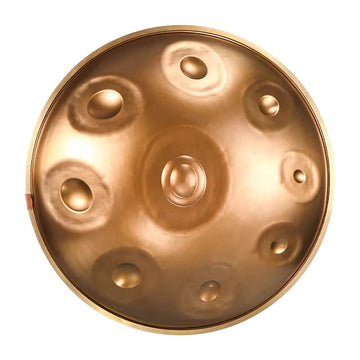
That said, even though this Swiss company has pursued legal action to assert its intellectual property rights, its production hasn’t truly increased to meet ever-growing demand. As a result, getting a genuine Hang is still difficult and expensive. That’s why I recommend choosing a handpan from the Instruments du Monde store instead. You’ll find excellent instruments there for an extraordinary journey of sound—like this 9-note model with deep, airy vibrations.
Fall in love with this superb handpan now by clicking on the image below:
The handpan is a fascinating musical instrument—and so is the metal it’s made from. After decades of research, three steels have become especially popular: nitrided steel, stainless steel, and Ember Steel. To choose your next handpan with confidence, read my dedicated article to learn about the acoustic characteristics of these steels.


